组成图示
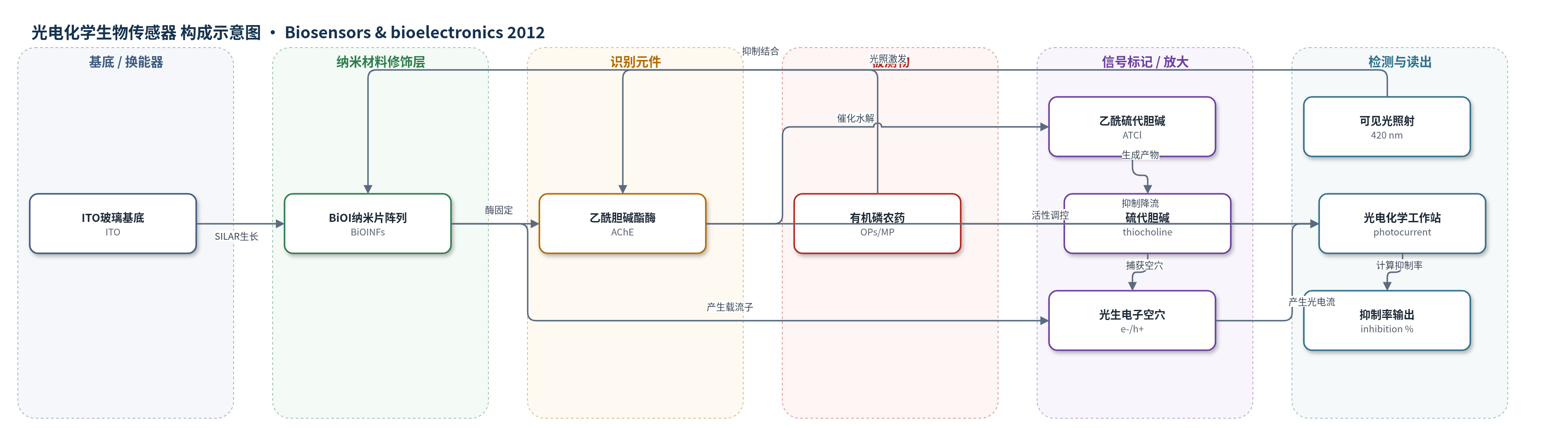
点击图片查看大图 · 依据论文自动绘制
传感器类型
光电化学生物传感器
检测对象
有机磷农药(organophosphate pesticides, OPs;模型化合物甲基对硫磷 methyl parathion, MP);样品基质:磷酸盐缓冲液标准溶液、加标蔬菜样品(大蒜、苹果、卷心菜)
检测原理
在420 nm可见光照射下,BiOI光阴极产生电子-空穴对,其层状内建电场促进载流子分离。固定于BiOINFs上的AChE催化ATCl水解生成硫代胆碱;硫代胆碱作为牺牲电子供体/空穴捕获剂,降低光生载流子复合,使阴极光电流增强。当有机磷农药存在时,其与AChE活性位点结合并不可逆抑制酶活性,ATCl水解减少,硫代胆碱生成降低,空穴捕获能力下降,光电流随之减小。以光电流抑制率随OPs浓度升高而增大实现定量。交叉纳米片阵列提供三维多孔网络,提高传质与AChE负载,增强响应。
检测灵敏度
LOD: about 0.04 ng mL−1 (S/N=3);线性范围: 0.001–0.08 mg mL−1 和 0.3–1.0 mg mL−1;灵敏度斜率: 656.9 和 12.31;相关系数: 0.9964 和 0.9985
效应效果
传感器对硝基苯胺、TNT、硝基苯酚、硝基苯及NO3−、SO42−、PO43−无明显干扰;对paraoxon、rogor、chlorpyrifos等其他有机磷农药也有明显抑制,显示对OPs良好特异性。五个独立制备电极对0.04 mg mL−1 MP的RSD为3.6%;4 ℃干燥保存10天响应无明显下降,30天后保留92%初始电流。大蒜、苹果、卷心菜加标回收率为96.0%–104.1%;卷心菜本底MP为0.0384 mg kg−1,低于欧盟0.05 mg kg−1限值。与HPLC相比,电化学结果7.67±0.01 ng mL−1,HPLC为8.80±0.01 ng mL−1,差异12.8%。经6.0 mM碘解磷定复能可恢复95%活性,可重复使用。
传感器的构成
- 基底/换能器电极:ITO玻璃(indium tin oxide, ITO),导电透明基底与光电化学工作电极
- 光活性纳米修饰层:交叉氧化铋碘(BiOI)纳米片阵列(BiOINFs),SILAR法制备,可见光吸收、光生载流子分离并提供三维多孔固定基质
- 识别元件:乙酰胆碱酯酶(AChE),固定于BiOINFs,催化水解底物并受OPs抑制
- 信号前体/酶底物:乙酰硫代胆碱氯化物(ATCl),AChE水解产生硫代胆碱(thiocholine)
- 电子供体:硫代胆碱(thiocholine),作为牺牲电子供体/空穴捕获剂增强光电流
- 支持电解质:0.1 M磷酸盐缓冲液(PBS, pH 7.0),提供离子传导与酶活性环境
- 被测物:有机磷农药(OPs),模型化合物甲基对硫磷(MP),抑制AChE并降低光电流
中文摘要
本文报道了一种用于光电化学(PEC)检测有机磷农药(OPs)的新型高灵敏、高选择性生物传感器。作者通过逐层离子吸附反应(SILAR)法在ITO基底上制备交叉氧化铋碘(BiOI)纳米片阵列(BiOINFs),并将其作为光活性电极。BiOINFs与乙酰胆碱酯酶(AChE)智能整合,形成AChE–BiOINFs杂化体系,构建三维多孔网络传感平台。XRD、SEM和多种电化学技术对传感器组成与表面结构进行了表征。交织网络结构有利于传质并提高单位面积AChE负载量,BiOI固有的强可见光捕获能力显著促进PEC响应。基于OPs对AChE–BiOINFs/ITO光电流的影响,作者以甲基对硫磷(MP)为模型化合物优化检测条件,建立了可见光激活的PEC生物传感器。优化条件下,该传感器对OPs的灵敏度和选择性显著提高,检出限约为0.04 ng mL−1(S/N=3)。进一步对加标蔬菜样品中的MP进行监测,表明该传感器在实际样品检测中具有良好的应用潜力。
英文摘要
A new, highly sensitive and selective biosensor for the photoelectrochemical (PEC) detection of organophosphate pesticides (OPs) has been developed, whereby newly synthesized crossed bismuth oxyiodide (BiOI) nanoflake arrays (BiOINFs) are fabricated as a photoactive electrode via a successive ionic layer adsorption and reaction (SILAR) approach. The smart integration of BiOINFs with biomolecules acetylcholinesterase (AChE) yields a novel AChE-BiOINFs hybrid, constructing a three-dimensional (3D) porous network biosensing platform. The composition and surface structure of the sensor were carefully characterized by X-ray diffraction (XRD), scanning electron microscopy (SEM), and various electrochemical techniques. Such interlaced network architectures, providing better mass transport and allowing more AChE loading per unit area, as well as the intrinsically strong visible light-harvesting effect from BiOI, greatly facilitate the PEC responses. On the basis of the effect of OPs on the photocurrent of AChE-BiOINFs/ITO, a highly sensitive visible light-activated photoelectrochemical biosensor was developed for biosensing OPs. The conditions for OPs detection were optimized by using methyl parathion (MP) as a model OP compound. Under the optimized experimental conditions, our results show that such a newly designed AChE-BiOINFs/ITO photoactive electrode provides remarkably improved sensitivity and selectivity for the biosensing of OPs. The detection limit was found to be as low as about 0.04 ng mL(-1) (S/N=3). Toward the goal for practical applications, the resulting sensor was further evaluated by monitoring MP in spiked vegetable samples, showing fine applicability for the detection of MP in real samples.