组成图示
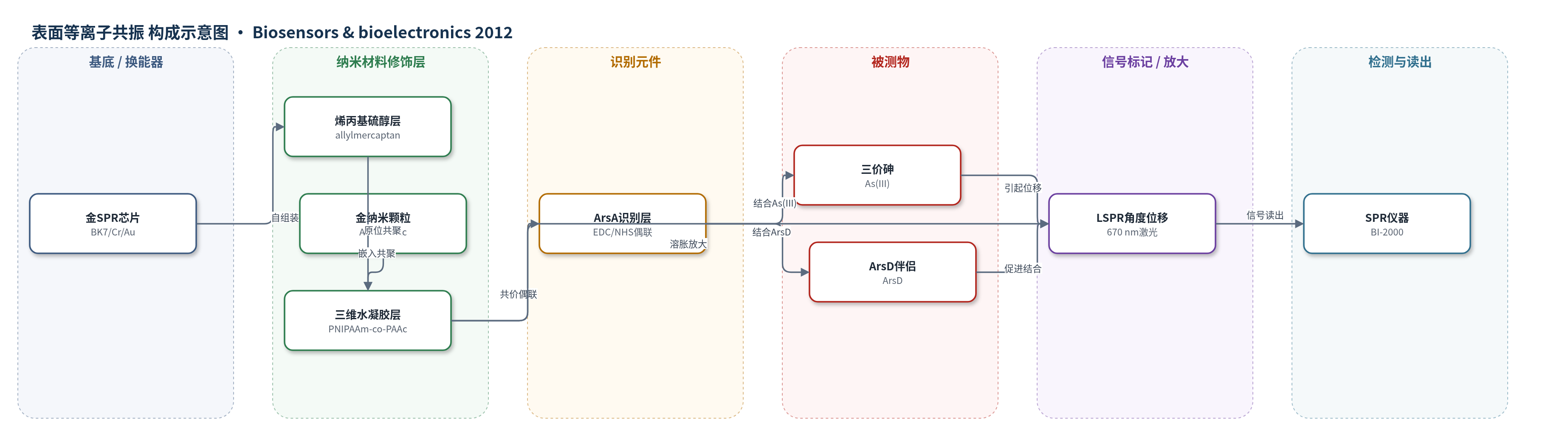
点击图片查看大图 · 依据论文自动绘制
传感器类型
表面等离子共振(SPR)生物传感器
检测对象
三价砷/亚砷酸盐(As(III), arsenite)、ArsD 金属伴侣蛋白(ArsD);样品基质为 MOPS 缓冲液(pH 7.5)中的重组蛋白体系
检测原理
金芯片经 allylmercaptan 自组装后,NIPAAm 与 AuNP-AAc 在 AIBN 引发、BIS 交联下原位自由基共聚,形成嵌入 AuNPs 的 PNIPAAm-co-PAAc 三维水凝胶。水凝胶中的 AAc 羧基经 EDC/NHS 活化后与重组 ArsA 的氨基共价偶联,形成识别层。当 As(III) 与表面 ArsA 结合时,结合位点附近质量、蛋白构象及水凝胶溶胀/收缩状态改变,导致 AuNPs 周围局部折射率和颗粒间距变化,引起 LSPR 消光峰/角度位移。670 nm 激光以 72.21° 入射,BI-2000 记录角度位移。三维水凝胶作为分子海绵增加 ArsA 负载并放大 LSPR 响应;MgATP 和 ArsD 改变 ArsA 催化构象,提高 As(III) 结合速率,使信号变化反映结合动力学。
检测灵敏度
未报告 LOD、线性范围、灵敏度斜率和相关系数;3D 水凝胶–AuNPs 传感器较 2D AuNPs 传感器信号增强约 6.8 倍。
效应效果
该传感器在 MOPS 缓冲液中实现 ArsA 与 As(III) 的实时 LSPR 检测。3D PNIPAAm-co-PAAc/AuNPs 涂层对 As(III) 的响应显著高于 2D AuNPs 芯片,8、4、2 mM As(III) 分别产生 25.8、19.1、16.5 mDeg 蓝移,而 2D 芯片仅 3.7、2.9、2.4 mDeg,信号增强约 6.8 倍。ArsA 与 ArsD 结合引起 356.2 mDeg 角度位移,BSA 阴性对照仅 45.5 mDeg,表明识别层具有较好特异性。结合速率常数在非催化、ArsD 促进和 MgATP 催化条件下分别为 1.07、2.79 和 16.09 M/min,说明 MgATP 显著促进 As(III) 结合。作者认为该平台可实时研究砷解毒蛋白相互作用,并可通过调节单体组成拓展到其他生物分子检测。
传感器的构成
- 基底/换能器:BK7 玻璃片上 5 nm Cr 和 45 nm Au 的 SPR 金芯片,提供 LSPR 换能表面
- 自组装锚定层:allylmercaptan(烯丙基硫醇)在金表面自组装,提供可聚合烯丙基位点
- 纳米材料修饰层:citrate 还原 AuNPs 经 cystamine 氨基修饰并与 AAc 共价连接,嵌入水凝胶增强 LSPR
- 三维水凝胶层:NIPAAm 与 AAc/AuNP-AAc 在 AIBN 引发、BIS 交联下原位共聚形成 PNIPAAm-co-PAAc,提供结合位点与溶胀-收缩放大
- 识别元件:重组 ArsA ATPase 经 EDC/NHS 活化羧基后与蛋白氨基共价偶联,特异性结合 As(III) 和 ArsD
- 封闭剂:1% ethanolamine 封闭水凝胶游离羧基,减少非特异结合
- 信号放大元件:AuNPs 与 PNIPAAm-co-PAAc 水凝胶溶胀-收缩结构,改变局部折射率并放大 LSPR 响应
中文摘要
本文报道一种自组装三维水凝胶–纳米颗粒复合集成表面等离子共振(SPR)传感器。通过表面介导自由基共聚方法制备新型传感基底,获得具有目标分析物特异性结合位点的高灵敏水凝胶薄膜。首先将氨基修饰金纳米颗粒(AuNPs)与丙烯酸单体共价连接;随后在引发剂和交联剂存在下,采用 grafting from 法使 N-异丙基丙烯酰胺(NIPAAm)和连接 AuNPs 的丙烯酸(AAc)单体在传感表面随机共聚。利用表面表征技术评价水凝胶–纳米颗粒膜的厚度与组成。该平台用于研究 ArsA ATPase 结合三价砷化物后在不同条件下的结合动力学与构象变化。ArsA 是大肠杆菌质粒 R773 砷抗性(ars)操纵子编码的 ArsAB 亚砷酸盐(As(III))转运 ATPase 的催化亚基,赋予细胞对三价和五价砷盐的抗性。SPR 测量表明,三维水凝胶–纳米颗粒涂层传感器比二维 AuNPs 修饰传感器具有更高灵敏度;镁离子和 ATP 的存在显著促进 As(III) 与 ArsA 的结合。
英文摘要
A self-assembled 3D hydrogel-nanoparticle composite integrated surface plasmon resonance (SPR) sensor is reported here. The novel assembled substrate was developed by means of a surface mediated radical co-polymerization process to obtain a highly sensitive hydrogel-based thin film that possesses specific binding sites for target analytes. Initially, amino group modified gold nanoparticles (AuNPs) were covalently linked to acrylic acid monomer. Following this, N-isopropylacrylamide (NIPAAm) and AuNPs linked acrylic acid (AAc) monomers were randomly co-polymerized by the "grafting from" method in the presence of initiator and crosslinker onto the sensing surface. Surface characterization techniques were utilized to evaluate the thickness and composition of the hydrogel-nanoparticle film. The sensing platform was employed to study the binding kinetics and conformational changes of the ArsA ATPase as a consequence of binding trivalent arsenicals under a variety of conditions. ArsA, the catalytic subunit of the ArsAB arsenite (As(III)) translocating ATPase, is one of the five proteins encoded by the arsenical resistance (ars) operon of plasmid R773 in cells of Escherichia coli, that confers resistance to trivalent and pentavalent salts of the metalloid arsenic. SPR measurements indicate that the 3D hydrogel-nanoparticle coated sensors exhibited a higher sensitivity than that of the 2D AuNPs decorated sensors. Binding of As(III) to ArsA is greatly facilitated by the presence of magnesium ion and ATP.