组成图示
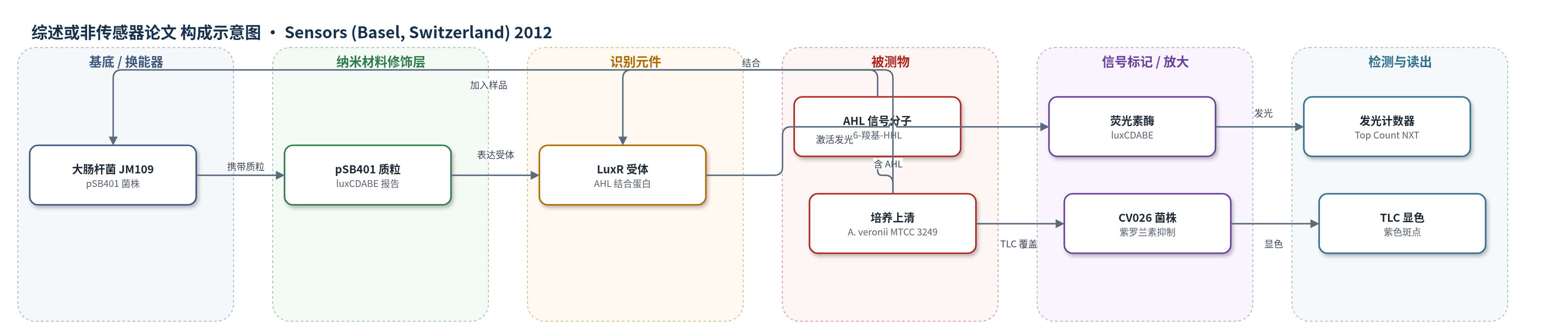
点击图片查看大图 · 依据论文自动绘制
传感器类型
综述或非传感器论文
检测对象
N-酰基高丝氨酸内酯(AHLs,含 6-羧基-HHL、N-十四酰基高丝氨酸内酯);样品基质:Aeromonas veronii MTCC 3249 LB/M9 培养上清
检测原理
待测 AHL 从 A. veronii 培养上清扩散进入 E. coli JM109(pSB401) 细胞,与质粒表达的 LuxR 型受体结合,形成 AHL-LuxR 复合物。该复合物结合 lux 启动子,激活 luxCDABE 荧光素酶基因转录,实现基因表达层面的信号放大。荧光素酶催化荧光素氧化产生光子,发光强度随 AHL 浓度升高而增加,由 Top Count NXT 以发光计数读出。pJBA89 中 AHL 则诱导 GFP 表达,用于定性/半定量检测。CV026 中 AHL 抑制紫罗兰素合成,TLC 覆盖后出现紫色斑点或抑制区,用于分离物定性。
检测灵敏度
原文未报告 LOD、线性范围、灵敏度斜率或相关系数。
效应效果
生物传感器检测显示 AHL 产量与 A. veronii 细胞密度高度相关;fold induction/OD540 曲线呈零斜率,说明 AHL 产量与 CFU/mL 成正比,并与 E. coli pSB401 发光呈线性相关。实验重复两次并取平均值,作者将微小差异归因于测量误差。TLC-CV026 显色可区分与 HHL 迁移值一致的主要 AHL 及位于 HHL 与 OHL 之间的未知极性斑点。MS、NMR 和 IR 进一步确认两种 AHL,其中 6-羧基-HHL 为首次报道。单拷贝 acuRI 和 10 拷贝 rrn operon 提示严格而高效的调控。作者认为该变异群体感应系统有助于理解该菌在蚊子中肠的生态策略和致病潜力。
传感器的构成
- 检测菌株/换能器:E. coli JM109 携带 pSB401,作为 AHL 诱导生物发光报告菌株
- 报告质粒:pSB401 含 luxCDABE 荧光素酶基因,AHL 诱导发光
- 识别元件:AHL 响应型受体系统(LuxR 型),结合 AHL 并激活报告基因
- 辅助报告质粒:pJBA89 含 GFP 报告系统,用于 AHL 诱导表达检测
- 辅助检测菌株:Chromobacterium violaceum CV026,AHL 抑制紫罗兰素合成用于 TLC 显色
- 样品基质:A. veronii MTCC 3249 LB/M9 培养上清,含待测 AHL
- 读出仪器:Top Count NXT 微孔板闪烁/发光计数器,读取发光计数
中文摘要
本文研究了最初从致倦库蚊中肠分离、后归入维氏气单胞菌的菌株 MTCC 3249 的群体感应调控。基于生物传感器检测,该菌随细胞密度增加持续产生多种酰基高丝氨酸内酯(AHLs)。通过反向 PCR 成功扩增 luxRI 同源基因 acuR 和 acuI,序列分析显示其与气单胞菌属已知群体感应基因同源物差异较大。acuR C 端自诱导剂结合域存在两处插入/缺失,提示自诱导剂特异性可能改变。Southern 杂交仅检测到单拷贝群体感应基因,表明其下游机制受严格调控。色谱与质谱、核磁、红外分析鉴定出培养上清中两种 AHL:新型 6-羧基-HHL 和 N-十四酰基高丝氨酸内酯。作者认为这种潜在变异的群体感应系统可能反映该菌在蚊子中肠中的生态策略。
英文摘要
We have investigated the quorum sensing control in Aeromonas veronii MTCC 3249, originally isolated as A. culicicola from the midgut of Culex quinquefasciatus. Based on biosensor assays, the bacterium showed constant production of multiple acyl-homoserine lactones (AHLs) with increasing cell-density. The luxRI gene homologs, acuR (A. culicicola transcriptional Regulator) and acuI (A. culicicola autoInducer) were successfully amplified by inverse-PCR. Sequence analysis indicated acuRI were divergent from all known quorum sensing gene homologs in Aeromonas. Two localized regions in the C-terminal autoinducer binding domain of acuR showed indels suggesting variations in autoinducer specificity. Further, only a single copy of the quorum sensing genes was detected, suggesting a tight regulation of mechanisms under its control. Chromatography and further chemical analysis identified two AHLs in the culture supernatant: 6-carboxy-HHL (homoadipyl homoserine lactone), a novel AHL, and N-tetradecanoylhomoserine lactone. The existence of a potentially variant quorum sensing system might therefore, reflect in some way the ecological strategies adopted by this bacterium in the mosquito midgut.