组成图示
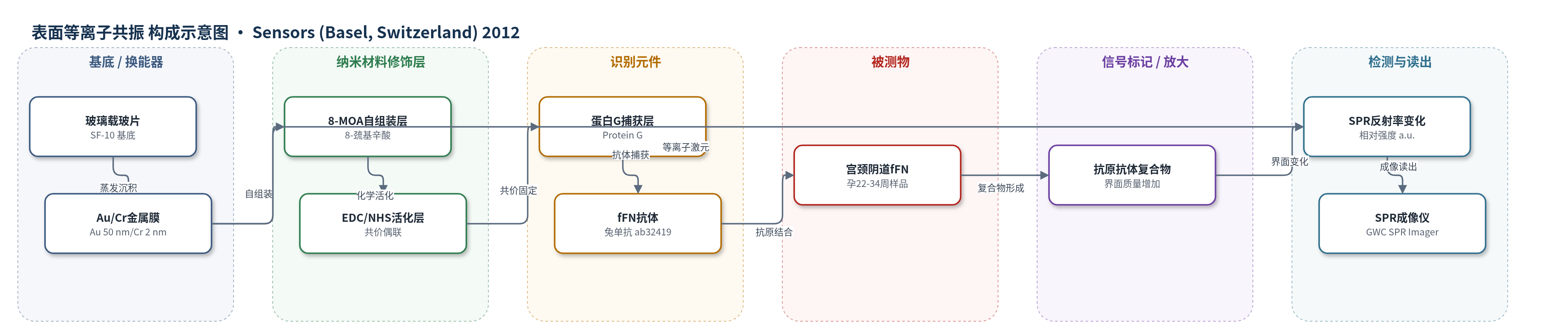
点击图片查看大图 · 依据论文自动绘制
传感器类型
表面等离子共振(SPR)生物传感器
检测对象
胎儿纤维连接蛋白(fetal fibronectin, fFN);样品基质:孕 22–34 周孕妇宫颈阴道分泌物(cervicovaginal secretions)
检测原理
该传感器采用无标记免疫 SPR 检测。玻璃基底上沉积 Au/Cr 金属膜,Au 表面经 8-MOA 自组装形成羧基层,再用 EDC/NHS 活化羧基,共价固定蛋白 G 和兔单克隆 fFN 抗体,形成识别界面。样品中的 fFN 与表面抗体特异性结合后,金属-介质界面处的质量与折射率发生变化,改变表面等离子激元的共振条件。GWC SPR Imager 在固定入射角下监测反射率变化,以相对强度(a.u.)输出信号。fFN 浓度越高,结合量越大,SPR 相对强度越高;通过 0.5–100 ng/mL 标准品的四参数 logistic 校准曲线进行定量。该过程无需酶或荧光标记放大,依靠抗原-抗体结合引起的界面光学响应直接读数。
检测灵敏度
线性范围: 0.5 ng/mL–100 ng/mL;R^2 = 0.985
效应效果
本研究分析 32 例孕 22–34 周孕妇宫颈阴道分泌物,平均检测孕周 29.91 ± 4.08 周,平均分娩孕周 35.56 ± 4.28 周。以 ELISA 50 ng/mL 对应 17 a.u. 为界,11 例 ≥17 a.u.,21 例 <17 a.u.。高 SPR 组规律宫缩 54.55% 高于低组 19.05%(p=0.040),住院保胎 100% 高于 71.43%(p=0.049),分娩孕周 33.00 ± 5.39 周早于 36.90 ± 2.90 周(p=0.043)。ROC 的 AUC 为 0.751(p=0.021,95% CI 0.582–0.920),37 孕周截断值敏感性 66.7%、特异性 72.7%。SPR 约 2 h 完成,ELISA 需 24–48 h;作者认为其定量、快速、低成本。
传感器的构成
- 基底:标准玻璃载玻片 SF-10(Schott Glass),经 Piranha 溶液清洗,提供平整支撑。
- 金属换能层:Au 50 nm 与 Cr 2 nm 电子束蒸发膜,构成 SPR 传感基底。
- 自组装功能层:8-巯基辛酸(8-MOA,10 mM)在 Au 表面形成羧基功能化自组装层。
- 活化偶联层:EDC(400 mM)/NHS(100 mM)活化羧基,用于与蛋白 G 形成共价键。
- 捕获层:蛋白 G(protein G,50 µg/mL)固定于表面,用于固定抗体。
- 识别元件:兔单克隆 fFN 抗体(Abcam, ab32419,0.5 µg/mL)特异性识别 fFN。
- 封闭层:1% BSA 封闭非特异性结合位点。
- 信号标记物:无(label-free),fFN 结合直接改变界面折射率,无需二级抗体或酶标记。
- 读出系统:GWC SPR Imager,固定入射角接近 SPR 角,测量反射率相对强度(a.u.)。
中文摘要
早产是围产期发病率和死亡率的主要原因。胎儿纤维连接蛋白(fetal fibronectin, fFN)是羊膜细胞外基质中的糖蛋白,也是预测早产风险最强的生物标志物。基于表面等离子共振(SPR)响应的生物传感器具有定量检测生物分子的潜力。本研究建立了 SPR 相对强度与 fFN 浓度之间的标准校准曲线,并利用该 SPR 生物传感器检测孕 22–34 周孕妇宫颈阴道分泌物中的 fFN 浓度。基于标准 fFN 样品,校准曲线范围为 0.5–100 ng/mL,相关系数 R² = 0.985。商业 ELISA 试剂盒中 50 ng/mL 的 fFN 临界值对应 SPR 相对强度 17 a.u.。共分析 32 名孕妇,其中 11 人 SPR 相对强度 ≥17 a.u.,21 人 <17 a.u.。两组在规律宫缩(p = 0.040)、住院保胎治疗(p = 0.049)和分娩孕周(p = 0.043)方面差异显著。前瞻性研究结果表明,SPR 生物传感器可定量测量 fFN 浓度,并显示其在预测早产风险方面的潜在应用价值。
英文摘要
Preterm birth is the leading cause of perinatal morbidity and mortality. Fetal fibronectin (fFN), a glycoprotein in the extracellular matrix of the amniotic membranes, is the most powerful biomarker for predicting the risk of preterm birth. Biosensors using the surface plasmon resonance (SPR) response are potentially useful in quantitatively measuring molecules. We established a standard calibration curve of SPR intensity against fFN concentration and used the SPR-based biosensor to detect fFN concentrations in the cervicovaginal secretions of pregnant women between 22 and 34 weeks of gestation. The calibration curve extends from 0.5 ng/mL to 100 ng/mL with an excellent correlation (R(2) = 0.985) based on standard fFN samples. A cutoff value of 50 ng/mL fFN concentration in commercial ELISA kits corresponds to a relative intensity of 17 arbitrary units (a.u.) in SPR. Thirty-two pregnant women were analyzed in our study. In 11 women, the SPR relative intensity was greater than or equal to 17 a.u., and in 21 women, the SPR relative intensity was less than 17 a.u. There were significant differences between the two groups in regular uterine contractions (p = 0.040), hospitalization for tocolysis (p = 0.049), and delivery weeks (p = 0.043). Our prospective study concluded that SPR-based biosensors can quantitatively measure fFN concentrations. These results reveal the potential utility of SPR-based biosensors in predicting the risk of preterm birth.