组成图示
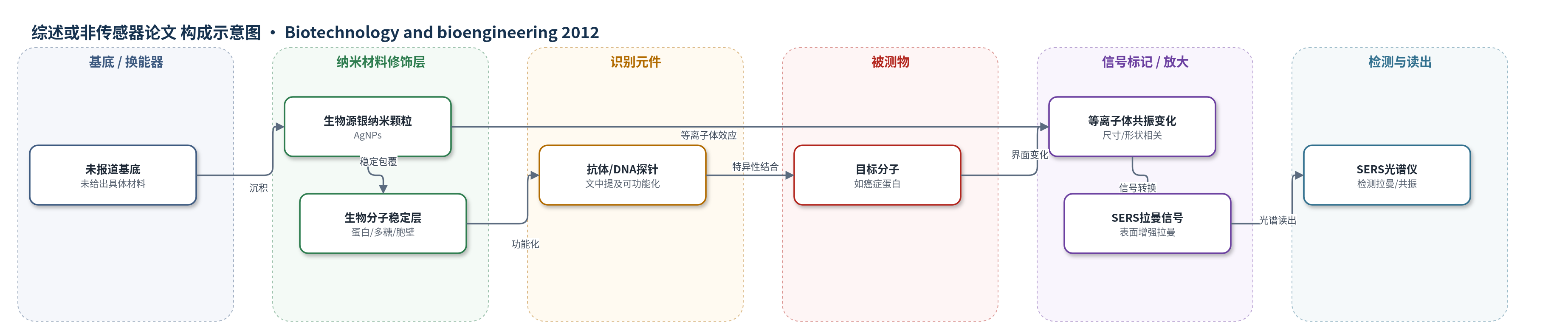
点击图片查看大图 · 依据论文自动绘制
传感器类型
综述或非传感器论文
检测对象
未明确报道;文中仅举例目标分子(如癌症蛋白,cancer proteins),样品基质未说明。
检测原理
本文未给出完整传感检测原理与定量响应,仅提出可能机制:生物源银纳米颗粒(AgNPs)与可见光相互作用产生局域表面等离子体共振(LSPR),共振峰依赖颗粒尺寸、形状和表面配体。由于生物源AgNPs表面通常包覆蛋白、多糖或细胞壁组分,可进一步偶联抗体或DNA探针作为识别元件。当目标分子(如癌症蛋白)与探针结合后,纳米颗粒界面、聚集状态或局部电磁场发生变化,引起共振频率或拉曼散射强度改变,并通过表面增强拉曼光谱(SERS)读出。文中未报告HCR、RCA、CRISPR-Cas、酶催化沉积等信号放大策略,也未给出信号随被测物浓度变化的具体关系。
检测灵敏度
原文未报告LOD、线性范围、灵敏度斜率或相关系数。
效应效果
本文未报道具体生物传感器性能指标,如选择性、抗干扰、RSD、回收率或LOD。综述指出生物源银纳米颗粒相比化学合成纳米银具有绿色合成、稳定性较好、表面生物分子易于功能化等优势;例如L. fermentum制备的生物源银在应用中较化学纳米银抗菌活性最高提高20倍,Aspergillus fumigates胞外颗粒稳定4个月,B. subtilis颗粒稳定6个月。作者认为其可拓展至杀菌、水处理、催化和生物传感/成像,但大规模生产、成本、毒性/生物相容性和应用导向生产仍是挑战。
传感器的构成
- 基底/换能器:未报道,本文未给出具体传感器基底或电极材料
- 纳米材料修饰层:生物源银纳米颗粒(AgNPs),由微生物或植物还原/稳定,可作等离子体传感元件
- 识别元件:未报道具体识别元件;文中仅提及可功能化抗体或DNA探针
- 信号标记/放大:未报道具体标记物;文中提及表面增强拉曼(SERS)检测
- 读出:表面增强拉曼光谱(SERS),用于检测共振频率或拉曼信号变化
中文摘要
银纳米颗粒是最商业化纳米材料之一,因强抗菌活性被广泛用作生物杀菌剂,其导电、光学和催化性能也使其在多种应用中具有价值。传统化学和物理合成方法存在成本高、放大困难、粒径分布宽以及使用有机溶剂和有毒试剂等不环保缺点。本文综述利用微生物或植物等生物系统制备生物源银纳米颗粒的替代策略。目前研究主要集中于其抗菌活性,而作为杀菌剂、生物传感器和催化剂等实际应用仍较少探索。纳米颗粒的形貌、尺寸和表面功能化由所用生物体系决定,因此不同应用需选择特定生物生产过程。另一方面,生物源银需与化学合成纳米银竞争,必须实现低成本大规模生产,这要求根据产量选择生物生产体系。因此,生物源银的核心挑战是在可扩展性、价格和应用性之间取得平衡。
英文摘要
Silver nanoparticles are one of the most commercialized nanomaterials. They are widely applied as biocides for their strong antimicrobial activity, but also their conductive, optic and catalytic properties make them wanted in many applications. The chemical and physical processes which are used to synthesize silver nanoparticles generally have many disadvantages and are not eco-friendly. In this review, we will discuss biological alternatives that have been developed using microorganisms or plants to produce biogenic silver. Until now, only their antimicrobial activity has been studied more into detail. In contrast, a wide range of practical applications as biocide, biosensor, and catalyst are still unexplored. The shape, size, and functionalization of the nanoparticles is defined by the biological system used to produce the nanoparticles, hence for every application a specific biological production process needs to be chosen. On the other hand, biogenic silver needs to compete with chemically produced nanosilver on the market. Large scale production generating inexpensive nanoparticles is needed. This can only be achieved when the biological production system is chosen in function of the yield. Hence, the true challenge for biogenic silver is finding the balance between scalability, price, and applicability.