组成图示
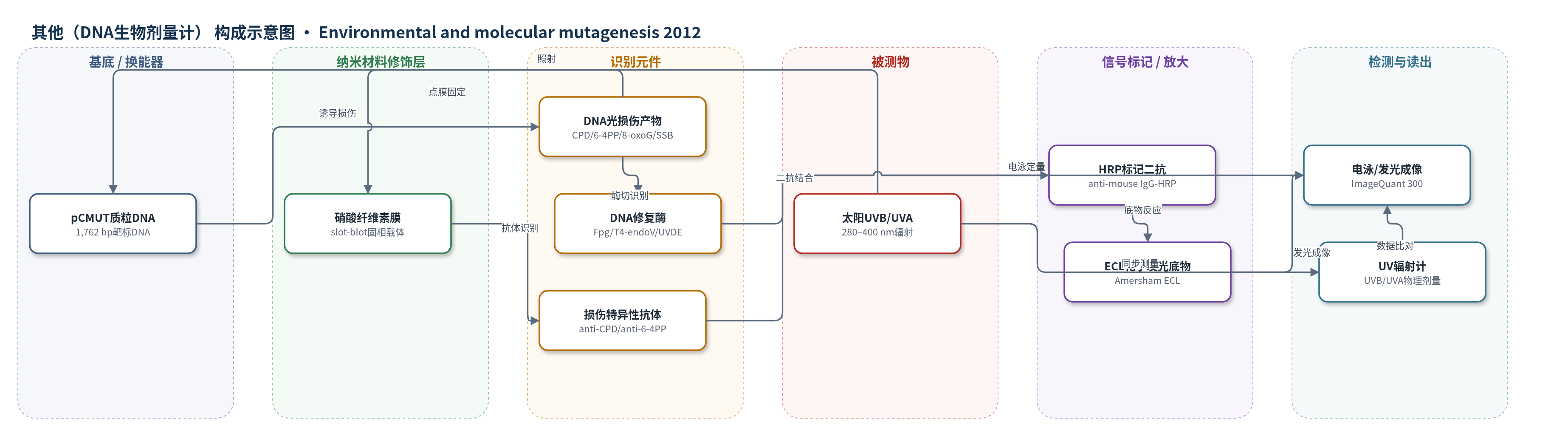
点击图片查看大图 · 依据论文自动绘制
传感器类型
其他(DNA生物剂量计)
检测对象
太阳紫外辐射(solar UV radiation, UVB/UVA);样品基质:户外阳光暴露的质粒DNA溶液(环境空气/地表辐射)
检测原理
pCMUT质粒DNA暴露于阳光,UVB直接诱导CPD和6-4PP,UVA主要通过活性氧诱导氧化碱基(8-oxoG)和SSB。损伤类型与UV波长/剂量相关。检测时,Fpg、T4-endo V、UVDE分别识别氧化嘌呤碱基、CPD和CPD/6-4PP/DewarPP,并将损伤切割为DNA断裂,使共价闭合环状DNA转为开环/线性;琼脂糖凝胶电泳区分构象,密度分析按Poisson分布计算每kbp损伤数。另一路线将损伤DNA点膜,anti-CPD/anti-6-4PP一抗识别,HRP二抗结合后由ECL底物发光,ImageQuant定量。信号随UV剂量增加而增强,6-4PP比例反映UVB,氧化碱基/SSB反映UVA或低UVB条件。
检测灵敏度
原文未报告 LOD、线性范围、灵敏度斜率或相关系数。
效应效果
该DNA剂量计具有损伤类型选择性:Fpg、T4-endo V、UVDE分别区分氧化碱基、CPD和6-4PP,免疫印迹确认光产物。抗干扰方面,铝箔覆盖对照与未暴露对照损伤水平相近,说明温度不直接诱导DNA损伤。圣保罗冬季全天暴露后损伤谱为SSB 2.7%、氧化碱基29.4%、CPD 50.2%、6-4PP 17.7%;正午UVB最高时6-4PP升高,氧化碱基和SSB降低,与辐射计一致。不同纬度UVB剂量相对Punta Arenas升高1.9、5.3和12.1倍,UVA在圣保罗和纳塔尔仅升高1.3和2.3倍;6-4PP在最低纬度显著更高,可作UVB标志。作者认为该系统适合连续野外监测太阳UV基因毒性。
传感器的构成
- 靶标分子/识别元件:pCMUT质粒DNA(1,762 bp,含supF突变靶基因),作为阳光UV损伤受体,暴露后形成CPD、6-4PP、氧化碱基和SSB
- 识别/转导酶层:E. coli Fpg糖基化酶、T4-endo V内切酶、UVDE内切酶,分别识别氧化嘌呤碱基、CPD和CPD/6-4PP/DewarPP,并将损伤转化为DNA断裂
- 固相载体:硝酸纤维素膜(nitrocellulose membrane),用于slot-blot固定DNA样本
- 封闭剂:5%奶粉/PBS(5% milk in PBS),封闭非特异性结合位点
- 一抗识别层:anti-CPD和anti-6-4PP抗体(Cosmo Bio),特异性识别DNA光产物
- 信号标记物:抗小鼠IgG-HRP二抗(R&D Systems),结合一抗并携带辣根过氧化物酶
- 信号读出试剂:Amersham ECL化学发光底物,与HRP反应产生化学发光信号
- 物理剂量对照:UVB/UVA辐射计(EKO Instruments),同步测量太阳UV剂量
中文摘要
尽管人们对紫外线(UV)辐射对人类健康和生态系统的生物学效应已有较多认识,但在全球变暖和气候变化背景下,预测太阳UV辐射增强带来的负面影响仍很困难。因此,开发并应用基于DNA的生物传感器监测不同环境条件下的太阳UV辐射具有重要意义。为从分子水平揭示阳光的基因毒性,研究者在南美洲不同纬度开展DNA剂量计野外实验,并同步进行太阳UVB/UVA物理光度测量。通过基于特异性DNA修复酶和抗体的生化与免疫学方法评估阳光诱导的DNA损伤谱,结果显示阳光的基因毒性确实随纬度变化:氧化DNA碱基的诱导随纬度升高而增加,6-4嘧啶-嘧啶酮光产物(6-4PP)的生成则相反,后者可视为UVB入射的生物分子标志。该DNA损伤模式基本反映特定纬度UVA与UVB的相对入射能量。研究证明该DNA基生物传感器可用于连续野外实验,以记录太阳UV辐射基因毒性效应的变化。
英文摘要
Despite growing knowledge on the biological effects of ultraviolet (UV) radiation on human health and ecosystems, it is still difficult to predict the negative impacts of the increasing incidence of solar UV radiation in a scenario of global warming and climate changes. Hence, the development and application of DNA-based biological sensors to monitor the solar UV radiation under different environmental conditions is of increasing importance. With a mind to rendering a molecular view-point of the genotoxic impact of sunlight, field experiments were undertaken with a DNA-dosimeter system in parallel with physical photometry of solar UVB/UVA radiation, at various latitudes in South America. On applying biochemical and immunological approaches based on specific DNA-repair enzymes and antibodies, for evaluating sunlight-induced DNA damage profiles, it became clear that the genotoxic potential of sunlight does indeed vary according to latitude. Notwithstanding, while induction of oxidized DNA bases is directly dependent on an increase in latitude, the generation of 6-4PPs is inversely so, whereby the latter can be regarded as a biomolecular marker of UVB incidence. This molecular DNA lesion-pattern largely reflects the relative incidence of UVA and UVB energy at any specific latitude. Hereby is demonstrated the applicability of this DNA-based biosensor for additional, continuous field experiments, as a means of registering variations in the genotoxic impact of solar UV radiation.