组成图示
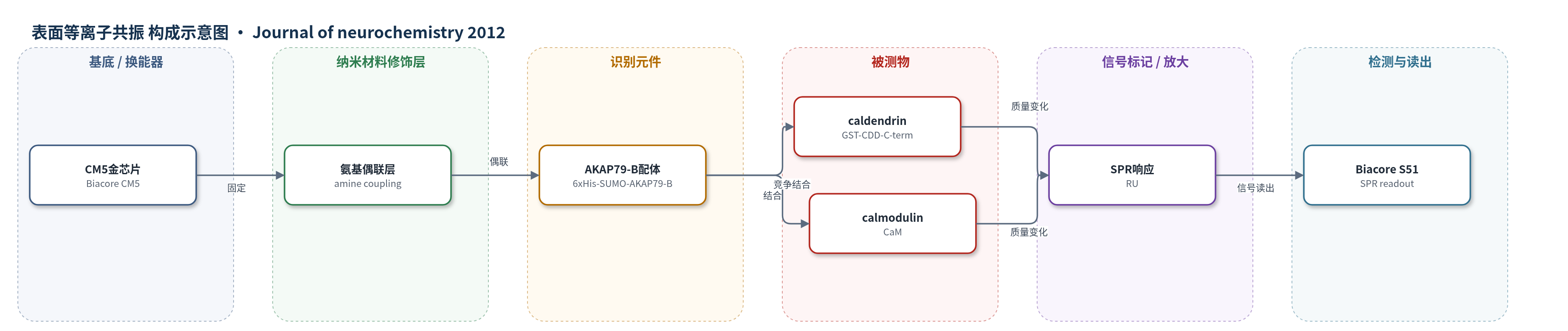
点击图片查看大图 · 依据论文自动绘制
传感器类型
表面等离子共振(SPR)生物传感器
检测对象
caldendrin(钙结合蛋白,GST-caldendrin-C-term)、calmodulin(CaM);样品基质为重组蛋白缓冲液(25 mM Tris-HCl、150 mM NaCl、2 mM CaCl2、1 mM MgCl2、0.05% Tween-20,pH 7.4)
检测原理
将 6xHis-SUMO-AKAP79-B 通过氨基偶联化学固定于 CM5 金表面,形成识别层。caldendrin(GST-caldendrin-C-term)或 CaM 以二倍稀释浓度系列流过芯片,在 25°C、含 2 mM CaCl2 的缓冲液中与 AKAP79-B 结合。结合事件使芯片表面质量增加,改变表面等离子共振条件,Biacore S51 以响应单位(RU)实时读出。RU 随分析物浓度升高而增大;CaM 结合呈简单可逆一步动力学,caldendrin 结合更复杂。结合后注入含 50 μM EGTA 的无钙缓冲液再生表面。该过程无酶促或核酸放大,直接依赖蛋白-蛋白识别与 SPR 质量传感。
检测灵敏度
原文未报告 LOD、线性范围、灵敏度斜率或 R^2。
效应效果
SPR 实验在 25°C、30 μL/min 下对 caldendrin 500–16 nM 和 CaM 250–8 nM 进行三倍重复,并用未处理表面与空白双参考扣除,显示 AKAP79-B 与两者直接结合。CaM 结合呈简单可逆一步机制,caldendrin 结合更复杂且响应强度不同。竞争实验显示等摩尔 CaM 明显降低 caldendrin 结合;caldendrin 可置换 CaM-AKAP 复合物,而 4 或 8 倍过量 CaM 不能置换 caldendrin-AKAP 复合物。co-IP 在低钙膜组分中共沉淀 AKAP150,高钙下不共沉淀;免疫荧光显示 AKAP150、caldendrin 与 PSD-95 在树突/棘突部分共定位。作者主张 caldendrin 是 AKAP 信号体中受钙调控的新成员。
传感器的构成
- 基底/换能器:CM5 金表面 SPR 芯片(Biacore S51),提供表面等离子共振信号读出
- 表面修饰层:氨基偶联化学(amine coupling)固定 6xHis-SUMO-AKAP79-B,形成配体表面
- 识别元件:AKAP79-B 域(aa 61–116),结合 caldendrin 与 calmodulin
- 被测物:caldendrin(GST-caldendrin-C-term,500–16 nM)和 calmodulin(CaM,250–8 nM)
- 信号读出:Biacore S51 监测响应单位(RU)
- 运行缓冲液:25 mM Tris-HCl、150 mM NaCl、2 mM CaCl2、1 mM MgCl2、0.05% Tween-20,pH 7.4
- 再生/洗脱:无钙缓冲液加 50 μM EGTA,去除结合蛋白
- 参考表面:未处理传感器表面,用于双参考扣除
中文摘要
AKAP79/150 是突触后密度中的支架蛋白,通过锚定蛋白激酶 A(PKA)、蛋白激酶 C(PKC)及磷酸酶 PP2B/钙调磷酸酶和 PP1,协调受体磷酸化与去磷酸化,调控兴奋性突触可塑性。本研究利用 pull-down 实验和表面等离子共振(SPR)生物传感器分析 AKAP79 与两种钙结合蛋白 caldendrin 和 calmodulin(CaM)的相互作用。已知 CaM 是 AKAP79/150 的相互作用伙伴,并以钙依赖方式调控 PKC 活性。结果显示,AKAP79 也能与神经元钙结合蛋白 caldendrin 直接结合;caldendrin 参与钙内流和释放调控。CaM 与 caldendrin 竞争结合 AKAP79 上部分重叠的位点,且两者结合对钙的依赖程度不同,因此竞争受胞内钙水平调控。两种蛋白结合特性不同,提示其可能发挥互补作用。突触后富集、复杂结合机制及与 CaM 的竞争,使 caldendrin 成为 AKAP 相互作用组中受钙调控的新成员。
英文摘要
The A kinase-anchoring protein AKAP79/150 is a postsynaptic scaffold molecule and a key regulator of signaling events. At the postsynapse it coordinates phosphorylation and dephosphorylation of receptors via anchoring kinases and phosphatases near their substrates. Interactions between AKAP79 and two Ca(2+) -binding proteins caldendrin and calmodulin have been investigated here. Calmodulin is a known interaction partner of AKAP79/150 that has been shown to regulate activity of the kinase PKC in a Ca(2+) -dependent manner. Pull-down experiments and surface plasmon resonance biosensor analyses have been used here to demonstrate that AKAP79 can also interact with caldendrin, a neuronal calcium-binding protein implicated in regulation of Ca(2+) -influx and release. We demonstrate that calmodulin and caldendrin compete for a partially overlapping binding site on AKAP79 and that their binding is differentially dependent on calcium. Therefore, this competition is regulated by calcium levels. Moreover, both proteins have different binding characteristics suggesting that the two proteins might play complementary roles. The postsynaptic enrichment, the complex binding mechanism, and the competition with calmodulin, makes caldendrin an interesting novel player in the signaling toolkit of the AKAP interactome.