组成图示
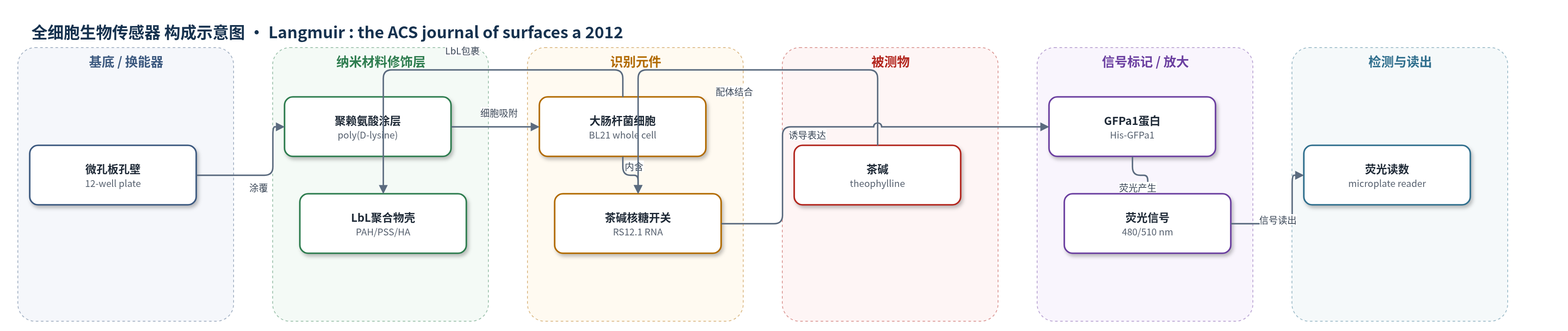
点击图片查看大图 · 依据论文自动绘制
传感器类型
全细胞生物传感器
检测对象
茶碱(theophylline);样品基质:M9 矿物盐培养基/茶碱检测缓冲液
检测原理
该全细胞传感器以大肠杆菌 BL21 为识别与换能单元,其基因组携带茶碱核糖开关 RS12.1 和 GFPa1 报告基因。样品中的茶碱扩散进入细胞并与核糖开关适配体域结合后,RNA 发生构象变化,解除对下游 GFPa1 翻译的抑制,使 His-GFPa1 蛋白表达积累。GFPa1 在 480 nm 激发下发出 510 nm 荧光,荧光强度随茶碱诱导后的表达量增加而升高,属于基因表达级联放大而非化学标记放大。细胞外 PAH 与 PVS/PSS/HA 的 LbL 聚合物壳吸收 254 nm 紫外光,降低 ROS 和 DNA 损伤,从而在杀菌灯辐照下维持细胞代谢、存活和传感响应。
检测灵敏度
原文未报告 LOD、线性范围、灵敏度斜率或相关系数。
效应效果
未涂覆细胞 120 min 杀菌灯辐照后 ATP 下降超过 90%,涂覆细胞至少保留 50%;未涂覆细胞 60 min 后丧失繁殖能力(>7 log dead),涂覆细胞仍有部分存活。HA 涂覆细胞 ATP 起始与终点无显著差异。PSS 涂覆细胞 Vmax 59.3 ± 18.2 RFU min−1、RFUVmax/RFU0 3.12 ± 0.71;HA 涂覆细胞 tVmax 345 ± 44 min、tlag 172 ± 22 min,优于未涂覆(Vmax 20.5 ± 11.0 RFU min−1)。紫外辐照下 PSS 与 HA 涂覆细胞仍能响应茶碱,PVS 与未涂覆细胞无显著荧光增加。该涂层可提升全细胞传感器紫外环境稳定性。
传感器的构成
- 基底/固定层:聚赖氨酸(poly(D-lysine))修饰微孔板孔壁,用于吸附固定大肠杆菌。
- 全细胞识别元件:大肠杆菌 BL21(pSAL:RS12.1GFPa1His),作为活细胞传感平台。
- 分子识别元件:茶碱核糖开关 RS12.1,其适配体域结合茶碱并诱导 RNA 构象变化。
- 报告信号元件:GFPa1(文昌鱼绿色荧光蛋白)融合 His 标签,表达后产生 480/510 nm 荧光。
- UV 保护修饰层:聚烯丙胺(PAH)与聚硫酸乙烯酯(PVS)、聚(4-苯乙烯磺酸)(PSS)或腐殖酸(HA)交替 LbL 沉积,吸收紫外并保护细胞。
中文摘要
本研究采用层状自组装(LbL)方法,在活大肠杆菌细胞表面构建紫外(UV)保护涂层。以阳离子聚合物聚烯丙胺(PAH)和三种具有不同紫外吸收特性的阴离子聚合物——聚硫酸乙烯酯(PVS)、聚(4-苯乙烯磺酸)(PSS)和腐殖酸(HA)——交替沉积,包裹携带两种绿色荧光蛋白(GFP)表达系统的大肠杆菌:组成型表达可被紫外激发的 GFP(GFPuv),以及由茶碱诱导核糖开关调控的高荧光文昌鱼 GFP(GFPa1)。核糖开关在特定配体与 RNA 结合后发生构象变化并启动报告蛋白表达,因而可作为细胞生物传感器。结果显示,经 UV 吸收聚合物涂覆的大肠杆菌在杀菌灯长时间辐照后,GFP 稳定性、代谢活性和存活率均显著优于未涂覆细胞。该工作证明 LbL 聚合物涂层能为活细胞提供有效 UV 防护,适用于生物技术及全细胞传感应用。
英文摘要
UV-protective coatings on live bacterial cells were created from the assembly of cationic and UV-absorbing anionic polyelectrolytes using layer-by-layer (LbL) methodology. A cationic polymer (polyallylamine) and three different anionic polymers with varying absorbance in the UV range (poly(vinyl sulfate), poly(4-styrenesulfonic acid), and humic acid) were used to encapsulate Escherichia coli cells with two different green fluorescent protein (GFP) expression systems: constitutive expression of a UV-excitable GFP (GFPuv) and regulated expression of the intensely fluorescent GFP from amphioxus (GFPa1) through a theophylline-inducible riboswitch. Riboswitches activate protein expression after specific ligand-RNA binding events. Hence, they operate as a cellular biosensor that will activate reporter protein synthesis after exposure to a ligand target. E. coli cells coated with UV-absorbing polymers demonstrated enhanced protection of GFP stability, metabolic activity, and viability after prolonged exposure to radiation from a germicidal lamp. The results show the effectiveness of LbL coatings to provide UV protection to living cells for biotechnological applications.