组成图示
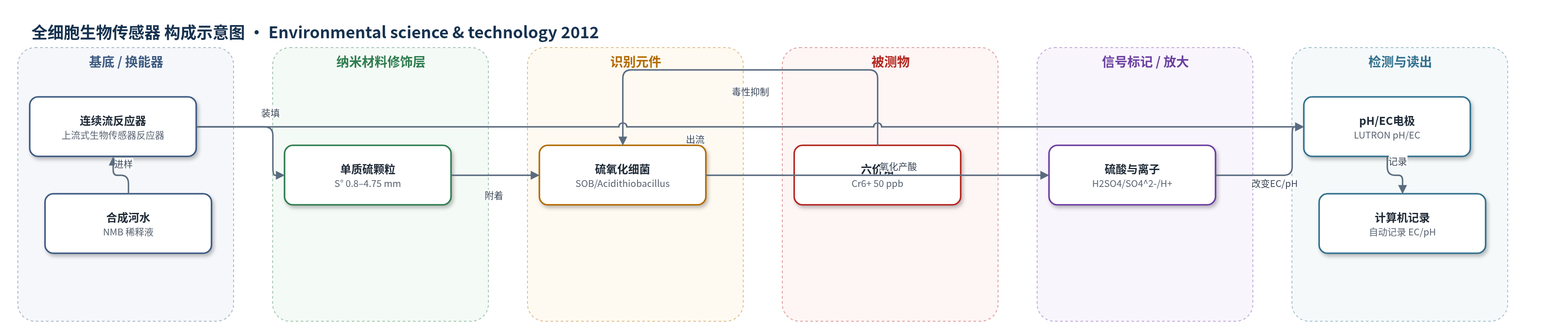
点击图片查看大图 · 依据论文自动绘制
传感器类型
全细胞生物传感器
检测对象
六价铬(Cr6+ / Cr(VI)),样品基质为合成河水/水样
检测原理
SOB 附着在单质硫(S°)颗粒表面,在有氧条件下将 S° 氧化为硫酸(H2SO4),释放 H+ 和 SO4^2−,使出流 pH 下降、电导率(EC)上升。当水样中的六价铬(Cr6+)进入反应器时,Cr6+ 抑制 SOB 的硫氧化代谢,产酸速率降低,H+ 和 SO4^2− 生成减少,出流 pH 回升、EC 下降。pH/EC 电极连续监测出流信号,抑制程度和恢复时间随 Cr6+ 暴露而改变。该传感器不依赖特异性结合,而是以全细胞代谢活性作为识别事件;通过连续流、短 HRT 和大粒径 S° 降低生物量与比表面积,使毒性抑制更快显现,实现 ppb 级 Cr6+ 的快速筛查。
检测灵敏度
未报告 LOD、线性范围、灵敏度斜率或 R^2。原文报告:Cr6+ (50 ppb);HRT 10/20/30 min 时 50% inhibition observed after 1, 7, and 13 h;complete inhibition after 3, 15, and 35 h;30 °C 完全抑制 20 h,45 °C 40 h。
效应效果
该传感器设无接种对照,稳态下不同 S° 粒径反应器出流 EC 约 1.7±0.1、0.9±0.06、0.6±0.15 mS/cm,pH 约 2.0±0.2、2.1±0.05、2.0±0.2,运行稳定。HRT 由 30 min 降至 10 min 时,50 ppb Cr6+ 的 50% 抑制时间由 13 h 缩至 1 h,完全抑制由 35 h 缩至 3 h;S° 粒径增至 4.0–4.75 mm 时 pH 恢复约 10 h,短于 25 和 35 h。30 °C 完全抑制约 20 h,45 °C 约 40 h,说明 30 °C 更利于快速检测。作者认为其简单、实时、成本低、无有毒副产物,适合水生态毒性连续监测。
传感器的构成
- 反应器/基底:连续流上流式生物传感器反应器,容纳 S° 颗粒与 SOB,形成流动床
- 换能器电极:pH 电极(LUTRON pH 208c)与电导率电极(LUTRON YK 22 CT),用于连续读出出流 pH 和 EC
- 反应介质:稀释合成河水(synthetic streamwater,NMB 营养盐稀释 100 倍),提供营养盐、缓冲和连续流动基质
- 底物/载体:单质硫颗粒(S°,粒径 0.8–1.0、2.0–4.0、4.0–4.75 mm),作为 SOB 附着位点和氧化底物
- 生物识别元件:硫氧化细菌(SOB,含 Acidithiobacillus caldus),附着于 S° 并氧化 S° 产酸,受 Cr6+ 抑制
- 供氧系统:底部曝气石(stone diffuser)通入空气(150–250 mL/min),提供 O2 电子受体
- 流控单元:蠕动泵(peristaltic pumps)控制 HRT(10–30 min),实现连续进样与出流监测
- 数据记录单元:计算机自动记录 EC/pH(每 10 min),用于判断抑制时间和程度
中文摘要
本文报道了一种基于硫氧化细菌(SOB)的水中毒性化学物质生物传感器。SOB 为嗜酸微生物,可在有氧条件下氧化还原态硫化合物生成硫酸,使体系电导率(EC)升高、pH 下降。该生物测定法通过监测 EC 和 pH 的变化,反映有毒化学物质对 SOB 活性的抑制。研究考察了水力停留时间(HRT)、单质硫(S°)粒径和温度对六价铬(Cr6+)检测的影响。结果表明,将 HRT 从 30 min 降至 10 min、将 S° 粒径从 1 mm 增至 4.75 mm 可改善 50 ppb Cr6+ 的检测;30 °C 下检测时间短于 45 °C,且 SOB 在较宽温度范围内保持活性,最高生长温度为 45 °C。该传感器结构简单、对低浓度 Cr6+ 敏感并缩短检测时间,可用于水生态系统毒性的连续筛查。
英文摘要
A biosensor based on sulfur-oxidizing bacteria (SOB) for detection of toxic chemicals in water was developed. SOB are acidophilic microorganisms that get their energy through the oxidation of reduced sulfur compounds in the presence of oxygen to produce sulfuric acid. The reaction results in an increase in electrical conductivity (EC) and a decrease in pH. The bioassay is based on the inhibition of SOB in the presence of toxic chemicals by measuring changes in EC and pH. The effect of different physical factors such as HRT, inorganic sulfur (S°) particle size, and temperature on detection of Cr(6+) was studied. The detection of Cr(6+) (50 ppb) was improved by decreasing the hydraulic retention time (HRT) from 30 to 10 min and increasing S° particle size from 1 to 4.75 mm. Detection time was shorter at 30 °C compared to 45 °C and the SOB were active over a wide range of temperatures with a maximum temperature for growth at 45 °C. This novel biosensor is simple, highly sensitive to low Cr(6+) concentrations (50 ppb), and also minimizes detection time. The present findings can be applied to the proper continuous screening of water ecosystem toxicity.