组成图示
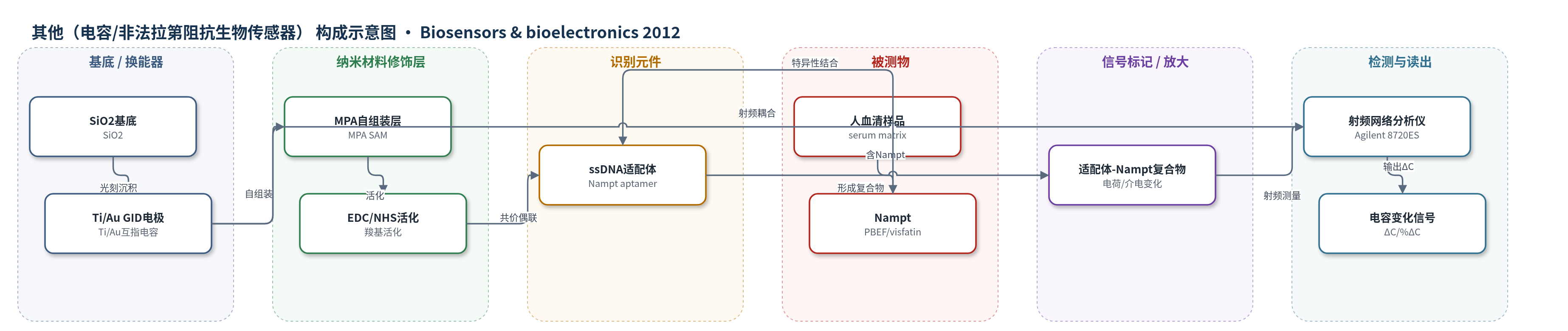
点击图片查看大图 · 依据论文自动绘制
传感器类型
其他(电容/非法拉第阻抗生物传感器)
检测对象
Nampt(烟酰胺磷酸核糖转移酶,Nicotinamide phosphoribosyl transferase,又称PBEF/visfatin);样品基质:人血清(human serum),亦在结合缓冲液中验证
检测原理
该传感器以金互指(GID)电容为换能器,MPA自组装层和EDC/NHS活化后共价固定氨基修饰ssDNA适配体。Nampt与适配体特异性结合形成ssDNA–蛋白复合物,使电极表面电荷分布、介电常数和导电性改变。在射频交流场下,结合复合物发生局部极化和弛豫,产生非法拉第电容/阻抗变化;Nampt浓度越高,表面复合物越多,电容变化越大。缓冲液有效频率约400–650 MHz,人血清因干扰蛋白和离子存在而移至600–1000 MHz;700–1 GHz下结合增强,Kd降至0.3–0.6 nM。方法无需红ox介质和标记物,通过网络分析仪读取ΔC实现无标记检测。
检测灵敏度
LOD: 1 ng/ml;动态范围: 1–50 ng/ml
效应效果
该传感器在缓冲液和人血清中均对Nampt呈剂量依赖响应,对50 ng/ml的RBP4、Vaspin和BSA等干扰蛋白无电容变化,血清加标检测未见假阳性,正常血清对照无显著变化,显示良好选择性和抗干扰能力。所有测量重复三次,但原文未报告RSD;作者通过单批次芯片降低批间差异。与SPR相比,电容表面适配体–Nampt解离常数为16.7–33.3 ng/ml(0.3–0.6 nM),较SPR的72.52 nM提高120–240倍;LOD 1 ng/ml、动态范围1–50 ng/ml,覆盖正常15.8 ng/ml和T2DM 31.9 ng/ml。方法无标记、无试剂、无需红ox介质,适合临床诊断和即时检测。
传感器的构成
- 基底/换能器电极:SiO2基底上光刻Ti/Au金互指(GID)电容器电极,Ti约20 nm粘附层、Au约180 nm,24指,作为电容换能器
- 自组装单分子层:100 mM巯基丙酸(MPA)乙醇溶液自组装,提供羧基用于后续共价偶联
- 活化层:EDC/NHS活化MPA羧基,形成活性酯以偶联氨基适配体
- 识别元件:氨基修饰Nampt特异性ssDNA适配体(5'-NH2-(CH2)6-...-3'),共价固定并特异性结合Nampt
- 封闭剂:100 mM乙醇胺封闭未占羧基,降低非特异结合
- 信号读出:Karl-Suss PM-5射频探针站与Agilent 8720ES S参数网络分析仪,50 MHz–1 GHz扫描电容/阻抗变化
中文摘要
通过指数富集系统进化(SELEX)成功筛选出能特异性结合烟酰胺磷酸核糖转移酶(Nampt)的单链DNA(ssDNA)适配体,并将其应用于金互指(GID)电容生物传感器。表面等离子共振(SPR)分析显示该适配体具有高特异性和亲和力(Kd=72.52 nM)。将适配体共价偶联于GID电容表面后,基于适配体与Nampt的特异性相互作用,测量施加交流频率变化引起的表面电容/电荷分布或介电性质变化作为传感信号。Nampt检出限为1 ng/ml,血清动态检测范围可达50 ng/ml;该范围涵盖正常Nampt水平15.8 ng/ml和2型糖尿病(T2DM)患者31.9 ng/ml的临床需求。此外,电容表面适配体–Nampt相互作用结合动力学显示,随频率升高(700 MHz–1 GHz)结合增强,且在施加频率下适配体解离常数提高120–240倍(Kd=0.3–0.6 nM),与频率无关。该检测系统为临床检测Nampt提供了具有更高特异性和亲和力的替代方法。
英文摘要
A single-stranded DNA (ssDNA) aptamer was successfully developed to specifically bind to nicotinamide phosphoribosyl transferase (Nampt) through systematic evolution of ligands by exponential enrichment (SELEX) and successfully implemented in a gold-interdigitated (GID) capacitor-based biosensor. Surface plasmon resonance (SPR) analysis of the aptamer revealed high specificity and affinity (K(d)=72.52 nM). Changes in surface capacitance/charge distribution or dielectric properties in the response of the GID capacitor surface covalently coupled to the aptamers in response to changes in applied AC frequency were measured as a sensing signal based on a specific interaction between the aptamers and Nampt. The limit of detection for Nampt was 1 ng/ml with a dynamic serum detection range of up to 50 ng/ml; this range includes the clinical requirement for both normal Nampt level, which is 15.8 ng/ml, and Nampt level in type 2 diabetes mellitus (T2DM) patients, which is 31.9 ng/ml. Additionally, the binding kinetics of aptamer-Nampt interactions on the capacitor surface showed that strong binding occurred with increasing frequency (range, 700 MHz-1 GHz) and that the dissociation constant of the aptamer under the applied frequency was improved 120-240 times (K(d)=0.3-0.6 nM) independent on frequency. This assay system is an alternative approach for clinical detection of Nampt with improved specificity and affinity.