组成图示
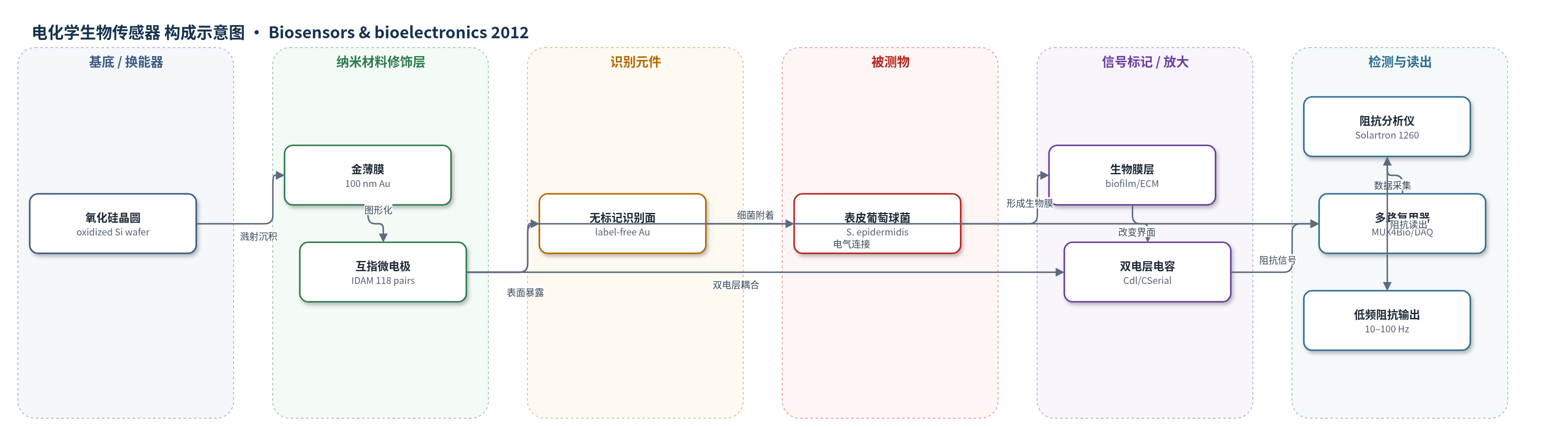
点击图片查看大图 · 依据论文自动绘制
传感器类型
电化学生物传感器
检测对象
表皮葡萄球菌生物膜(Staphylococcus epidermidis biofilm);样品基质:改良 CDC 生物膜反应器中的 TSB/BHI 培养液(初始 8.5×10^5 CFU/mL)
检测原理
该传感器采用无标记阻抗谱原理。表皮葡萄球菌直接附着于互指金电极表面并分泌胞外基质形成生物膜,使电极/溶液界面的双电层电容(Cdl)和溶液体电阻(Rsol)发生变化;细菌代谢活动还会改变培养基电导率。系统以 50 mV 正弦交流信号激励 IDAM,在 10 Hz–100 kHz 范围内测量阻抗幅值、相位及等效串联电容/电阻。随着细菌数量增加和生物膜增厚,低频区电容行为主导,阻抗幅值下降,等效串联电容相对变化增大,最大达 59%。低频(10–100 Hz)对生物膜附着最敏感,较高频则更多反映培养基代谢活动。方法无需抗体或标记物,依靠生物膜生长引起的界面电学变化实现实时监测。
检测灵敏度
未报告 LOD、线性范围、灵敏度斜率或相关系数。
效应效果
改良 CDC 反应器在 37 ℃、10% CO2、150 rpm 下培养表皮葡萄球菌,初始 8.5×10^5 CFU/mL,18 个 IDAM 每 30 min 测一次,持续 30 h。感染后约 4 h 阻抗变化,接种后 9 h 达最大;CSerial 在 10 Hz、100 Hz 相对变化 59%、46%,阻抗幅值约 49 kΩ–25 Ω。低频(<1 kHz,约 100 Hz)较优。与 Kim 等 15%、Ben-Yoav 等约 50%、Zikmund 等约 12% 相比,可实时监测生物膜发育。作者认为适合植入器械感染监测,但未报告 RSD、回收率或选择性。
传感器的构成
- 基底:氧化硅晶圆(oxidized silicon wafer),提供机械支撑与绝缘基底。
- 换能电极:100 nm 金薄膜(Au thin film),RF 溅射沉积,形成导电互指电极。
- 敏感结构:互指微电极(IDAM),118 对金指,指宽 20 μm、间距 30 μm,构成 6 mm 直径敏感区。
- 识别层:无标记识别面(label-free surface),表皮葡萄球菌直接附着于金表面,无抗体/适配体等识别元件。
- 信号界面:金电极/培养液界面双电层(double layer, Cdl)与溶液体电阻(Rsol),随生物膜生长改变阻抗。
中文摘要
器械相关感染检测仍是临床难题。细菌附着器械表面形成生物膜,对抗微生物药物产生耐药,增加病死率和发病率,常需手术移除感染器械。高昂费用、患者不适及风险凸显开发更高效、准确、快速检测方法的需求。与植入器械集成的生物传感器可提供有效诊断工具;在体内快速、灵敏地检测附着于器械表面的细菌有助于高效治疗。阻抗谱技术可通过监测阻抗特性变化检测微生物附着与生长。本文开发了一种无标记互指微电极(IDAM)生物传感器,用于与植入器械集成。对表皮葡萄球菌(Staphylococcus epidermidis)生物膜进行阻抗表征,实现了从感染起始数小时内对细菌生长的电学监测。该病原体是血管内导管相关感染中最常见的微生物。本文提出的改良 CDC 生物膜反应器可模拟细菌生物膜发育的自然环境条件。结果表明,低频范围最适合监测生物膜发育,阻抗等效串联电容分量变化达 59%,证明该技术有效。
英文摘要
Detection of device-associated infectious processes is still an important clinical challenge. Bacteria grow adhered to the device surfaces creating biofilms that are resistant to antimicrobial agents, increasing mortality and morbidity. Thus there is need of a surgical procedure to remove the indwelling infected device. The elevated cost of these procedures, besides patients discomfort and increased risks, highlights the need to develop more efficient, accurate and rapid detection methods. Biosensors integrated with implantable devices will provide an effective diagnostic tool. In vivo, rapid and sensitive detection of bacteria attached to the device surfaces will allow efficient treatments. Impedance spectroscopy technique would be an adequate tool to detect the adherence and the growth of the microorganism by monitoring the impedance characteristics. In this work a label-free interdigitated microelectrode (IDAM) biosensor has been developed to be integrated with implantable devices. Impedance characterization of Staphylococcus epidermidis biofilms has been performed achieving electrical monitoring of the bacterial growths in a few hours from the onset of the infection. This pathogen represents the most common microorganism related to intravascular catheters associated infections. The experimental setup presented in this work, a modified CDC biofilm reactor, simulates the natural environment conditions for bacterial biofilm development. The results prove that the low range of frequency is the most suitable setting for monitoring biofilm development. Our findings prove the effectiveness of this technique which shows variations of 59% in the equivalent serial capacitance component of the impedance.