组成图示
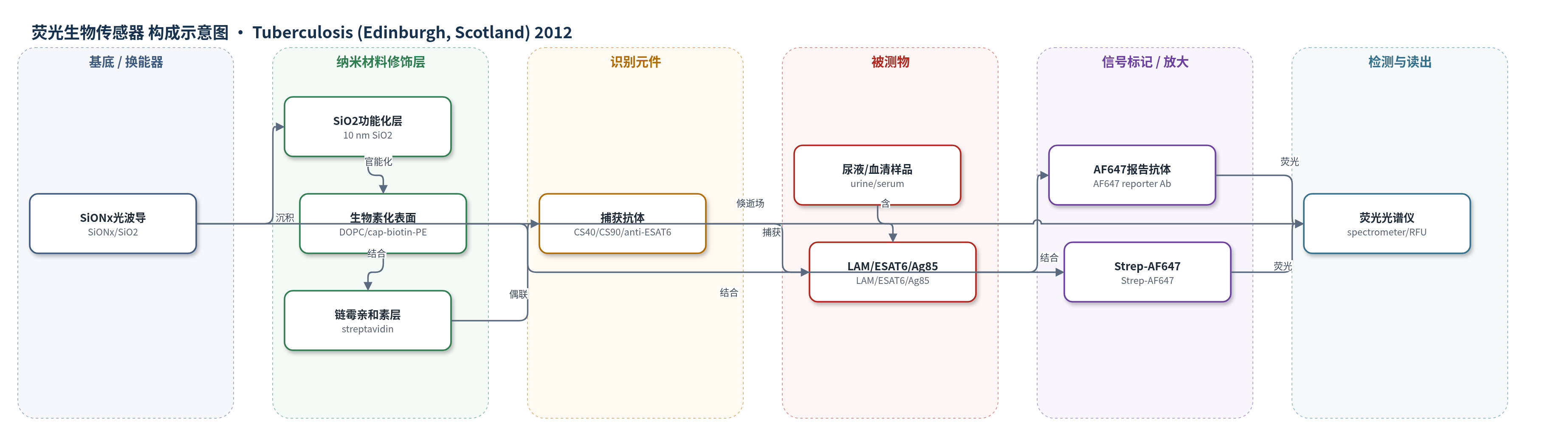
点击图片查看大图 · 依据论文自动绘制
传感器类型
荧光生物传感器
检测对象
结核分枝杆菌生物标志物:脂阿拉伯甘露聚糖(lipoarabinomannan, LAM)、早期分泌抗原靶6(early secretory antigenic target 6, ESAT6)、抗原85复合物(antigen 85 complex, Ag85);样品基质:尿液、血清/血浆。
检测原理
传感器以SiONx平面光波导为换能器,表面经SiO2、脂质双层或PEG-SAM官能化并引入生物素位点,再用链霉亲和素固定生物素化捕获抗体(CS40、抗ESAT6单抗、CS90)。尿液或血清中的LAM、ESAT6或Ag85被捕获抗体特异性结合,形成夹心结构;随后加入AF647标记报告抗体,与目标抗原另一表位结合。光波导倏逝场激发表面AF647,光谱仪采集荧光(RFU)。目标浓度越高,表面结合的报告抗体越多,荧光信号越强。脂质双层/SAM降低非特异结合,提高信噪比;同一波导上已知浓度标准用于内标定量,并扣除背景与非特异信号。
检测灵敏度
LOD: LAM 1 pM(尿液,19 ng/mL,164 RFU);ESAT6 100 pM(50%血清);Ag85 500 fM(血清,0.5 pM,由两次测量得出);R^2: LAM 0.817,ESAT6 0.99
效应效果
该传感器非特异结合低:LAM基线122 RFU,ESAT6 247 RFU,Ag85 350 RFU;100 pM LAM、200 pM ESAT6、500 pM Ag85分别产生1420、850、5020 RFU。检测15–60 min,可定量。与同抗体ELISA相比,LAM LoD由78 nM降至1 pM,ESAT6由125 nM降至100 pM,Ag85由183 nM降至500 fM。14例尿液中10例检出LAM(17–338 pM),与疾病状态100%一致;6例血浆中3例活动性结核检出ESAT6,3例对照阴性。LAM室温2 h后不稳定,需速冻;波导表面冷藏稳定约1周。
传感器的构成
- 基底/换能器:硅氧氮化物(SiONx)平面光波导,厚度约120 nm、折射率1.80,提供倏逝场光学换能。
- 表面薄层:约10 nm二氧化硅(SiO2)涂层,用于后续表面官能化。
- 表面功能化层:DOPC/cap-biotin-PE脂质双层或APMDES/PEG-Fmoc胺/生物素自组装单分子层(SAM),提供生物素位点并降低非特异结合。
- 亲和偶联层:链霉亲和素(streptavidin)结合生物素化捕获抗体;ESAT6采用链霉亲和素偶联捕获抗体直接固定。
- 识别元件:生物素化捕获抗体(抗LAM CS40、抗ESAT6单克隆抗体、抗Ag85 CS90),特异性捕获目标生物标志物。
- 信号标记物:AlexaFluor 647(AF647)标记报告抗体(兔多克隆抗LAM/ESAT6/Ag85);Strep-AF647用于确认表面完整性。
- 封闭剂:PBS含2%牛血清白蛋白(BSA),封闭非特异位点。
- 读出:光谱仪接口测量荧光(RFU),实现定量检测。
中文摘要
活动性结核病的早期诊断仍是重大挑战,尤其在播散性结核和HIV共感染人群中。近年研究表明,直接检测病原体特异性生物标志物(如脂阿拉伯甘露聚糖,LAM)对HIV阳性者结核诊断具有前景。然而,传统免疫分析平台灵敏度低且非特异性相互作用高。本文报道了一种基于平面光波导的光学生物传感器,用于以夹心免疫分析格式直接检测三种结核分枝杆菌特异性生物标志物:LAM、早期分泌抗原靶6(ESAT6)和抗原85复合物(Ag85)。该平台将平面光波导倏逝场检测与可抑制非特异性相互作用的官能化表面相结合,使复杂患者样品(尿液、血清)中的生物标志物可在短时间内实现超灵敏、定量检测,灵敏度较板式ELISA提高约一个数量级。作者还利用该方法检测了正在接受抗结核治疗受试者尿液中的LAM,结果显示灵敏度高,并与疾病状态100%一致。结果表明,病原体特异性生物标志物可用于疾病的快速有效诊断;联合检测多种生物标志物可能比单一标志物更可靠。临床试验注册号:NCT00341601。
英文摘要
Early diagnosis of active tuberculosis (TB) remains an elusive challenge, especially in individuals with disseminated TB and HIV co-infection. Recent studies have shown a promise for the direct detection of pathogen-specific biomarkers such as lipoarabinomannan (LAM) for the diagnosis of TB in HIV-positive individuals. Currently, traditional immunoassay platforms that suffer from poor sensitivity and high non-specific interactions are used for the detection of such biomarkers. In this manuscript, we demonstrate the development of sandwich immunoassays for the direct detection of three TB-specific biomarkers, namely LAM, early secretory antigenic target 6 (ESAT6) and antigen 85 complex (Ag85), using a waveguide-based optical biosensor platform. Combining detection within the evanescent field of a planar optical waveguide with functional surfaces that reduce non-specific interactions allows for the ultra-sensitive and quantitative detection of biomarkers (an order of magnitude enhanced sensitivity, as compared to plate-based ELISA) in complex patient samples (urine, serum) within a short time. We also demonstrate the detection of LAM in urine from a small sample of subjects being treated for TB using this approach with excellent sensitivity and 100% corroboration with disease status. These results suggest that pathogen-specific biomarkers can be applied for the rapid and effective diagnosis of disease. It is likely that detection of a combination of biomarkers offers greater reliability of diagnosis, rather than detection of any single pathogen biomarker. NCT00341601.