组成图示
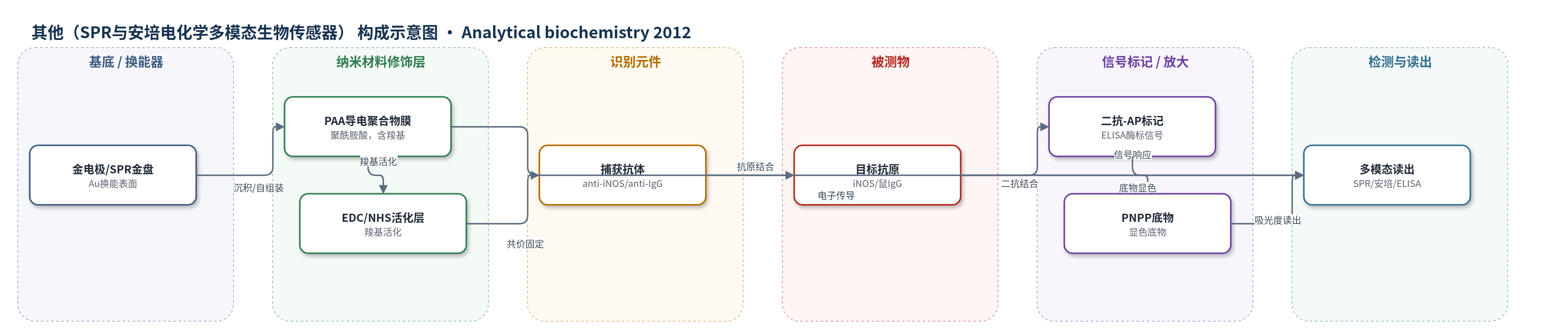
点击图片查看大图 · 依据论文自动绘制
传感器类型
其他(SPR与安培电化学多模态生物传感器)
检测对象
诱导型一氧化氮合酶(inducible nitric oxide synthase, iNOS,PBS–BSA缓冲液)、鼠免疫球蛋白G(mouse IgG,PBS–BSA缓冲液;ELISA中PBS–BSA/Tris/DEA缓冲液)
检测原理
PAA膜中的羧基经EDC/NHS活化形成NHS酯,与捕获抗体的氨基形成酰胺键,实现抗体在Au或SPR金盘表面的定向共价固定。目标抗原(iNOS或鼠IgG)与抗体结合后,在SPR通道中引起界面折射率变化,共振信号随抗原浓度升高而增大,HCl再生使信号回落;在安培法中,抗原-抗体复合物增加界面阻抗并阻碍电子转移,固定电位下电流随抗原浓度增加而下降;在ELISA中,二抗-AP结合后AP催化PNPP生成有色产物,405 nm吸光度随抗原浓度升高。PAA导电膜提供电子通路,但膜层使铁氰化钾扩散系数降低,体现界面电子转移受阻。
检测灵敏度
LOD: 3.10 × 10^-3 ng/ml(SPR);线性范围: 3.35 × 10^1–1.08 × 10^3 ng/ml(SPR);LOD: 10 ng/ml(安培法,鼠IgG);LOD: 2.7 × 10^-1 ng/ml(摘要,安培生物传感器)
效应效果
ELISA中,改性PAA表面因抗体定向排列而比未改性表面吸光度更高,说明结合位点增加。SPR在3.35×10^1–1.08×10^3 ng/mL范围内线性,LOD为3.10×10^-3 ng/mL,但作者认为其不优于常用巯基十一烷酸(MUA),因MUA硫醇可直接结合金且烷基间隔臂提高抗体可及性。安培法对鼠IgG呈阶梯式电流下降,HSA和BSA无显著电流变化,显示选择性;鼠IgG LOD为10 ng/mL。CV/EIS显示PAA及抗体修饰使铁氰化钾扩散系数由3.96×10^-6降至9.55×10^-8 cm²/s,界面电容由1.72增至2.6 μF。
传感器的构成
- 基底/换能器:金电极(Au)或SPR金盘,提供电化学/光学换能表面
- 导电聚合物修饰层:聚酰胺酸(PAA)膜,电沉积或自组装,含羧基/酰胺基,用于共价固定和电子传导
- 活化层:EDC/NHS,活化PAA羧基形成NHS酯,实现抗体定向共价连接
- 识别元件:捕获抗体(鼠抗iNOS抗体或羊抗鼠IgG抗体),特异性结合目标抗原
- 封闭剂:牛血清白蛋白(BSA),封闭非特异性位点
- 信号标记物:兔抗鼠IgG二抗及羊抗兔IgG-碱性磷酸酶(AP)偶联物,用于ELISA酶标信号
- 底物/显色剂:对硝基苯磷酸钠(PNPP),AP催化生成405 nm吸光度信号
- 被测物:诱导型一氧化氮合酶(iNOS)或鼠IgG,与捕获抗体结合
中文摘要
本文报道了一种基于聚酰胺酸(PAA)的生物传感器平台,用于生物分子定向固定。PAA是功能化导电聚合物基底,可提供电化学检测并控制生物特异性结合;通过N-羟基琥珀酰亚胺(NHS)和1-乙基-3-(3-二甲基氨基丙基)碳二亚胺(EDC)连接,将PAA抗体(或抗原)复合层共价自组装到金(Au)电极上,提高检测灵敏度。改性PAA经傅里叶变换红外光谱(FTIR)、1H核磁共振(NMR)和电化学方法表征。循环伏安和阻抗实验表明,Au电极上电沉积的PAA使铁氰化钾扩散系数降低,说明PAA本体材料阻碍电子转移。随后在改性PAA表面固定抗体,并采用酶联免疫吸附试验(ELISA)、表面等离子共振(SPR)和安培法检测诱导型一氧化氮合酶(iNOS)和鼠免疫球蛋白G(IgG)。ELISA显示改性PAA具有显著信号放大作用;SPR和安培传感器随抗原浓度升高产生明显响应。SPR和安培生物传感器检出限分别为3.1×10^-3 ng/mL和2.7×10^-1 ng/mL。
英文摘要
A biosensor platform based on polyamic acid (PAA) is reported for oriented immobilization of biomolecules. PAA, a functionalized conducting polymer substrate that provides electrochemical detection and control of biospecific binding, was used to covalently attach biomolecules, resulting in a significant improvement in the detection sensitivity. The biosensor sensing elements comprise a layer of PAA antibody (or antigen) composite self-assembled onto gold (Au) electrode via N-hydroxysuccinimide (NHS) and 1-ethyl-3-(3-dimethylaminopropyl) carbodiimide (EDC) linking. The modified PAA was characterized by Fourier transform infrared (FTIR), (1)H nuclear magnetic resonance (NMR), and electrochemical techniques. Cyclic voltammetry and impedance spectroscopy experiments conducted on electrodeposited PAA on Au electrode using ferricyanide produced a measurable decrease in the diffusion coefficient compared with the bare electrode, indicating some retardation of electron transfer within the bulk material of the PAA. Thereafter, the modified PAA surface was used to immobilize antibodies and then to detect inducible nitric oxide synthase and mouse immunoglobulin G (IgG) using enzyme-linked immunosorbent assay (ELISA), surface plasmon resonance (SPR), and amperometric techniques. ELISA results indicated a significant amplified signal by the modified PAA, whereas the SPR and amperometric biosensors produced significant responses as the concentration of the antigen was increased. Detection limits of 3.1×10(-3)ng/ml and 2.7×10(-1)ng/ml were obtained for SPR and amperometric biosensors, respectively.