组成图示
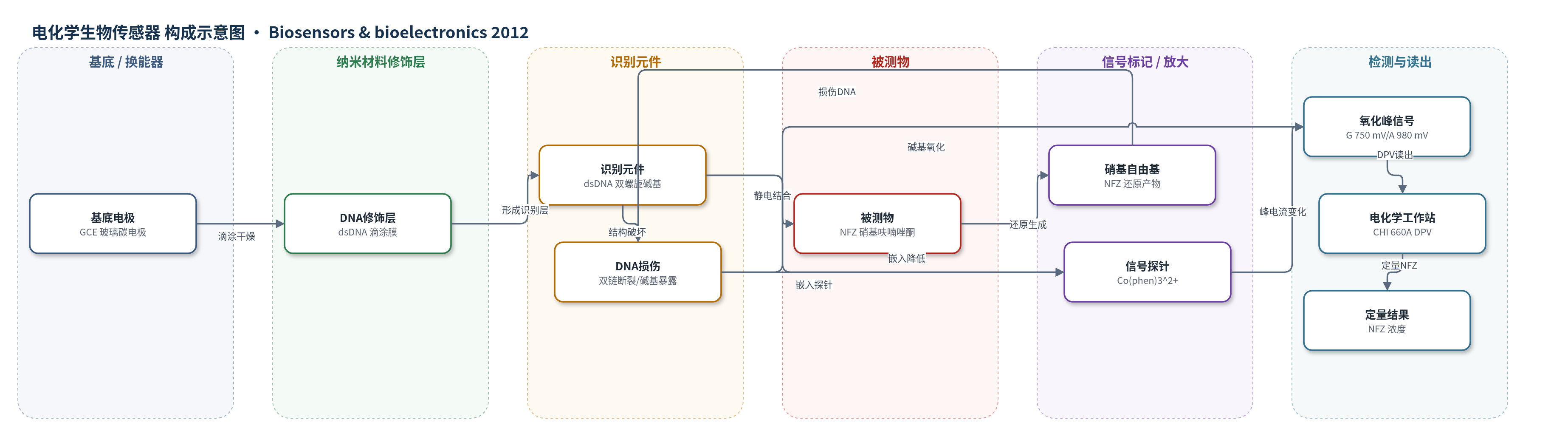
点击图片查看大图 · 依据论文自动绘制
传感器类型
电化学生物传感器
检测对象
硝基呋喃唑酮(nitrofurazone, NFZ);样品基质:鼻滴剂(nasal drops)、乙醇/Britton–Robinson 缓冲液(30:70, v/v,pH 9.10)
检测原理
在 pH 9.10 的乙醇/Britton–Robinson 缓冲液中,NFZ 在 GCE 上发生还原:先经单电子还原生成短寿命硝基自由基阴离子,再进一步还原为羟胺。NFZ 与带负电的 dsDNA 主要通过静电作用结合,形成电活性降低的复合物;其还原峰电流随 NFZ 浓度变化,可用于 DPV 定量。当 NFZ 被连续阴极扫描还原时,生成的硝基自由基攻击 dsDNA,破坏双螺旋结构,使原本被屏蔽的鸟嘌呤和腺嘌呤暴露。直接 DPV 中,鸟嘌呤(约 750 mV)和腺嘌呤(约 980 mV)氧化峰增强,表明 DNA 损伤程度与硝基自由基产生相关。间接检测中,Co(phen)3^2+ 嵌入 dsDNA 双链,DNA 损伤后嵌入能力下降,DPV 峰电流降低。该传感器以 DNA 结构变化为识别事件,以氧化还原峰电流为换能信号,实现 NFZ 及其诱导 DNA 损伤的电化学检测。
检测灵敏度
LOD: 8.0 × 10^-7 mol L^-1;线性范围: 2.50 × 10^-6–3.75 × 10^-5 mol L^-1;斜率: 1.94;R^2 = 0.9997
效应效果
dsDNA/GCE 的致密性通过 [Fe(CN)6]3-/4- 探针验证,修饰后其峰电流较裸 GCE 降低约 99%,说明 DNA 膜紧密覆盖电极表面。AFM 显示 NFZ 处理后厚/薄 dsDNA 膜高度降低 4–5 nm,DNA 网络结构明显破坏,支持 NFZ 及其硝基自由基损伤 DNA。定量分析中,DPV 校准方程为 I=1.94cNFZ−1.32,R^2=0.9997,线性范围 2.50×10^-6–3.75×10^-5 mol/L,检出限 8.0×10^-7 mol/L。鼻滴剂样品中 NFZ 测定结果为 1.27±0.1 mg/mL,并通过加标实验验证方法可行性。作者认为相比 HPLC、PCR 和 RAPD 等方法,该电化学 DNA 生物传感器操作简便、成本较低、响应快速,可用于药物样品中 NFZ 分析以及新化学物质和纳米材料的体外毒性筛选。
传感器的构成
- 基底电极:玻璃碳电极 GCE,经氧化铝抛光、酸洗和电位活化,作为工作电极与电子转导基底
- 生物分子修饰层:双链牛胸腺 DNA dsDNA,1.0 mg/mL 滴涂干燥形成致密膜,作为识别与损伤响应元件
- 识别元件:dsDNA 双链碱基(G、A 等),响应 NFZ 及硝基自由基损伤并暴露氧化活性碱基
- 信号探针:三(邻菲罗啉)钴(II) Co(phen)3^2+,嵌入 dsDNA 双螺旋,其 DPV 峰电流随 DNA 损伤降低而间接指示损伤
- 电解液介质:乙醇/Britton–Robinson 缓冲液 30:70 (v/v),pH 9.10,支持 NFZ 还原生成硝基自由基并用于 DPV 定量
- 电极体系:铂辅助电极 Pt 与 Ag/AgCl 参比电极,配合 CHI 660A 电化学工作站完成 CV/DPV 测量
中文摘要
本文采用循环伏安法(CV)和差分脉冲伏安法(DPV)研究了硝基呋喃唑酮(NFZ)在乙醇/Britton–Robinson 缓冲液(30:70,v/v)中的电化学行为。在玻璃碳电极(GCE)上,NFZ 的还原行为具有 pH 依赖性;在高 pH(>7.0)条件下,NFZ 可被还原生成短寿命硝基自由基。DNA 存在时,NFZ 的 DPV 峰电流降低且峰电位负移,表明 NFZ 与 DNA 之间存在静电相互作用。作者制备了双链 DNA/玻璃碳电极(dsDNA/GCE)电化学生物传感器,并以三(邻菲罗啉)钴(II)(Co(phen)3^2+)为电活性探针,间接监测 NFZ 引起的 DNA 损伤。鸟嘌呤(约 750 mV)和腺嘌呤(约 980 mV)氧化峰的出现表明 DNA 损伤与硝基自由基直接相关。实验表明,NFZ 代谢产生硝基自由基的过程中,DNA 损伤通过两个不同步骤发生。原子力显微镜(AFM)结果支持体内硝基自由基比 NFZ 分子具有更强细胞毒性。在修饰 dsDNA/GCE 上建立了 NFZ 的线性 DPV 校准(浓度范围 2.50×10^-6–3.75×10^-5 mol/L,检出限 8.0×10^-7 mol/L),并成功测定了药物样品中的 NFZ。
英文摘要
Electrochemical behavior of nitrofurazone (NFZ) was investigated with the use of cyclic voltammetry (CV) and differential pulse voltammetry (DPV) methods. The pH-dependence of NFZ was studied at a glassy carbon electrode (GCE) in ethanol/Britton-Robinson buffer (30:70), and short-lived nitro-radicals were generated by the reduction of NFZ at high pHs (>7.0). In the presence of DNA, the DPV peak current of NFZ decreased and the peak potential shifted negatively, which indicated that there was an electrostatic interaction between NFZ and DNA. An electrochemical dsDNA/GCE biosensor was prepared to study the DNA damage produced in the presence NFZ; this process was followed with the use of the Co(phen)(3)(2+) electroactive probe. Also, the oxidation peaks of guanosine (750 mV) and adenosine (980 mV) indicated that DNA damage was related directly to the nitro-radicals. Experiments demonstrated that DNA damage occurred via two different steps while NFZ was metabolized and nitro-radicals were produced. Novel work with AFM on the NFZ/DNA interaction supported the suggestion that in vivo, the nitro-radicals were more cytotoxic than the NFZ molecules. A linear DPV calibration plot was obtained for NFZ analysis at a modified dsDNA/GCE (concentration range: 2.50 × 10(-6)-3.75 × 10(-5) mol L(-1); limit of detection: 8.0 × 10(-7) mol L(-1)), and NFZ was determined successfully in pharmaceutical samples.