组成图示
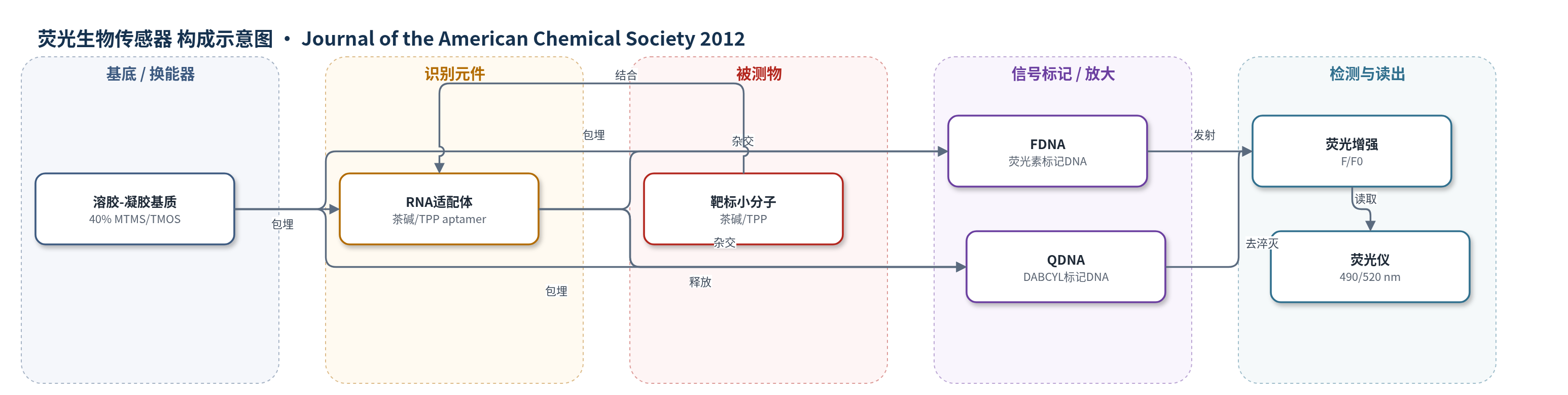
点击图片查看大图 · 依据论文自动绘制
传感器类型
荧光生物传感器
检测对象
茶碱(theophylline)、焦磷酸硫胺素(TPP);样品基质:Tris·HCl/MgCl2缓冲液(溶液/固相包埋体系)
检测原理
该传感器基于结构转换荧光去淬灭机制。RNA适配体与荧光素标记DNA(FDNA)和DABCYL标记DNA(QDNA)自组装成三组分RNA/DNA双链报告复合物,此时荧光素与淬灭剂距离较近,背景荧光较低。当茶碱或TPP结合RNA适配体时,适配体构象由RNA/DNA双链转变为RNA/靶标复合物,导致QDNA释放,荧光素远离DABCYL淬灭剂,荧光强度增加。信号以F/F0表示,并随靶标浓度升高而增强。将报告复合物包埋于40% MTMS/60% TMOS溶胶-凝胶基质中,可限制RNA骨架运动、降低局部碱性环境对RNA磷酸二酯键水解的影响,并阻挡核酸酶进入,从而提高固相传感稳定性。
检测灵敏度
LOD: 1 μM(TPP);动态范围: 茶碱 1–1000 μM,TPP 至 100 μM(初始速率可更宽)
效应效果
包埋于40% MTMS/60% TMOS后,茶碱和TPP适配体保持与游离类似的选择性,对咖啡因、茶溴碱、TMP、硫胺素、氧硫胺素及突变适配体响应几乎不变。抗核酸酶方面,溶液中RNase A/RNase H使荧光增强>20倍和>4倍,而包埋体系分别<4倍和<2倍,消化降低约80%和70%。时间响应三次独立实验变异<10%。4℃储存1个月,溶液信号降至约2倍和1.5倍,包埋体系仍保持>8倍和>2.5倍,活性损失约20–30%。作者认为该方法可扩展至微阵列、生物亲和柱和薄膜涂层,用于环境与临床小分子代谢物检测。
传感器的构成
- 固相载体:40% MTMS/60% TMOS 溶胶-凝胶有机无机复合材料,包埋并稳定三组分RNA适配体报告系统,提供介孔环境
- 识别元件:茶碱结合RNA适配体或TPP结合RNA适配体,识别小分子靶标并发生结构转换
- 信号标记物:荧光素标记DNA(FDNA)与DABCYL标记DNA(QDNA),形成RNA/DNA双链,靶标结合后释放QDNA实现荧光去淬灭
- 缓冲介质:50 mM Tris·HCl(pH 7.5)含20 mM MgCl2,维持适配体折叠与杂交
- 读出条件:荧光激发490 nm、发射520 nm,以F/F0表示信号增强
中文摘要
结构转换荧光信号DNA和RNA适配体已被报道为生物传感器开发中高度通用的分子识别元件。虽然结构转换DNA适配体已用于固相传感,但等效RNA适配体由于化学稳定性差且易受核酸酶攻击,尚未成功用于固相传感器。本研究考察将结构转换荧光信号RNA适配体报告分子包埋到溶胶-凝胶衍生有机无机复合材料中,作为固相固定化平台,并以合成茶碱结合和天然焦磷酸硫胺素(TPP)结合RNA适配体为测试对象。两种适配体的结构转换版本被包埋到从高度极性二氧化硅到疏水甲基硅氧烷基材料的一系列复合材料中,并评估其相对于溶液状态的靶标结合与信号能力。当包埋于由40%(v/v)甲基三甲氧基硅烷/四甲氧基硅烷制备的复合材料中时,两种固定化适配体均表现出与游离适配体相似的敏感性和选择性。重要的是,该材料还赋予其抵抗核酸酶降解的保护作用,并赋予RNA报告系统长期化学稳定性。鉴于溶胶-凝胶包埋用于开发生物传感器、微阵列、生物亲和柱及其他器件的通用性,该方法应为多种固相RNA适配体器件提供有用平台。
英文摘要
Structure-switching, fluorescence-signaling DNA and RNA aptamers have been reported as highly versatile molecular recognition elements for biosensor development. While structure-switching DNA aptamers have been utilized for solid-phase sensing, equivalent RNA aptamers have yet to be successfully utilized in solid-phase sensors due to their lack of chemical stability and susceptibility to nuclease attack. In this study, we examined entrapment into sol-gel derived organic-inorganic composite materials as a platform for immobilization of structure-switching fluorescence-signaling RNA aptamer reporters, using both the synthetic theophylline- and naturally occurring thiamine pyrophosphate-binding RNA aptamers as test cases. Structure-switching versions of both aptamers were entrapped into a series of sol-gel derived composites, ranging from highly polar silica to hydrophobic methylsilsesquioxane-based materials, and the target-binding and signaling capabilities of these immobilized aptamers were assessed relative to solution. Both immobilized aptamers demonstrated sensitivity and selectivity similar to that of free aptamers when entrapped in a composite material derived from 40% (v/v) methyltrimethoxysilane/tetramethoxysilane. Importantly, this material also conferred protection from nuclease degradation and imparted long-term chemical stability to the RNA reporter systems. Given the versatility of sol-gel entrapment for development of biosensors, microarrays, bioaffinity columns, and other devices, this entrapment method should provide a useful platform for numerous solid-phase RNA aptamer-based devices.