组成图示
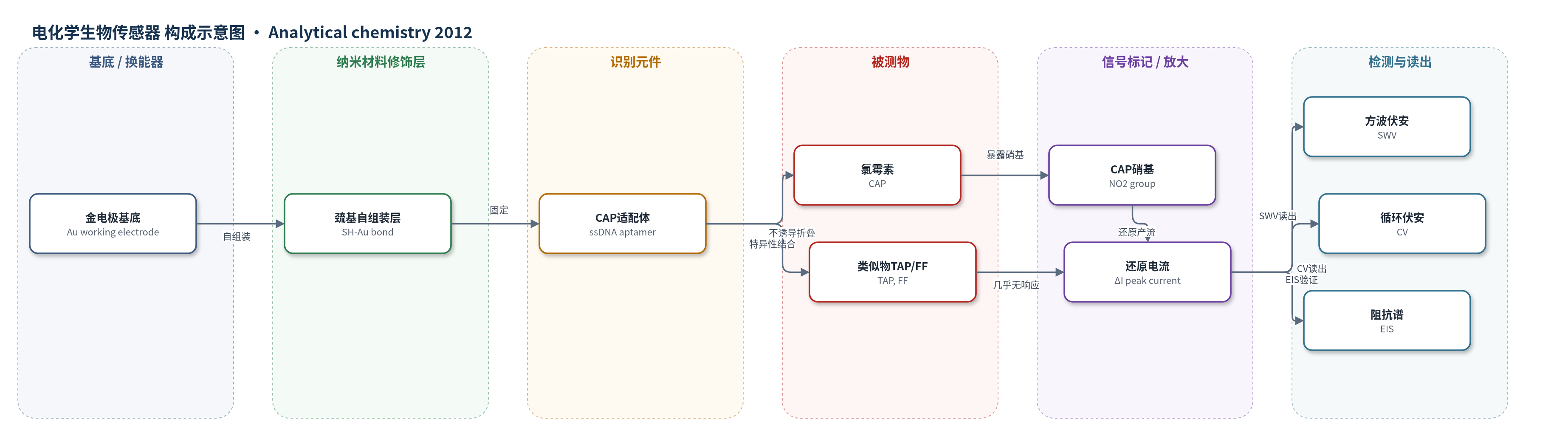
点击图片查看大图 · 依据论文自动绘制
传感器类型
电化学生物传感器
检测对象
氯霉素(chloramphenicol, CAP);样品基质:牛奶(milk)及Tris缓冲液标准溶液(含类似物TAP/FF)
检测原理
该传感器采用无标记适配体识别与电化学换能。巯基修饰的CAP特异性ssDNA适配体自组装固定于金电极表面。未结合CAP时,适配体部分展开,磷酸骨架负电荷阻碍界面电子转移;CAP结合后,适配体折叠为茎环/发夹结构,将含硝基的CAP拉近电极表面。CAP的硝基在约-0.65 V发生不可逆还原:R-NO2+4e-+4H+→R-NHOH+H2O,产生还原电流。随着CAP浓度升高,结合并靠近电极的CAP增多,SWV峰高增量∆I线性增大。信号放大不依赖外源标记,而来自适配体构象变化对电活性硝基的空间富集与电子转移增强。
检测灵敏度
LOD: 1.6×10⁻⁹ mol L-1(缓冲液);LOD: 6×10⁻⁹ mol L-1(牛奶样品);线性范围: 1.6×10⁻⁹–4.2×10⁻⁷ mol L-1;灵敏度斜率: 0.238(∆I=0.238Ccap+1.62);R^2 = 0.9957
效应效果
在1×10⁻⁶ mol/L的TAP和FF存在下,传感器对CAP仍给出最高电流响应,类似物响应几乎可忽略,选择性良好。稳定性方面,适配体修饰金电极在1×10-6 mol/L CAP中孵育后连续5次CV测量,峰电流仅下降3.01%;EIS半圆直径在检测后保持一致,表明自组装适配体膜稳定。牛奶加标回收率为87.3%、88.0%和92.1%(加标2、4、6×10⁻⁶ mol/L),牛奶中检测限为6×10-9 mol/L。作者认为该法简单、低成本、灵敏度高,可达到欧盟MRL(0.3×10-6 g/kg),适用于牛奶中CAP残留筛查。
传感器的构成
- 工作电极基底:金电极(Au),经机械抛光与电化学清洗,作为电子转导界面
- 自组装修饰层:巯基(SH)与金表面形成Au-S键,实现适配体稳定固定
- 识别元件:氯霉素特异性单链DNA适配体(CAP ssDNA aptamer),特异性结合CAP并诱导构象折叠
- 信号标记物:无外源标记物;被测物氯霉素(CAP)自身硝基(NO2)作为电活性信号源,结合后靠近电极发生还原
- 结合缓冲液:Tris缓冲液(含NaCl、Tris-HCl、MgCl2、KCl、CaCl2,pH 7.6),维持适配体结合与电化学环境
- 电化学电极系统:饱和甘汞电极(SCE)与石墨辅助电极,用于三电极CV、SWV和EIS测量
中文摘要
本文报道了一种新型无标记、折叠诱导的适配体电化学生物传感器,用于在结构类似物存在下检测氯霉素(chloramphenicol, CAP)。CAP是一种广谱抗生素,因对造血系统的严重毒性副作用而受到严格限制。研究将巯基修饰的CAP特异性单链DNA适配体通过自组装方式固定于金电极表面。无CAP时,电极表面的单链适配体呈部分展开状态;当CAP存在时,适配体发生构象折叠并形成茎环结构,使CAP分子靠近电极表面并触发电子转移,从而显著增强电流响应。该传感器检测限为1.6×10⁻⁹ mol/L。结构类似的硫霉素(TAP)和氟甲砜霉素(FF)几乎不产生干扰,表明传感器具有良好的选择性。方法简单、成本低、检测限低,适用于牛奶样品中CAP残留的实际检测,并可达到欧盟最大残留限量要求。
英文摘要
A novel, label-free folding induced aptamer-based electrochemical biosensor for the detection of chloramphenicol (CAP) in the presence of its analogues has been developed. CAP is a broad-spectrum antibiotic that has lost its favor due to its serious adverse toxic effects on human health. Aptamers are artificial nucleic acid ligands (ssDNA or RNA) able to specifically recognize a target such as CAP. In this article, the aptamers are fixed onto a gold electrode surface by a self-assembly approach. In the presence of CAP, the unfolded ssDNA on the electrode surface changes to a hairpin structure, bringing the target molecules close to the surface and triggering electron transfer. Detection limits were determined to be 1.6 × 10(-9) mol L(-1). In addition, thiamphenicol (TAP) and florfenicol (FF), antibiotics with a structure similar to CAP, did not influence the performance of the aptasensor, suggesting a good selectivity of the CAP-aptasensor. Its simplicity and low detection limit (because of the home-selected aptamers) suggest that the electrochemical aptasensor is suitable for practical use in the detection of CAP in milk samples.