组成图示
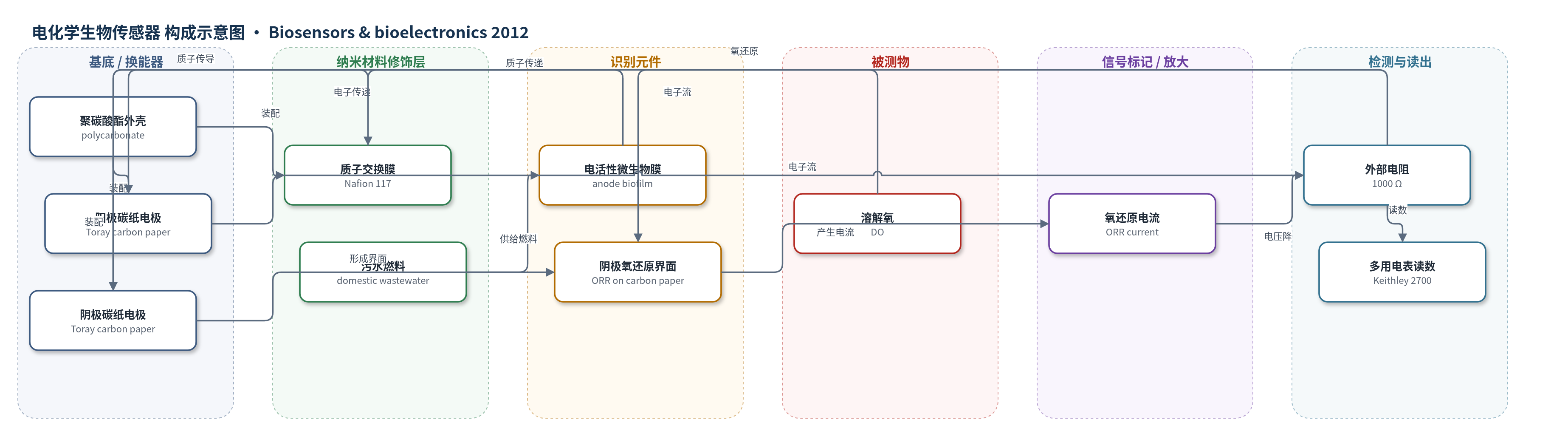
点击图片查看大图 · 依据论文自动绘制
传感器类型
电化学生物传感器
检测对象
溶解氧(dissolved oxygen, DO);样品基质:自来水、海水、湖水、家庭污水、藻类生物反应器水
检测原理
该传感器没有传统分子识别元件,而是利用微生物燃料电池的电化学过程直接检测溶解氧。阳极电活性微生物氧化家庭污水中的有机物,产生电子和质子;电子经阳极碳纸进入外电路,质子经 Nafion 117 质子交换膜迁移至阴极。阴极碳纸面向环境水体,溶解氧作为终端电子受体在阴极表面发生氧还原反应(ORR)。DO 浓度越高,阴极氧还原速率和电子消耗速率越高,外电路电流越大。通过 1000 Ω 外部电阻测量电压,并按欧姆定律换算为电流密度,从而定量反映 DO 浓度。微生物持续氧化有机物提供电子流,使传感器无需外部电源,并具有一定信号放大效应。
检测灵敏度
线性范围: 0–8.8±0.3 mg/L(电流密度 5.6±0.5–462.2±0.5 mA/m2);灵敏度斜率: 53.02 mA/m2 per mg/L;R^2 = 0.9912
效应效果
在自来水中,响应时间小于 4 min,各 DO 水平电流密度 RSD 小于 5%。外阻 10–2000 Ω 下均线性,R2 高于 0.9902;底物 100–1000 mg-COD/L 下线性良好,说明污水可自供电。pH 5.5–9.0、温度 15–30 °C、电导率 200–5000 µS/cm 下均线性,pH 5.5 时 R2=0.9929,电导率高于 200 µS/cm 时影响较小。硝酸盐在 DO 高于 2.0 mg/L 时干扰不明显,低 DO 下高浓度硝酸盐造成偏差,10 mg-N/L 时 R2=0.93。实际水样中 SBMFC 与 DO 计无显著差异(p>0.05),响应时间小于 2 min,稳定运行超过 6 个月,适合原位、低成本、长期监测。
传感器的构成
- 反应器外壳:聚碳酸酯(polycarbonate)板,构成单室阳极腔并密封,防止泄漏
- 阳极电极:未防水碳纸(Toray carbon paper, E-TEK),作为阳极换能器,供电活性微生物附着并氧化有机物
- 生物膜/代谢层:家庭污水接种形成的电活性微生物生物膜,氧化污水有机物产生电子
- 质子交换膜:Nafion 117(DuPont),热压于阳极与阴极之间,传导质子并分隔阳极燃料与外部水体
- 阴极电极:未防水碳纸(Toray carbon paper, E-TEK),面向外部水体,作为氧还原反应基底
- 传感界面:阴极碳纸(Toray carbon paper)表面溶解氧还原反应(ORR),DO 作为电子受体
- 燃料/电子供体:家庭污水(domestic wastewater, COD 约300 mg/L),为阳极微生物提供有机物和接种物
- 外部电路:外部电阻(1000 Ω)与多用电表(Keithley 2700/7701),将电压转换为电流密度信号
中文摘要
本文开发了一种可潜水微生物燃料电池(SBMFC)生物传感器,用于环境水体中溶解氧(DO)的原位实时监测。该传感器以家庭污水作为唯一燃料和接种物,无需外部电源。首先在不同 DO 水平的自来水中考察其性能:在 1000 Ω 外阻下,电流密度(5.6±0.5–462.2±0.5 mA/m2)随 DO 浓度线性增加至 8.8±0.3 mg/L,相关系数 R2=0.9912,单次测量最大响应时间小于 4 min。改变外阻时,电流密度对 DO 的响应不同,但均保持线性关系。不同底物浓度实验表明,家庭污水中的有机物足以维持传感电流。进一步考察 pH、温度、电导率和替代电子受体等环境条件的影响,结果表明现场应用前需进行校准。最后,传感器在海水、污水、湖水、生物反应器水和自来水中测试,结果与 DO 计测量无显著差异(p>0.05)。该结构简单、紧凑,具有直接、低成本、快速监测多种环境水体 DO 的潜力。
英文摘要
A submersible microbial fuel cell (SBMFC) was developed as a biosensor for in situ and real time monitoring of dissolved oxygen (DO) in environmental waters. Domestic wastewater was utilized as a sole fuel for powering the sensor. The sensor performance was firstly examined with tap water at varying DO levels. With an external resistance of 1000Ω, the current density produced by the sensor (5.6 ± 0.5-462.2 ± 0.5 mA/m(2)) increased linearly with DO level up to 8.8 ± 0.3mg/L (regression coefficient, R(2)=0.9912), while the maximum response time for each measurement was less than 4 min. The current density showed different response to DO levels when different external resistances were applied, but a linear relationship was always observed. Investigation of the sensor performance at different substrate concentrations indicates that the organic matter contained in the domestic wastewater was sufficient to power the sensing activities. The sensor ability was further explored under different environmental conditions (e.g. pH, temperature, conductivity, and alternative electron acceptor), and the results indicated that a calibration would be required before field application. Lastly, the sensor was tested with different environmental waters and the results showed no significant difference (p>0.05) with that measured by DO meter. The simple, compact SBMFC sensor showed promising potential for direct, inexpensive and rapid DO monitoring in various environmental waters.