组成图示
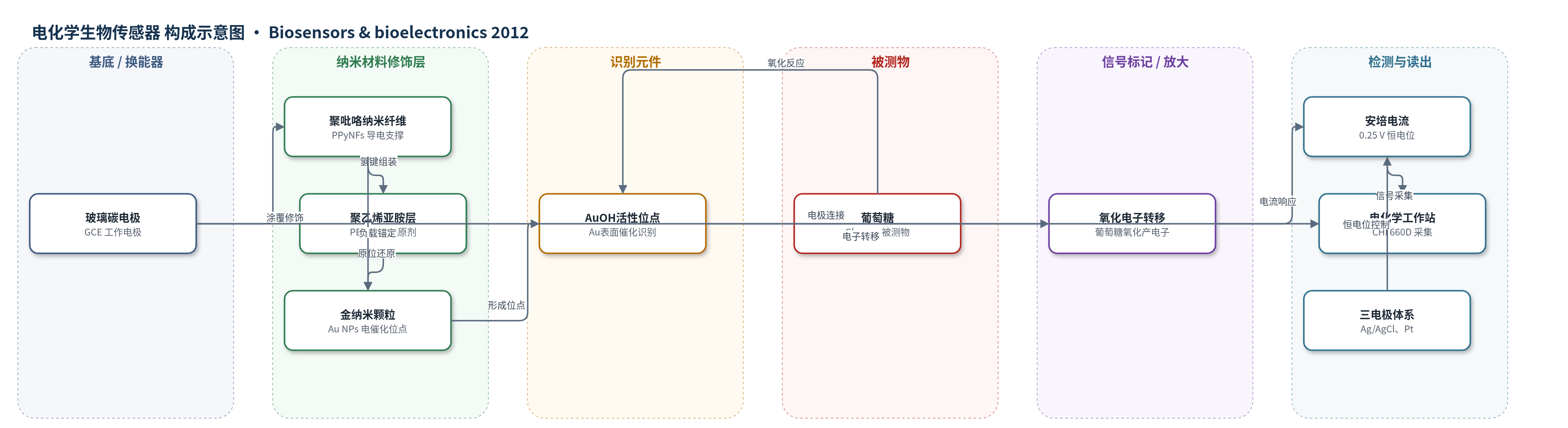
点击图片查看大图 · 依据论文自动绘制
传感器类型
电化学生物传感器
检测对象
葡萄糖(glucose,Glu);实验样品基质为 0.1 M NaOH 溶液,面向血液/临床诊断样品
检测原理
该传感器为无酶安培型葡萄糖传感器。Au/PPyNFs 修饰层中,PPyNFs 提供导电网络并分散负载 Au NPs;PEI 通过氢键锚定在 PPyNFs 表面,并在原位还原 HAuCl4 过程中形成可控负载的 Au NPs。在 0.1 M NaOH 碱性介质中,Au NPs 表面形成 AuOH 活性位点,葡萄糖在 0.25 V 恒电位下被电催化氧化。氧化过程中电子经 Au NPs 和 PPyNFs 导电网络传递至 GCE,产生与葡萄糖浓度成正比的安培电流。由于 Au NPs 的高电催化活性和 PPyNFs 的导电支撑,传感器在 0.2–13 mM 范围内呈线性响应,无需酶或外源信号标记物。
检测灵敏度
线性范围: 0.2–13 mM;灵敏度: 1.003 mA cm−2 mM−1;R^2 = 0.9993
效应效果
基于 Au/PPyNFs-3 的传感器在 0.2–13 mM 葡萄糖范围内线性良好(R2=0.9993),灵敏度为 1.003 mA cm−2 mM−1。抗干扰测试中,0.1 mM 尿素和 0.1 mM 抗坏血酸对 2 mM 葡萄糖的安培响应无明显干扰,表明其具有一定选择性。文中未报告实际血清或尿液加标回收率,也未给出与 ELISA、HPLC 或 qPCR 等方法的定量对比;重复性以三次检测的标准差误差棒表示,但未给出具体 RSD 数值。作者认为该无酶体系可避免酶失活导致的长期稳定性问题,适合用于糖尿病早期诊断和预防中的快速、灵敏、抗干扰葡萄糖检测。
传感器的构成
- 基底/换能器电极:玻璃碳电极(GCE,直径3 mm),作为工作电极和电子传导基底
- 成膜固定层:0.5% 全氟磺酸树脂(Nafion)溶液,将 Au/PPyNFs 分散液涂覆并固定于 GCE 表面
- 导电支撑层:聚吡咯纳米纤维(PPyNFs),提供导电网络并分散负载 Au NPs
- 功能化/还原层:聚乙烯亚胺(PEI)通过氢键结合于 PPyNFs 表面,并作为还原剂原位还原氯金酸(HAuCl4)
- 催化修饰层:金纳米颗粒(Au NPs,平均6.5 nm)负载于 PPyNFs 表面,提供葡萄糖电催化氧化活性位点
- 识别元件:无酶体系,无抗体/适配体/酶等生物识别元件,依赖 Au 表面 AuOH 活性位点识别并氧化葡萄糖
- 信号标记物:无外源信号标记物,葡萄糖氧化产生安培电流作为信号
中文摘要
本研究报道了一种基于聚吡咯纳米纤维负载金纳米颗粒(Au/PPyNFs)的无酶葡萄糖生物传感器。通过氢键作用将聚乙烯亚胺(PEI)原位组装到聚吡咯纳米纤维(PPyNFs)表面,PEI 同时作为还原剂将氯金酸(HAuCl4)还原为金纳米颗粒(Au NPs)。通过改变 PPy 与 HAuCl4 的摩尔比,可调控 Au 负载量,获得不同 Au 含量的 Au/PPyNFs 复合材料。利用 SEM、TEM、FTIR、XRD 和 XPS 对复合材料的形貌、结构和组成进行了表征。结果表明,Au/PPyNFs 对葡萄糖氧化具有高电催化活性。基于 Au/PPyNFs 的无酶安培葡萄糖传感器可在 0.2–13 mM 范围内检测葡萄糖,灵敏度为 1.003 mA cm−2 mM−1,电流密度与葡萄糖浓度之间呈良好线性(R2=0.9993)。该传感器为构建快速、灵敏、抗干扰的安培传感器提供了可行策略,有望用于糖尿病的早期诊断和预防。
英文摘要
An enzymeless glucose biosensor based on polypyrrole nanofibers-supporting Au nanoparticles (Au/PPyNFs) was investigated in this study. The Au/PPyNFs heterogeneous composite materials were synthesized in-situ via hydrogen bonding interactions for the assembly of polyethyleneimine (PEI) on the surface of polypyrrole nanofibers (PPyNFs). By changing the molar ratio of PPy to HAuCl(4), Au/PPyNFs with different Au loadings were obtained. The morphology and composition of Au/PPyNFs were characterized using SEM, TEM, FTIR, XRD and XPS, respectively. The hybrids exhibited a high electrocatalytic activity toward glucose oxidation, which is prerequisite for the catalysts to be applied in amperometric glucose sensors. By using the nonenzymatic glucose sensor based on Au/PPyNFs, 0.2-13 mM glucose can be detected with a sensitivity of 1.003 μA cm(-2)mM(-1) and a good linearity (R(2)=0.9993) between current density and glucose concentration. The proposed glucose sensor provides a promising strategy to construct fast, sensitive, and anti-interfering amperometric sensors for early diagnosis and prevention of diabetes.