组成图示
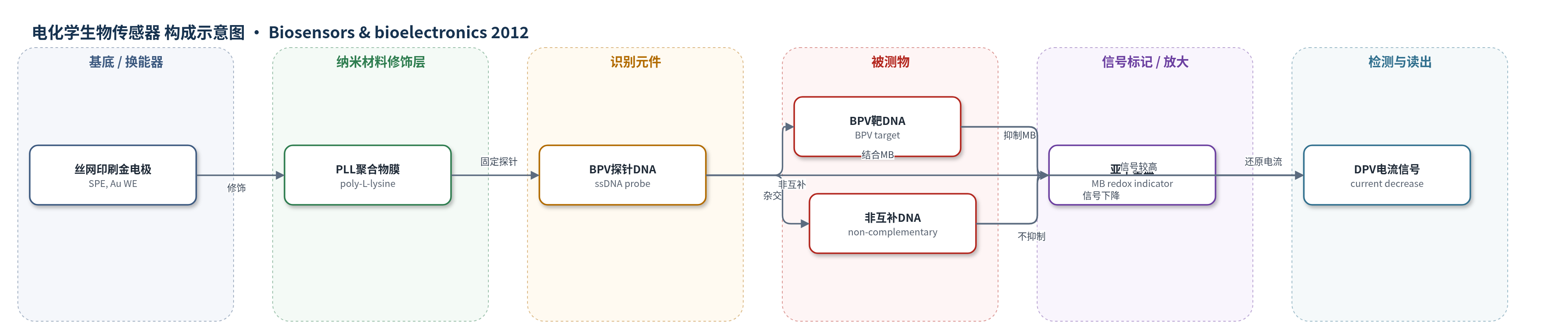
点击图片查看大图 · 依据论文自动绘制
传感器类型
电化学生物传感器
检测对象
牛乳头瘤病毒 DNA(bovine papillomavirus DNA, BPV DNA);样品基质:牛血(EDTA 抗凝血)提取的病毒 DNA,以及合成 BPV 靶 DNA/非互补 DNA。
检测原理
传感器以带正电的聚-L-赖氨酸(PLL)膜修饰金工作电极,通过静电作用将带负电的 BPV 单链 DNA 探针固定于电极表面。亚甲基蓝(MB)作为氧化还原指示剂,优先与单链探针中的鸟嘌呤碱基结合,在差分脉冲伏安法(DPV)下产生较强的还原电流。当 BPV 靶 DNA 与探针杂交形成双链 DNA 后,MB 与双链的结合/嵌入能力减弱,导致 MB 还原电流下降;非互补序列不能形成稳定杂交,MB 结合受抑制较小,电流较高。因此,电流相对未杂交探针的下降可指示 BPV 靶 DNA 的存在,并在 5–100 nM 范围内随靶浓度变化呈线性关系。
检测灵敏度
LOD: 4.35 nM;线性范围: 5 nM–100 nM;斜率: 0.0053 µA/nM;R^2 = 0.99763;RSD: 0.056%(100 nM,三个独立电极)
效应效果
该传感器对互补 BPV 靶序列具有明显响应,杂交后 MB 还原电流较未杂交探针下降;非互补序列不形成杂交,电流高于互补杂交组,仅略低于未杂交探针,表明其具有较高选择性。在 100 nM 靶序列下,三个独立探针修饰电极的相对标准偏差(RSD)为 0.056%,重现性良好。实际样品方面,15 份患牛乳头瘤病牛血样本中,2 份经 MY09/MY11 引物 PCR 扩增出 450 bp 的 L1 基因片段;对应提取病毒 DNA(EVD1、EVD2)在传感器上均引起 MB 还原电流下降,与 PCR 阳性结果一致。作者认为该装置可简化样品处理、实现快速低成本检测,并有望发展为便携式牛乳头瘤病毒诊断系统。
传感器的构成
- 基底/换能器电极:丝网印刷电极(SPE)金工作电极(Au WE)、Ag/AgCl 参比电极、碳对电极;作用:提供导电界面与三电极电化学检测体系。
- 聚合物修饰层:聚-L-赖氨酸(PLL)电聚合膜;作用:带正电,通过静电作用固定带负电 DNA 探针。
- 对比修饰层:壳聚糖(chitosan)膜;作用:作为聚合物修饰对比,因导电性较差,固定效果不如 PLL。
- 识别元件:BPV 单链 DNA 探针(BPV probe);作用:与 BPV 靶序列互补杂交。
- 信号标记物:亚甲基蓝(MB);作用:氧化还原指示剂,与 ssDNA 鸟嘌呤结合,DPV 还原电流反映杂交状态。
- 检测缓冲体系:0.5 M 醋酸缓冲液(pH 5)用于探针固定与杂交,20 mM Tris-HCl(pH 7.0)用于洗涤和 DPV 测量;作用:维持杂交条件并清洗非结合物。
- 样品前处理:牛血 EDTA 样本提取病毒 DNA,94°C 变性后杂交;作用:提供真实 BPV 双链 DNA 样品。
中文摘要
本研究开发了一种基于丝网印刷电极的电化学 DNA 生物传感器,用于检测牛乳头瘤病毒(BPV)。以金工作电极为基底,采用聚-L-赖氨酸(PLL)和壳聚糖聚合物膜修饰,并通过循环伏安法(CV)和差分脉冲伏安法(DPV)系统评价。实验设计考察了聚合物种类、BPV 探针浓度和固定时间对亚甲基蓝(MB)电化学还原的影响。结果表明,PLL 膜、1 mM 探针浓度和 60 min 固定时间可获得最佳固定效果。当互补靶序列(BPV target)与固定探针杂交后,MB 还原电流较未杂交探针明显降低;从患乳头瘤病牛只血液中提取的病毒 DNA 同样引起 MB 还原电流下降,提示该电化学信号变化可反映 BPV 感染。特异性实验表明,传感器能够区分互补序列与非互补序列。研究证明,该生物传感器有望用于牛乳头瘤病毒 DNA 的快速、高效检测,并辅助牛乳头瘤病的预防和治疗。
英文摘要
A new electrochemical DNA biosensor for bovine papillomavirus (BPV) detection that was based on screen-printed electrodes was comprehensively studied by electrochemical methods of cyclic voltammetry (CV) and differential pulse voltammetry (DPV). A BPV probe was immobilised on a working electrode (gold) modified with a polymeric film of poly-L-lysine (PLL) and chitosan. The experimental design was carried out to evaluate the influence of polymers, probe concentration (BPV probe) and immobilisation time on the electrochemical reduction of methylene blue (MB). The polymer poly-L-lysine (PLL), a probe concentration of 1 μM and an immobilisation time of 60 min showed the best result for the BPV probe immobilisation. With the hybridisation of a complementary target sequence (BPV target), the electrochemical signal decreased compared to a BPV probe immobilised on the modified PLL-gold electrode. Viral DNA that was extracted from cattle with papillomatosis also showed a decrease in the MB electrochemical reduction, which suggested that the decreased electrochemical signal corresponded to a bovine papillomavirus infection. The hybridisation specificity experiments further indicated that the biosensor could discriminate the complementary sequence from the non-complementary sequence. Thus, the results showed that the development of analytical devices, such as a biosensor, could assist in the rapid and efficient detection of bovine papillomavirus DNA and help in the prevention and treatment of papillomatosis in cattle.