组成图示
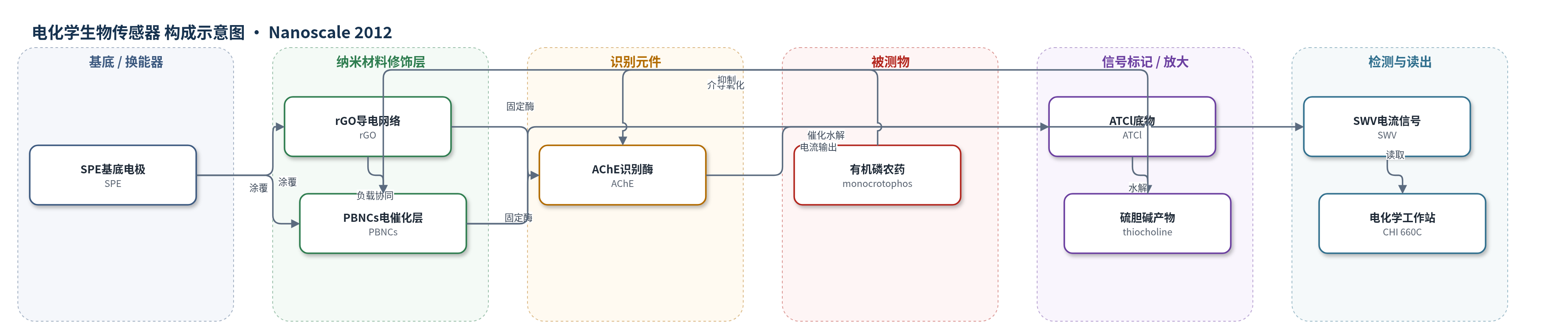
点击图片查看大图 · 依据论文自动绘制
传感器类型
电化学生物传感器
检测对象
有机磷农药(organophosphorus pesticides, OPs;模型化合物 monocrotophos),样品基质为黄瓜样品溶液(cucumber solution)
检测原理
该传感器采用抑制型 AChE 生物传感机制。AChE 催化底物 ATCl 水解,生成 thiocholine 与胆碱;thiocholine 在 PBNCs/rGO 修饰电极表面被 PB 可逆氧化还原中心介导氧化,PB 将 thiocholine 氧化峰电位负移至约 220 mV,rGO 提供导电网络并促进电子与 K+ 传输,使过电位较裸电极降低约 460 mV,从而产生可测电流。当样品中存在 monocrotophos 等 OPs 时,农药与 AChE 结合并抑制其催化活性,thiocholine 生成量减少,电流随之下降。通过计算抑制率 I%=100%(i0−i)/i0,可依据电流下降程度定量农药浓度。检测采用方波伏安法读取信号,被抑制的 AChE 还可用 pralidoxime iodide 再生。
检测灵敏度
LOD: 0.1 ng mL−1;线性范围: 1.0–600 ng mL−1
效应效果
该传感器对 monocrotophos 响应迅速,电流响应由 AChE/SPE 的 1.4 mA、26 s 提升至 AChE–PBNCs/rGO/SPE 的 15.2 mA、10.9 s,且过电位降低约 460 mV。其检出限 0.1 ng mL−1 低于报道的 5 ng mL−1 壳聚糖 AChE 传感器,并与 0.9 ng mL−1 自组装膜电极相当。批内和批间 RSD 分别为 4.9% 和 7.2%;4 ℃干燥保存 10 d 无明显衰减,30 d 后保留 80% 初始电流。黄瓜加标样品回收率为 97–104%。作者认为该传感器虽不能区分特定 OPs 或氨基甲酸酯类,但适合现场快速检测农药总量。
传感器的构成
- 基底电极:screen printed electrode (SPE),提供导电基底与电化学换能
- 纳米修饰层:PBNCs/rGO nanocomposite,由 Prussian blue nanocubes (PBNCs) 与 reduced graphene oxide (rGO) 组成,PBNCs 电催化氧化 thiocholine,rGO 提供导电网络与大比表面积
- 识别元件:human acetylcholinesterase (AChE),催化水解 acetylthiocholine chloride (ATCl) 生成 thiocholine
- 固定剂:chitosan,与 AChE 共同成膜并固定酶
- 电催化介质:Prussian blue (PB) 纳米立方,介导 thiocholine 氧化并降低过电位
- 底物:acetylthiocholine chloride (ATCl),AChE 底物,水解产生 thiocholine
- 再生剂:pralidoxime iodide,恢复被 OPs 抑制的 AChE 活性
中文摘要
本文报道了一种简便制备普鲁士蓝纳米立方/还原氧化石墨烯(PBNCs/rGO)纳米复合材料的方法:在聚乙烯亚胺(PEI)水溶液中,将 Fe3+ 与 [Fe(CN)6]3− 在氧化石墨烯(GO)存在下直接混合,原位生成 PBNCs/rGO,并用于构建乙酰胆碱酯酶(AChE)生物传感器以检测有机磷农药(OPs)。XPS、TEM 和 EDX 表征表明,立方 PB 纳米颗粒均匀负载于还原 GO 表面,未观察到孤立 PB 颗粒,说明二者相互作用强。PBNCs/rGO 修饰电极对硫胆碱(thiocholine)氧化具有高电催化活性,使氧化峰电位负移至 220 mV,过电位较裸电极降低约 460 mV。该 AChE 生物传感器对 monocrotophos 响应迅速、灵敏度高,线性范围为 1.0–600 ng mL−1,检出限为 0.1 ng mL−1。结果表明,PBNCs/rGO 复合材料可显著增强硫胆碱电催化氧化,从而实现有机磷农药的灵敏检测。
英文摘要
We demonstrate a facile procedure to efficiently prepare Prussian blue nanocubes/reduced graphene oxide (PBNCs/rGO) nanocomposite by directly mixing Fe(3+) and [Fe(CN)(6)]((3)-) in the presence of GO in polyethyleneimine aqueous solution, resulting in a novel acetylcholinesterase (AChE) biosensor for detection of organophosphorus pesticides (OPs). The obtained nanocomposite was characterized by X-ray photoelectron spectroscopy (XPS), transmission electron microscopy (TEM) and energy-dispersive X-ray (EDX) microanalysis. It was clearly observed that the nanosheet has been decorated with cubic PB nanoparticles and nearly all the nanoparticles are distributed uniformly only on the surface of the reduced GO. No isolated PB nanoparticles were observed, indicating the strong interaction between PB nanocubes and the reduced GO and the formation of PBNCs/rGO nanocomposite. The obtained PBNCs/rGO based AChE biosensor make the peak potential shift negatively to 220 mV. The over-potential decreases ∼460 mV compared to that on a bare electrode, suggesting that PBNCs/rGO has a high electrocatalytic activity towards the oxidation of thiocholine. The AChE biosensor shows rapid response and high sensitivity for detection of monocrotophos with a linear range from 1.0 to 600 ng mL(-1) and a detection limit of 0.1 ng mL(-1). These results suggest that the PBNCs/rGO hybrids nanocomposite exhibited high electrocatalytic activity towards the oxidation of thiocholine, which lead to the sensitive detection of OP pesticides.