组成图示
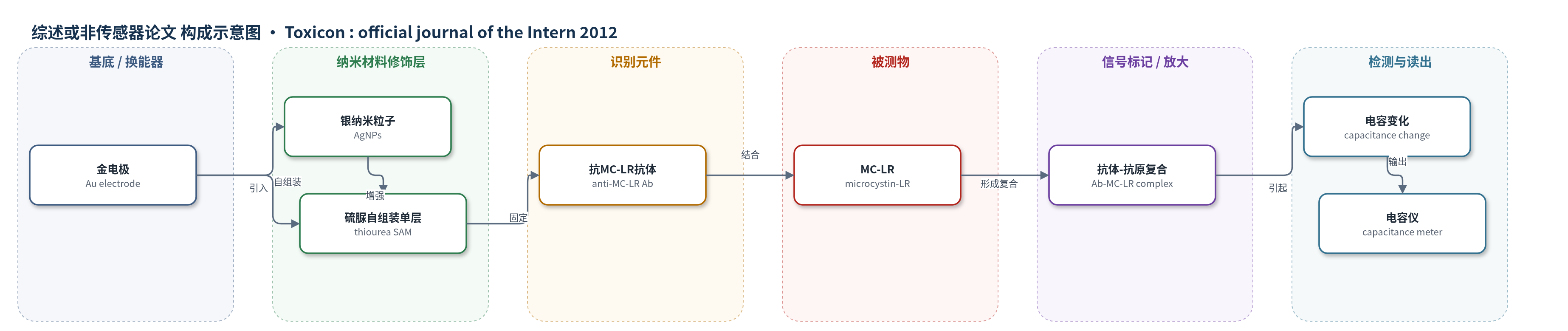
点击图片查看大图 · 依据论文自动绘制
传感器类型
综述或非传感器论文
检测对象
微囊藻毒素(microcystins, MCs,尤其MC-LR及MC-LR/MC-RR/MC-YR等变体);样品基质:环境水样、饮用水、蓝藻食品补充剂、藻类样品
检测原理
本文综述多种微囊藻毒素生物传感器。以无标记电容免疫传感器为例:抗MC-LR抗体经硫脲自组装单层固定于掺银纳米粒子的金电极表面;MC-LR与抗体结合形成Ab-MC-LR复合,改变电极界面介电性质和双电层电容,电容仪据此读出,MC-LR浓度越高,电容变化越大。综述还报道酶抑制型传感器利用MCs抑制PP1A/PP2A,使磷酸底物去磷酸化减少,安培电流下降,并可用底物循环或酶循环放大;SPR和QCM分别通过折射率变化和质量变化监测结合事件;DNA/适配体传感器依赖杂交或亲和结合改变氧化还原探针或光学信号。
检测灵敏度
LOD: 7.0 pg/L;LOD: 0.03 mg/L;检测范围: 0.1–10.1 mg/L;LOD: 0.099 mg/L;工作范围: 0.227–50 mg/L;LOD: 0.05 mg/L;LOD: 1 ng/ml;LOD: 9.0 × 10^-11 M;最小可检测量: 0.35 nM
效应效果
综述指出免疫传感器比酶传感器选择性、稳定性更好,可ng/L级检测。无标记电容免疫传感器LOD 7.0 pg/L,复用43次;EWAI传感器LOD 0.03 mg/L、范围0.1–10.1 mg/L,再生>150次、20 min,PBS/腐殖酸无干扰,Cu 5–10 mg/L降低信号,EDTA可缓解;QD/Ab探针工作范围0.227–50 mg/L、LOD 0.099 mg/L;SWNT纸传感器较ELISA快约28倍;SPR芯片复用>50次或40次;酶循环放大使LOD由37 mg/L降至0.05 mg/L;PDA脂质体LOD 1 ng/ml且肉眼可见变色。作者认为其适合现场快速、便携、低成本监测。
传感器的构成
- 基底/换能器:金电极(Au electrode),作为电容换能器并提供固定界面
- 纳米材料修饰层:银纳米粒子(AgNPs),掺入金电极以增强界面响应
- 修饰层:自组装硫脲单层(thiourea SAM),在金表面形成绝缘层并固定抗体
- 识别元件:抗MC-LR抗体(anti-MC-LR antibody),特异性结合MC-LR
中文摘要
蓝藻水华与气候变化和富营养化密切相关,是蓝藻毒素的重要来源,已成为全球关注的环境与公共卫生问题。微囊藻毒素具有强肝毒性、肾毒性和致癌性,威胁旅游、农业和动物健康,但微囊藻毒素产生调控机制仍不清楚;有毒与无毒蓝藻菌株共存以及多种微囊藻毒素变体的出现使检测更加复杂。虽然生物测定、ELISA、HPLC和LC-MS等分析方法已广泛应用,但生物传感器具有快速、准确、重复性好和便携等优点。微囊藻属基因组测序为在分子和遗传水平开发生物传感器提供了新途径。本文综述了微囊藻毒素检测生物传感器发展的最新趋势,包括酶基、免疫、核酸及其他类型传感器,并讨论其技术进展、性能比较与应用挑战。
英文摘要
Increased cyanobacterial blooms, a source of cyanotoxins are linked with climate change and eutrophication in aquatic bodies, a major concern worldwide. Microcystins are potently hepatotoxic, nephrotoxic as well as carcinogenic. Thus microcystins are threat to tourism, agriculture and animal's health. However, there is a still lacuna in the knowledge of regulation of microcystins production. Presence of toxic and non-toxic cyanobacterial strains together and occurrence of various microcystin variants in aquatic bodies compounded the problem. Although several analytical techniques for microcystin detection such as bioassay, ELISA, HPLC and LC-MS etc. have been already prevalent, the development of biosensors offered rapid and accurate detection, high reproducibility and portability. Sequencing of Microcystis spp., opened the new vistas towards the development of biosensor at molecular and genetic level. This review incorporates the current trends in the development of biosensors for microcystin detection in the light of state-of-the-art techniques.