组成图示
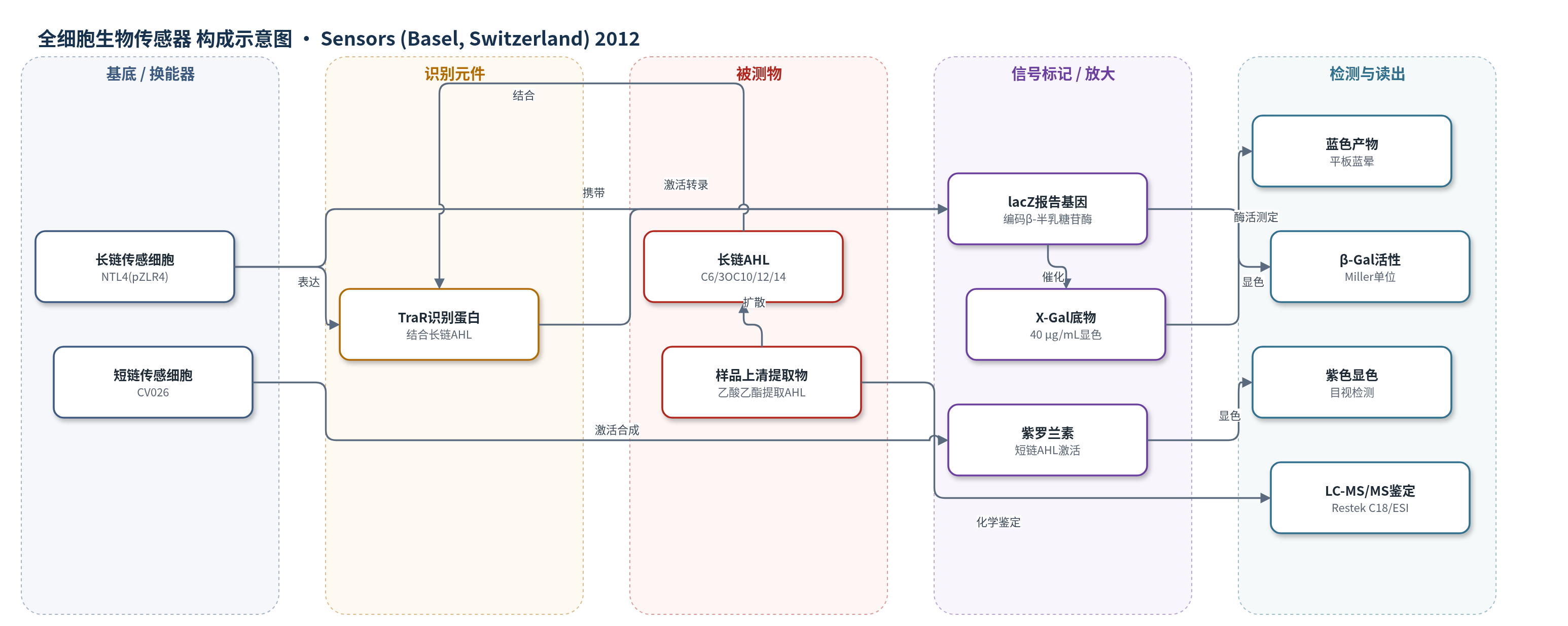
点击图片查看大图 · 依据论文自动绘制
传感器类型
全细胞生物传感器
检测对象
N-酰基高丝氨酸内酯(N-acylhomoserine lactones, AHLs;C6、3OC10、3OC12、3OC14);样品基质:花生固氮慢生根瘤菌培养上清乙酸乙酯提取物
检测原理
花生固氮慢生根瘤菌培养上清中的AHLs经乙酸乙酯提取后扩散进入全细胞生物传感器。长链AHLs与A. tumefaciens NTL4(pZLR4)中的TraR结合,形成AHL-TraR复合物,激活traG::lacZ启动子转录,使细胞表达β-半乳糖苷酶。酶催化X-Gal产生蓝色沉淀,形成平板蓝晕;同时以Miller单位测定β-半乳糖苷酶活性,信号强度随AHL浓度升高而增强。短链AHLs则激活C. violaceum CV026中紫罗兰素合成,产生紫色。LC-MS/MS进一步比对标准品鉴定C6、3OC10、3OC12和3OC14。
检测灵敏度
原文未报告LOD、线性范围、灵敏度斜率或相关系数。
效应效果
53株菌中14株(26%)长链AHL阳性,2株(4%)不确定,37株(70%)阴性,未检出短链AHLs。β-半乳糖苷酶活性分低、中、高三类,P8A、P8B、PC31为369.7±15.5、411.8±17.1、678.9±50.4 Miller单位。LC-MS/MS测得62B株C6为840.1 nM,3OC10/12/14为23.2/28.0/19.6 nM;P8A为15.4/0.13/0.31/0.54 nM。外源AHLs改变运动性、生物膜和聚集,20 μM 3OC10使生物膜增加3–5倍,P5在3OC10下聚集约提高10倍。作者认为长链AHLs调控花生共生菌群体行为。
传感器的构成
- 传感细胞:A. tumefaciens NTL4,作为长链AHL全细胞生物传感器
- 质粒修饰:pZLR4,携带traG::lacZ融合和traR
- 识别元件:TraR响应调节蛋白,结合长链AHL并激活traG::lacZ转录
- 报告基因:lacZ,编码β-半乳糖苷酶,将AHL结合事件转化为酶活信号
- 显色底物:X-Gal(40 μg/mL),被β-半乳糖苷酶水解产生蓝色产物
- 短链传感细胞:C. violaceum CV026,紫罗兰素合成缺陷突变株,短链AHL激活紫罗兰素产生
- 读出体系:Miller β-半乳糖苷酶活性测定与平板蓝晕显色,用于定量和定性检测
中文摘要
慢生根瘤菌属细菌能与花生根细胞建立共生关系并固定大气氮。群体感应(QS)是细菌通过信号分子调控群体行为的细胞间通讯机制,革兰氏阴性菌常用N-酰基高丝氨酸内酯(AHLs)。本研究旨在鉴定和表征花生固氮慢生根瘤菌产生的QS信号,并评价其对细胞互作过程的影响。采用生物传感器菌株A. tumefaciens NTL4(pZLR4)和C. violaceum CV026分别检测长链和短链AHLs。53株菌中未检出短链AHLs,14株产生长链AHLs。通过β-半乳糖苷酶活性定量AHL类似诱导活性,并用LC-MS/MS化学鉴定。每株产AHL菌株至少检出C6、3OC10、3OC12和3OC14四种AHLs。外源添加合成AHLs可改变产AHL和不产AHL菌株的运动性、生物膜形成和细胞聚集。结果表明花生固氮慢生根瘤菌存在细胞通讯机制,长链AHLs是调控重要QS生理过程的信号分子。
英文摘要
Bacteria of the genus Bradyrhizobium are able to establish a symbiotic relationship with peanut (Arachis hypogaea) root cells and to fix atmospheric nitrogen by converting it to nitrogenous compounds. Quorum sensing (QS) is a cell-cell communication mechanism employed by a variety of bacterial species to coordinate behavior at a community level through regulation of gene expression. The QS process depends on bacterial production of various signaling molecules, among which the N-acylhomoserine lactones (AHLs) are most commonly used by Gram-negative bacteria. Some previous reports have shown the production of QS signaling molecules by various rhizobia, but little is known regarding mechanisms of communication among peanut-nodulating strains. The aims of this study were to identify and characterize QS signals produced by peanut-nodulating bradyrhizobial strains and to evaluate their effects on processes related to cell interaction. Detection of AHLs in 53 rhizobial strains was performed using the biosensor strains Agrobacterium tumefaciens NTL4 (pZLR4) and Chromobacterium violaceum CV026 for AHLs with long and short acyl chains, respectively. None of the strains screened were found to produce AHLs with short acyl chains, but 14 strains produced AHLs with long acyl chains. These 14 AHL-producing strains were further studied by quantification of β-galactosidase activity levels (AHL-like inducer activity) in NTL4 (pZLR4). Strains displaying moderate to high levels of AHL-like inducer activity were subjected to chemical identification of signaling molecules by high-performance liquid chromatography coupled to mass spectrometry (LC-MS/MS). For each AHL-producing strain, we found at least four different AHLs, corresponding to N-hexanoyl-DL-homoserine lactone (C(6)), N-(3-oxodecanoyl)-L-homoserine lactone (3OC(10)), N-(3-oxododecanoyl)-L-homoserine lactone (3OC(12)), and N-(3-oxotetradecanoyl)-L-homoserine lactone (3OC(14)). Biological roles of 3OC10, 3OC12, and 3OC14 AHLs were evaluated in both AHL-producing and -non-producing peanut-nodulating strains. Bacterial processes related to survival and nodulation, including motility, biofilm formation, and cell aggregation, were affected or modified by the exogenous addition of increasing concentrations of synthetic AHLs. Our results clearly demonstrate the existence of cell communication mechanisms among bradyrhizobial strains symbiotic of peanut. AHLs with long acyl chains appear to be signaling molecules regulating important QS physiological processes in these bacteria.