组成图示
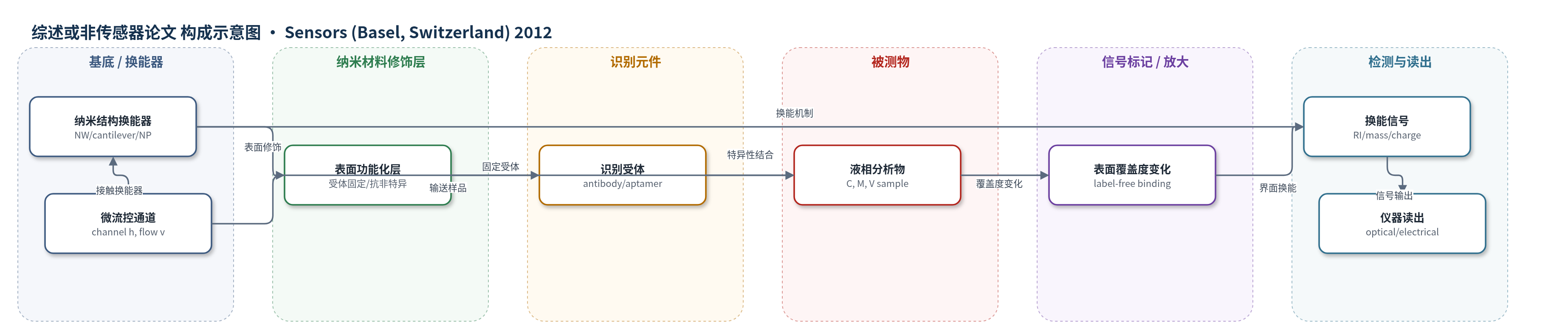
点击图片查看大图 · 依据论文自动绘制
传感器类型
综述或非传感器论文
检测对象
液相生物分析物(analyte):血液/血清中的降钙素(calcitonin)、蛋白生物标志物(protein biomarker)、单细胞内分析物(single-cell analyte)、食品与环境样品中的目标分子;样品基质:血液、血清、单细胞裂解液、食品与环境水样。
检测原理
本文所述为通用表面敏感无标记检测:识别受体固定于纳米或微尺度换能表面,液相分析物与受体结合后使表面覆盖度 Γ 增加。结合事件改变界面折射率、质量、电荷或表面应力,进而被纳米线电导、悬臂梁偏转、等离子体共振波长/散射、压电频率等换能机制转换为光学、电学或机械信号。信号通常随 Γ 近似线性变化,而 Γ 由分析物浓度 C、结合/解离动力学(kon、koff、KD)以及扩散/对流输运决定。传感器尺寸 A 会影响扩散边界层、流动捕获效率、分子离散化、噪声和稳定性,因此微型化并不总是提高检测限。
检测灵敏度
未报告(综述未给出具体传感器的 LOD、线性范围、灵敏度斜率或相关系数)
效应效果
作者指出,高度微型化传感器在多数实际生物传感应用中并不必然优于较大传感器。纳米尺度换能器常受分子离散化、扩散/对流输运限制、仪器散粒噪声和机械/光学稳定性问题影响,可能导致表面覆盖度检测限变差。选择性主要依赖受体固定与抗非特异结合,而非单纯减小尺寸。微尺度活性区域(约100×100 μm)可在保持较高分子通量、多路复用能力和较低噪声之间取得折中。对单细胞、极低分子数样品或单分子机制研究,纳米传感器仍有必要;作者建议采用多个纳米传感器集成测量,以平均噪声并提高稳健性。
传感器的构成
- 基底/换能器:纳米线(nanowire)、纳米悬臂梁(nanocantilever)、等离子体纳米颗粒(plasmonic nanoparticle)等,作为单结构换能单元
- 表面功能化层:受体固定与抗非特异结合的表面化学(surface functionalization),提供特异性识别界面
- 识别元件:抗体(antibody)、适配体(aptamer)等受体(receptor),捕获目标分析物
- 被测物:液相分析物(analyte),具有浓度 C、分子质量 M,存在于样品体积 V 中
- 信号读出:光学/电学/机械读出(optical/electrical/mechanical readout),监测表面覆盖度 Γ 引起的折射率、质量、电荷或位移变化
中文摘要
本文综述了纳米技术推动的微型化传感器在生物传感中的应用及其利弊。纳米结构(如纳米线、纳米悬臂梁和等离子体纳米颗粒)可基于电导、机械偏转或光谱等物理现象作为单一换能单元,实现极小传感面积。作者重点讨论液相样品中无标记实时分析的表面敏感技术,分析传感器尺寸对结合动力学、扩散与对流输运、多路复用、单分子分辨、噪声和稳定性的影响。文章指出,许多常见应用中样品体积和分析物分子数足够,微尺度传感器往往比单一纳米传感器更稳健;微型化虽可提高静止液相中的扩散通量,但会削弱流动增强结合,并可能增加噪声和漂移。作者建议,除单细胞、极低分子数或单分子机制研究等少数场景外,多数实际生物传感应用宜采用微尺度活性区域或多个纳米传感器集成测量,以兼顾灵敏度、稳定性和实用性。
英文摘要
There is no doubt that the recent advances in nanotechnology have made it possible to realize a great variety of new sensors with signal transduction mechanisms utilizing physical phenomena at the nanoscale. Some examples are conductivity measurements in nanowires, deflection of cantilevers and spectroscopy of plasmonic nanoparticles. The fact that these techniques are based on the special properties of nanostructural entities provides for extreme sensor miniaturization since a single structural unit often can be used as transducer. This review discusses the advantages and problems with such small sensors, with focus on biosensing applications and label-free real-time analysis of liquid samples. Many aspects of sensor design are considered, such as thermodynamic and diffusion aspects on binding kinetics as well as multiplexing and noise issues. Still, all issues discussed are generic in the sense that the conclusions apply to practically all types of surface sensitive techniques. As a counterweight to the current research trend, it is argued that in many real world applications, better performance is achieved if the active sensor is larger than that in typical nanosensors. Although there are certain specific sensing applications where nanoscale transducers are necessary, it is argued herein that this represents a relatively rare situation. Instead, it is suggested that sensing on the microscale often offers a good compromise between utilizing some possible advantages of miniaturization while avoiding the complications. This means that ensemble measurements on multiple nanoscale sensors are preferable instead of utilizing a single transducer entity.