组成图示
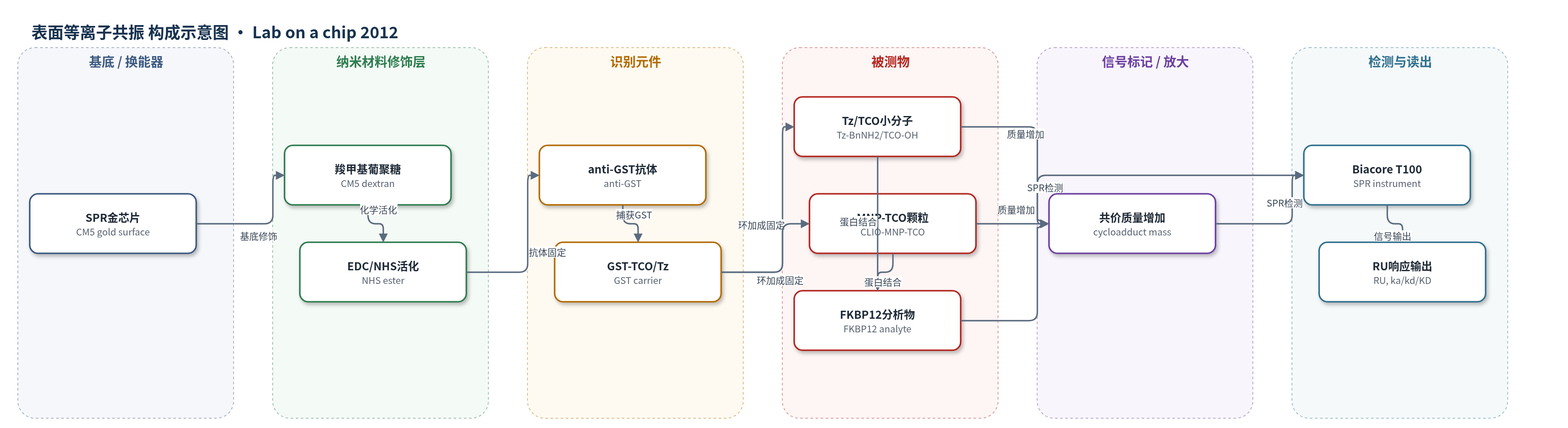
点击图片查看大图 · 依据论文自动绘制
传感器类型
表面等离子共振(SPR)生物传感器
检测对象
四嗪/环辛烯小分子(Tz-BnNH2、TCO-OH)、FK506四嗪衍生物(FKBP12配体)、FKBP12蛋白、TCO/四嗪修饰磁性纳米颗粒(MNP-TCO/MNP-Tz);样品基质:PBS-P、RPMI 1640含10% FBS、100% FBS、PBS-P/2% DMSO。
检测原理
CM5芯片羧基经EDC/NHS活化后共价固定anti-GST,再捕获GST-TCO或GST-Tz,形成可再生识别表面。TCO与Tz发生[4+2]生物正交环加成,将小分子或MNP-TCO/MNP-Tz共价固定到表面,界面质量增加引起金膜表面等离子体共振角/波长偏移,Biacore T100以共振单位(RU)实时读出;共价固定kd=0。GST上约10个TCO/Tz提供多价位点,提高Rmax和灵敏度。当FKBP12作为分析物流过时,与固定化FK506衍生物或功能化纳米颗粒结合,结合量随浓度增加,按1:1 Langmuir模型拟合得到ka、kd和KD。纳米颗粒表面反应位点增加底物可用性,使MNP-TCO/MNP-Tz的ka显著高于游离小分子。
检测灵敏度
原文未报告LOD、线性范围、灵敏度斜率或相关系数;仅给出浓度测量范围:小分子0.3–10 mM,MNP 7–224 nM,FKBP12 0.020–5 mg/mL,FK506衍生物2–2000 nM。
效应效果
GST-TCO修饰(约10个TCO/GST)未明显影响抗体识别、结合动力学或稳定性;共价固定kd=0,可用10 mM glycine-HCl pH 2.0再生。方法在PBS、RPMI 1640含10% FBS和100% FBS中稳健,10 mM以下分析物数分钟内Rmax饱和。Tz-BnNH2 ka=34062 M^-1 s^-1,TCO-OH ka=18880 M^-1 s^-1;MNP-Tz ka=89573 M^-1 s^-1(2.6倍),MNP-TCO ka=235440 M^-1 s^-1(12.5倍),100% FBS中降低但仍最快。FKBP12与小分子/纳米颗粒KD在正反向固定中可比,ka/kd差异不超过一个数量级,纳米颗粒-蛋白为单价结合、无显著亲合力增强。作者认为其减少纳米颗粒用量、免除纯化,优于NMR/停流UV-Vis用于快速筛选。
传感器的构成
- 基底/换能器:金表面SPR芯片(CM5 sensor chip,gold surface),提供表面等离子体共振换能基础
- 修饰层:羧甲基葡聚糖基质(CM5 carboxymethylated dextran matrix),提供羧基用于共价偶联
- 活化/封闭层:EDC/NHS活化形成NHS酯,乙醇胺(ethanolamine)封闭剩余NHS酯
- 识别/捕获元件:anti-GST抗体(anti-GST)固定于CM5表面,捕获GST蛋白;BSA作参考表面
- 载体/反应平台:GST-TCO或GST-Tz(glutathione-S-transferase conjugated with trans-cyclooctene/tetrazine),每个GST约10个TCO/Tz,提供多价生物正交反应位点
- 生物正交固定层:Tz-BnNH2、TCO-OH或FK506四嗪衍生物通过[4+2]环加成共价固定到GST表面
- 纳米颗粒层:MNP-TCO或MNP-Tz(CLIO cross-linked dextran-coated iron oxide magnetic nanoparticles),通过TCO/Tz环加成固定并可原位功能化
- 信号标记物:无外源标记,SPR质量响应(RU)
- 抗非特异/再生:PBS-P中0.005% P-20表面活性剂减少非特异吸附;10 mM glycine-HCl pH 2.0再生anti-GST/GST界面
中文摘要
在连续流微流控条件下高效固定小分子可显著提升基于生物传感器的无标记分子相互作用研究。目前小分子固定化化学常需特殊条件,且多需在检测器和微流控系统外完成,无法实时监测。本文开发并优化了一种芯片上生物正交化学方法,可实现小分子的快速、可逆固定化,并能控制其取向和固定密度,并将其应用于表面等离子共振(SPR)研究。固定化小分子可反转传统SPR相互作用研究的取向,并拓展多种新应用,包括功能化纳米颗粒等多组分结构的芯片上组装与相互作用研究,以及生物正交反应速率测定。作者利用该方法证明芯片上组装的功能化纳米颗粒仍保留与目标蛋白相互作用的能力,并可测量快速生物正交反应速率(ka > 10^3 M^-1 s^-1)。该方法具有快速筛选靶向纳米颗粒、大幅降低纳米颗粒合成需求、在血清存在下固定化稳健、以及比NMR或紫外-可见停流光谱更接近生物环境的连续流优势,是评价多种反应和分子间相互作用的灵活有力技术。
英文摘要
Efficient methods to immobilize small molecules under continuous-flow microfluidic conditions would greatly improve label-free molecular interaction studies using biosensor technology. At present, small-molecule immobilization chemistries require special conditions and in many cases must be performed outside the detector and microfluidic system where real-time monitoring is not possible. Here, we have developed and optimized a method for on-chip bioorthogonal chemistry that enables rapid, reversible immobilization of small molecules with control over orientation and immobilization density, and apply this technique to surface plasmon resonance (SPR) studies. Immobilized small molecules reverse the orientation of canonical SPR interaction studies, and also enable a variety of new SPR applications including on-chip assembly and interaction studies of multicomponent structures, such as functionalized nanoparticles, and measurement of bioorthogonal reaction rates. We use this approach to demonstrate that on-chip assembled functionalized nanoparticles show a preserved ability to interact with their target protein, and to measure rapid bioorthogonal reaction rates with k(2) > 10(3) M(-1) s(-1). This method offers multiple benefits for microfluidic biological applications, including rapid screening of targeted nanoparticles with vastly decreased nanoparticle synthetic requirements, robust immobilization chemistry in the presence of serum, and a continuous flow technique that mimics biologic contexts better than current methods used to measure bioorthogonal reaction kinetics such as NMR or UV-vis spectroscopy (e.g., stopped flow kinetics). Taken together, this approach constitutes a flexible and powerful technique for evaluating a wide variety of reactions and intermolecular interactions for in vitro or in vivo applications.