组成图示
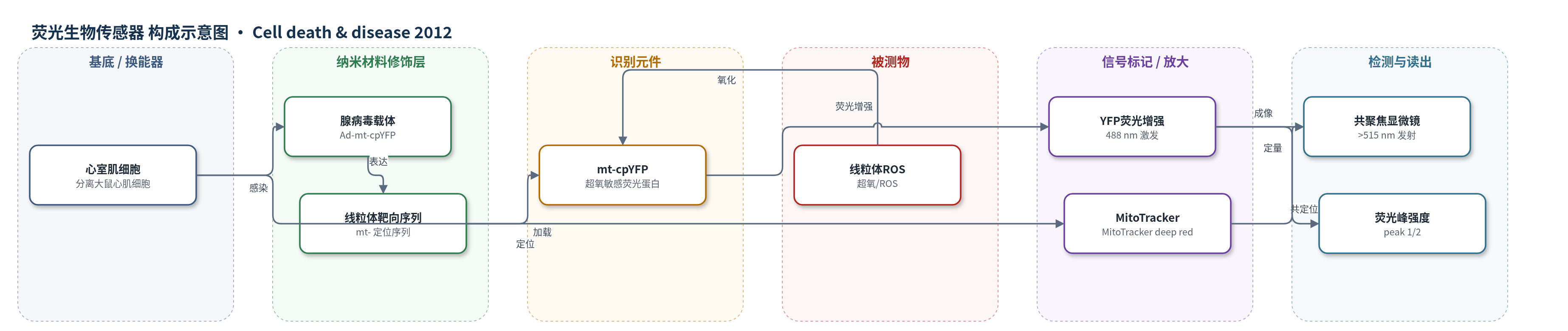
点击图片查看大图 · 依据论文自动绘制
传感器类型
荧光生物传感器
检测对象
线粒体活性氧(mitochondrial ROS,超氧 superoxide);样品基质:分离大鼠心室肌细胞(isolated rat ventricular myocytes)。
检测原理
该检测基于线粒体靶向超氧敏感荧光蛋白 mt-cpYFP。腺病毒将 mt-cpYFP 编码序列导入分离大鼠心室肌细胞,mt- 靶向序列使传感器定位于线粒体。当线粒体产生超氧/ROS 时,mt-cpYFP 发生氧化响应,YFP 荧光增强;ROS 水平下降后荧光回落。低温预处理(16°C、2 min)诱导线粒体呼吸状态改变并短暂升高 ROS,使传感器荧光出现可逆峰。共聚焦显微镜以 488 nm 激发、>515 nm 长通滤片采集荧光,峰强度随线粒体 ROS 产生量增加而升高。加入 ROS 清除剂 MPG 可降低荧光峰,证明信号来自 ROS 而非温度本身。该传感器无电极换能,属于细胞内荧光换能,信号放大主要依赖荧光蛋白氧化响应与显微镜成像,不涉及 HCR、RCA 或 CRISPR-Cas 等体外放大。
检测灵敏度
原文未报告 LOD、线性范围、灵敏度斜率或相关系数。
效应效果
该 mt-cpYFP 生物传感器在分离大鼠心室肌细胞中经腺病毒转染 48 h 后表达,感染效率约 70%。外源 ROS 供体黄嘌呤/黄嘌呤氧化酶可诱导荧光升高,验证传感器对 ROS 的响应。低温预处理期间,对照组两次低温峰荧光分别为 1020±136.5 和 1190±143.9 任意单位;MPG 处理后降至 510.4±167.3 和 217.2±98.58,说明信号具有 ROS 依赖性。MitoTracker deep red 共定位确认传感器位于线粒体。实验在 3 只大鼠、每组 18–19 个细胞重复,未报告 RSD、LOD 或线性范围。作者主张该传感器可用于实时监测低温预处理中线粒体 ROS 释放,并揭示 ROS-ERK1/2-mPTP 心肌保护信号轴。
传感器的构成
- 样品基底:分离大鼠心室肌细胞(isolated rat ventricular myocytes),作为传感器表达与检测的细胞基质。
- 递送/表达载体:腺病毒(adenovirus, Ad-mt-cpYFP),携带 mt-cpYFP 编码 DNA,感染心肌细胞 48 h 实现表达。
- 定位元件:线粒体靶向序列(mitochondrial targeting sequence, mt-),将 mt-cpYFP 导向线粒体。
- 识别/传感元件:mt-cpYFP 超氧敏感荧光蛋白(mitochondrially targeted cpYFP superoxide biosensor),响应线粒体 ROS/超氧。
- 信号标记物:YFP 荧光(yellow fluorescent protein fluorescence),ROS 氧化后荧光增强。
- 验证标记物:MitoTracker deep red,共定位确认 mt-cpYFP 位于线粒体。
- 读出系统:共聚焦显微镜(Olympus IX70 confocal microscope),488 nm 激发、>515 nm 长通滤片采集。
中文摘要
低温和低温预处理具有显著心肌保护作用,但其分子机制尚未完全阐明。本研究在分离成年大鼠心室肌细胞中发现,16°C 温度预处理可增强氧化应激后收缩功能恢复并防止钙稳态紊乱。低温预处理通过延迟线粒体通透性转换孔(mPTP)的病理性开放而维持线粒体功能,但短暂 mPTP 闪烁未改变。作者首次证明线粒体活性氧(ROS)仅在温度预处理的低温阶段释放。利用线粒体靶向 ROS 生物传感器,观察到短暂降至 16°C 时 ROS 释放增加。ROS 清除剂 N-(2-巯基丙酰)甘氨酸(MPG)降低温度预处理期间 ROS 积累,并消除 mPTP 开放延迟的保护效应。温度预处理诱导 ROS 依赖的促存活激酶细胞外调节激酶(ERK)1/2 磷酸化;ROS 清除剂可完全阻断 ERK1/2 激活,说明 ERK1/2 位于 ROS 释放下游。抑制 ERK1/2 激活则完全消除低温预处理对 mPTP 开放的保护。因此,线粒体 ROS 释放和 ERK1/2 激活是低温预处理诱导心肌细胞保护所必需的信号事件。
英文摘要
Hypothermia and hypothermic preconditioning are known to be profoundly cardioprotective, but the molecular mechanisms of this protection have not been fully explained. In this study, temperature preconditioning (16 °C) was found to be cardioprotective in isolated adult rat ventricular myocytes, enhancing contractile recovery and preventing calcium dysregulation after oxidative stress. Hypothermic preconditioning preserved mitochondrial function by delaying the pathological opening of the mitochondrial permeability transition pore (mPTP), whereas transient mPTP flickering remained unaltered. For the first time, reactive oxygen species (ROS) from the mitochondria are shown to be released exclusively during the hypothermic episodes of the temperature-preconditioning protocol. Using a mitochondrially targeted ROS biosensor, ROS release was shown during the brief bursts to 16 °C of temperature preconditioning. The ROS scavenger N-(2-mercaptopropionyl) glycine attenuated ROS accumulation during temperature preconditioning, abolishing the protective delay in mPTP opening. Temperature preconditioning induces ROS-dependant phosphorylation of the prosurvival kinase extracellular signal-regulated kinase (ERK)1/2. ERK1/2 activation was shown to be downstream of ROS release, as the presence of a ROS scavenger during temperature preconditioning completely blocked ERK1/2 activation. The cardioprotective effects of temperature preconditioning on mPTP opening were completely lost by inhibiting ERK1/2 activation. Thus, mitochondrial ROS release and ERK1/2 activation are both necessary to signal the cardioprotective effects of temperature preconditioning in cardiac myocytes.