组成图示
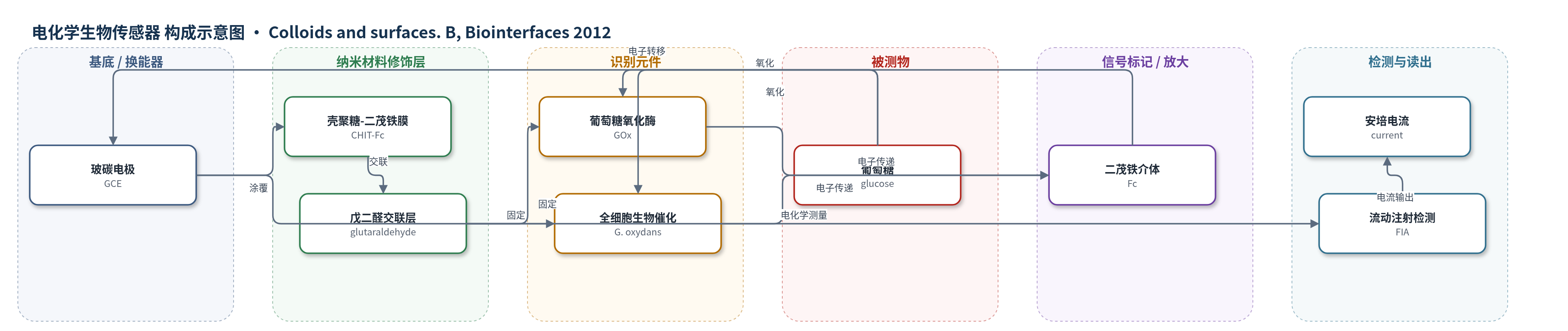
点击图片查看大图 · 依据论文自动绘制
传感器类型
电化学生物传感器
检测对象
葡萄糖(glucose,D-glucose);样品基质为缓冲液标准品及可乐、樱桃汁等饮料样品
检测原理
葡萄糖进入 CHIT–Fc 修饰电极后,被 GOx 或 G. oxydans 膜结合 PQQ 依赖葡萄糖脱氢酶(GDH)氧化为葡萄糖内酯,同时生物催化剂辅因子被还原。还原型辅因子将电子传递给 CHIT–Fc 中的氧化型二茂铁(Fc),再生催化剂;Fc 在玻碳电极表面发生可逆氧化还原,在 +0.35 V(vs. Ag/AgCl)下产生与葡萄糖浓度成正比的安培电流。共价结合 Fc 的壳聚糖膜既防止介体泄漏,又提供电子传递通道和生物相容微环境。FIA 系统以缓冲液为载液连续流动,样品注入后酶传感器约 20 s、全细胞传感器约 70 s 达到稳态,实现快速定量。
检测灵敏度
LOD: 0.565 mM (S/N = 3);线性范围: 2.0–16.0 mM(GOx);LOD: 0.797 mM (S/N = 3);线性范围: 1.5–25.0 mM(G. oxydans)
效应效果
GOx 传感器对 8.0 mM 葡萄糖连续 10 次注入 CV 为 4.3%,7.2 h 内 208 次注入后活性损失 13%,4 ℃ 保存 14 d 保留 82%;可乐和樱桃汁中葡萄糖分别为 5.99±0.38、4.25±0.21 g/100 mL,回收率 110% 和 97%,与商品酶法试剂盒结果相近。全细胞传感器 10 次注入 CV 为 4.8%,3 h 内 72 次注入后保留 85%,线性上限 25.0 mM 高于多种报道体系。FIA 模式具有自动化、高通量和低成本优势。
传感器的构成
- 基底/工作电极:玻碳电极(GCE),抛光清洗后作为电子换能基底
- 修饰层:壳聚糖–二茂铁(CHIT–Fc)杂化膜,由 1.0 wt.% CHIT–Fc 醋酸溶液涂覆,提供生物相容固定化基质和氧化还原介导
- 交联层:戊二醛(glutaraldehyde,1.0%),交联 CHIT–Fc 与生物催化剂,防止酶和细胞泄漏
- 识别/生物催化元件:葡萄糖氧化酶(GOx,125 U 或 2.5 mg),催化葡萄糖氧化
- 识别/生物催化元件:Gluconobacter oxydans 全细胞(细胞计数 2.72×10^9),膜结合 PQQ 依赖葡萄糖脱氢酶催化葡萄糖氧化
- 信号介体:二茂铁(Fc),共价结合于 CHIT–Fc,介导生物催化剂与电极间电子传递
- 参比电极:Ag/AgCl 电极,提供稳定电位参考
- 对电极:铂电极/铂丝(Pt),完成电化学回路
- 检测池:交叉流池(cross-flow cell)与流动注射分析(FIA)系统,实现样品注入和安培信号读出
中文摘要
本文通过共价修饰合成壳聚糖–二茂铁(CHIT–Fc)杂化材料,并用循环伏安法研究了其固定化状态下的电化学性质。该杂化膜在 pH 5.5 下呈现可逆氧化还原行为,形式电位为 +0.35 V(vs. Ag/AgCl),二茂铁(Fc)在壳聚糖基质中保持电催化活性且不发生泄漏。进一步以该氧化还原活性杂化膜为支撑,通过戊二醛交联将葡萄糖氧化酶(GOx)和 Gluconobacter oxydans 全细胞固定在玻碳电极(GCE)表面,构建酶生物传感器和微生物生物传感器,并在流动注射分析(FIA)系统中优化条件、评价其对葡萄糖的分析性能。优化条件下,GOx 传感器和全细胞传感器对葡萄糖的线性范围分别为 2.0–16.0 mM 和 1.5–25.0 mM,且响应较快、重现性和稳定性良好。结果表明,CHIT–Fc 既能提供生物相容微环境,又能作为电子传递路径,可用作生物分子固定化基质,适用于低成本、自动化和高通量分析。
英文摘要
Chitosan-ferrocene (CHIT-Fc) hybrid was synthesized through covalent modification and its electrochemical properties in immobilized form were studied by using cyclic voltammetry. The hybrid film exhibited reversible electrochemistry with a formal potential of +0.35 V (vs. Ag/AgCl) at pH 5.5. The Fc in CHIT matrix retained its electrocatalytic activity and did not diffuse from the matrix. This redox-active hybrid was further employed as a support for immobilization of glucose oxidase (GOx) and whole cells of Gluconobacter oxydans using glutaraldehyde on a glassy carbon electrode (GCE). The experimental conditions were optimized and the analytical characteristics of enzyme and microbial biosensors were evaluated for glucose in flow injection analysis (FIA) system. Under optimized conditions, both enzyme and microbial biosensors exhibited wide linear ranges for glucose from 2.0 to 16.0 mM and from 1.5 to 25.0 mM, respectively. Moreover, the biosensors have the advantages of relatively fast response times, good reproducibility and stability in FI mode. It was demonstrated that CHIT-Fc provides a biocompatible microenvironment for both bioctalysts and an electron transfer pathway. Additionally, integration of the enzyme and microbial biosensors into the FIA system has several advantages including capability of automation and high throughput at low cost. This promising redox hybrid can be utilized as an immobilization matrix for biomolecules in biosensor systems.