组成图示
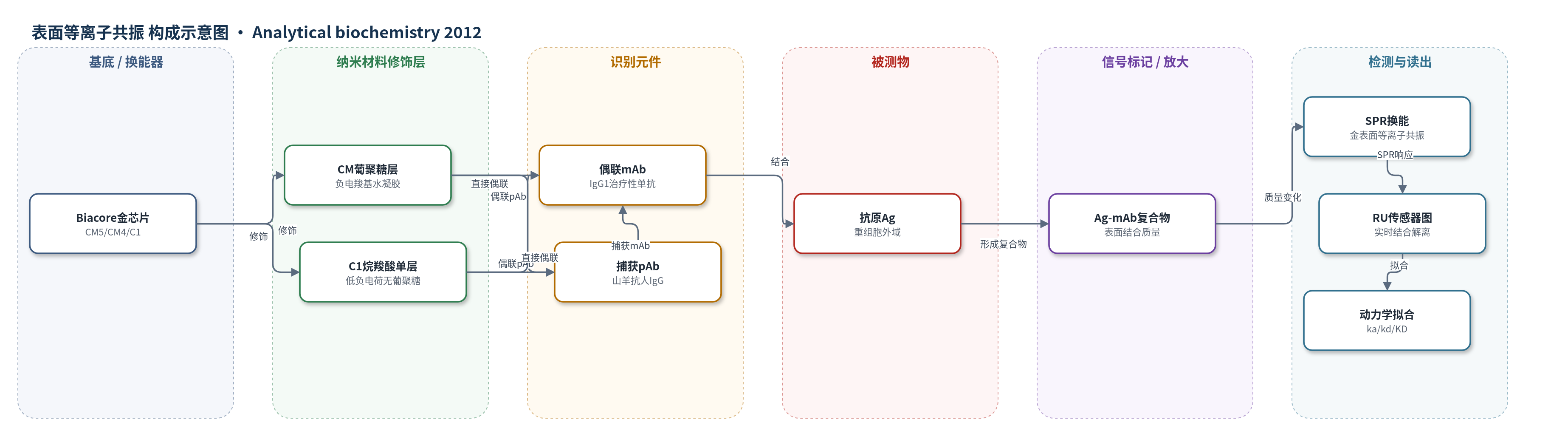
点击图片查看大图 · 依据论文自动绘制
传感器类型
表面等离子共振(SPR)生物传感器
检测对象
抗原(antigen, Ag,重组胞外域);样品基质:HBS-P缓冲液(含100 μg/mL BSA、0.02%叠氮化钠)
检测原理
Biacore SPR传感器将治疗性mAb通过EDC/NHS胺键合或醛键合固定于CM5/CM4羧甲基葡聚糖层,或固定于C1巯基烷羧酸单层;也可先用山羊抗人IgG pAb捕获mAb。抗原溶液流过表面后,mAb与Ag特异性结合,表面结合质量增加,引起金表面SPR共振条件变化,以RU实时记录结合与解离。不同Ag浓度产生不同Rmax和结合/解离曲线,经1:1双分子模型全局拟合得到ka、kd和KD。CM-dextran负电羧基可与高pI mAb静电吸引造成位阻,或与负电Ag静电排斥,降低表观ka并使KD偏离溶液相真实值;降低表面负电荷或采用溶液相KinExA/Biacore可校正。
检测灵敏度
未报告LOD、线性范围、灵敏度斜率、相关系数
效应效果
研究完成53项Biacore和KinExA实验,显示Biacore结果依赖芯片负电荷:CM5胺键合KD 1970 pM,CM4胺键合664 pM,C1胺键合186 pM;溶液相Biacore KD 91.9 pM,KinExA标准KD 22.1 pM,加可溶CM-dextran后60.1 pM。ka由CM5的1.13×10^5 M^-1 s^-1升至C1的1.02×10^6 M^-1 s^-1,接近KinExA的3.31×10^6 M^-1 s^-1;kd各芯片RSD约21%。mAb活性CM5胺键合0.8%,C1捕获62%。作者提出用CM5/CM4/C1趋势、溶液相与表面法比较、KinExA与Biacore比较识别基质假象。
传感器的构成
- 换能基底:Biacore金表面芯片(CM5/CM4/C1),提供SPR换能表面并承载表面化学
- 表面修饰层:CM5/CM4羧甲基葡聚糖(CM-dextran)水凝胶层,含负电羧基用于EDC/NHS偶联;C1为巯基烷羧酸自组装单层,低负电荷且无葡聚糖
- 偶联/封闭层:EDC/NHS活化羧基,乙醇胺(ethanolamine)封闭未反应羧基,用于固定识别元件
- 识别元件:治疗性人源IgG1单克隆抗体(mAb)共价胺键合或醛键合,作为抗原结合探针
- 捕获抗体层:山羊抗人IgG多克隆抗体(pAb)胺键合于芯片,用于捕获mAb
- 再生清洗层:10 mM glycine(pH 2.0)再生共价mAb表面;146 mM phosphoric acid再生捕获表面
- 信号标记物:无外源标记,SPR质量响应以共振单位(RU)读出
中文摘要
为表征一种专有治疗性单克隆抗体(mAb)候选药物,作者对其与靶抗原的结合开展了包含53项Biacore和动力学排除法(KinExA)实验的严格生物物理研究。出乎意料的是,观察到的结合动力学随所用芯片类型变化,提示CM5、CM4和C1芯片上的负电羧基对Biacore动力学结果产生不利影响。为检验该假设,作者进行了Biacore溶液相和KinExA平衡滴定以及KinExA动力学测量,以建立抗原与mAb结合反应的准确亲和力和动力学速率常数。结果显示,随着生物传感器表面负电荷降低,测得的结合动力学和解离常数KD更接近溶液相测得的准确参数。造成Biacore表面测量假象的两种可能原因是:(i)负电羧甲基葡聚糖基质与高碱性mAb(pI 9.4)相互作用导致抗原结合的空间位阻;(ii)负电抗原与羧甲基葡聚糖基质之间的静电排斥。重要的是,可在测量早期进行简单诊断试验以识别此类基质介导的假象。
英文摘要
To characterize a proprietary therapeutic monoclonal antibody (mAb) candidate, a rigorous biophysical study consisting of 53 Biacore and kinetic exclusion assay (KinExA) experiments was undertaken on the therapeutic mAb complexing with its target antigen. Unexpectedly, the observed binding kinetics depended on the chip used, suggesting that the negatively charged carboxyl groups on CM5, CM4, and C1 chips were adversely affecting the Biacore kinetic results. To study this hypothesis, Biacore solution-phase and KinExA equilibrium titrations, as well as KinExA kinetic measurements, were performed to establish accurate values for the affinity and kinetic rate constants of the binding reaction between antigen and mAb. The results revealed that as the negative charge on the biosensor surface decreased, the binding kinetics and K(D) approached the accurate binding parameters more closely when measured in solution. Two potential causes for the artifactual Biacore surface-based measurements are (i) steric hindrance of antigen binding arising from an interaction of the negatively charged carboxymethyldextran matrix with the mAb, which is a highly basic protein with a pI of 9.4, and (ii) an electrostatic repulsion between the negatively charged antigen and the carboxymethyldextran matrix. Importantly, simple diagnostic tests can be performed early in the measurement process to identify these types of matrix-mediated artifacts.