组成图示
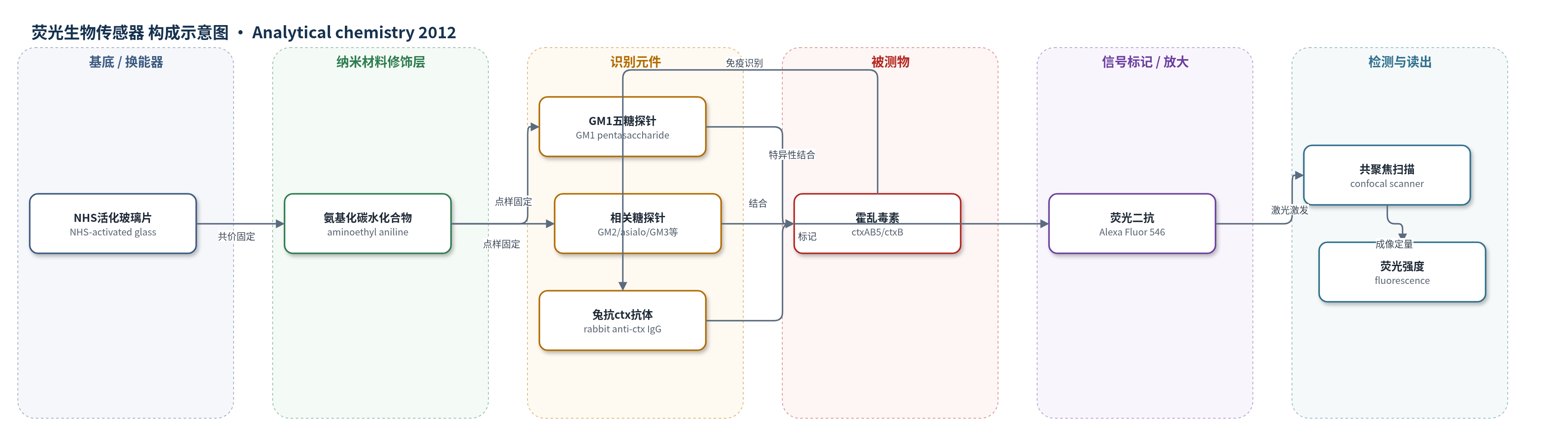
点击图片查看大图 · 依据论文自动绘制
传感器类型
荧光生物传感器
检测对象
霍乱毒素(cholera toxin, ctx;ctxAB5、ctxB),样品基质:霍乱弧菌培养上清(V. cholerae culture supernatant)
检测原理
碳水化合物经 4-(2-aminoethyl)aniline 修饰引入氨基,再通过 NHS 酯与玻璃片表面共价固定,形成多价碳水化合物微阵列。ctx 的 B 亚基识别 GM1 五糖等碳水化合物,ctxAB5 五聚体通过多价结合增强界面结合。结合事件后,兔抗 ctx IgG 识别 ctx,Alexa Fluor 546 标记山羊抗兔 IgG 进一步结合,形成免疫荧光复合物。ctx 浓度越高,表面捕获量越多,荧光强度越强;10–200 ng/mL 呈线性,>1 μg/mL 饱和。信号放大主要来自多价碳水化合物-毒素结合与二级免疫荧光标记。
检测灵敏度
LOD: 2 ng mL−1 (23 pM);视觉检出限: 5 ng mL−1 (≈58 pM);动态分析范围: 5 ng mL−1–1 μg mL−1;线性范围: 10–200 ng mL−1
效应效果
该微阵列对 ctx 的识别具有明显选择性,ctxB 与 ctxAB5 均表现为 GM1 五糖≫GM2 四糖>去唾液酸 GM1 四糖≥GM3 三糖;ctxAB5 对 GM1 的结合亲和力约为 ctxB 的 5 倍,且底物特异性更严格。GM2 点可视觉检出至 750 ng/mL ctxAB5,其他类似物需 >5 μg/mL。固定 GM1 密度约 250–500 μM 时灵敏度最佳。未经浓缩的培养上清直接检测约 3 h 可检出实际毒素,对副溶血弧菌和金黄色葡萄球菌培养上清无交叉反应。LOD 2 ng/mL 与高灵敏脂质体方法相当,优于单糖微阵列和双糖比色法。作者认为可发展为毒素检测生物传感器。
传感器的构成
- 基底:NHS-activated glass slides(NHS 活化玻璃片),提供表面活化位点用于碳水化合物共价固定
- 识别元件:GM1 pentasaccharide(GM1 五糖)及 GM2、asialo GM1、GM3、Galβ(1→3)GalNAc、lactose、Neu5Ac 等碳水化合物探针,经 4-(2-aminoethyl)aniline 引入氨基后固定,用于捕获 ctx
- 封闭剂:50 mM ethanolamine in 50 mM sodium borate buffer(pH 8.0),灭活剩余官能团并阻断非特异性结合
- 识别抗体:rabbit polyclonal anti-ctx IgG(兔抗 ctx IgG,50 μg/mL),识别结合在碳水化合物上的 ctx
- 信号标记物:Alexa Fluor 546-conjugated goat anti-rabbit IgG(Alexa Fluor 546 标记山羊抗兔 IgG,50 μg/mL),产生荧光信号
- 清洗缓冲液:washing buffer I/II(PBS 含 Tween 20 或 PBS),去除未结合抗体与杂质
- 读出装置:commercial confocal laser scanner(GSI Lumonics 共聚焦激光扫描仪),采集荧光图像并定量强度
中文摘要
为理解病原菌感染机制,本文开发了一种功能碳水化合物微阵列并结合荧光免疫分析,用于分析霍乱弧菌毒素(ctx)蛋白与 GM1 相关碳水化合物之间的相互作用。将 ctx 蛋白加载到表面固定的 GM1 五糖及六种相关碳水化合物上,通过免疫学方法检测其结合亲和力。结果显示,ctx 的固有选择性为 GM1 五糖≫GM2 四糖>去唾液酸 GM1 四糖≥GM3 三糖,说明“两指握持”构象和末端单糖在 ctx-GM1 相互作用中起重要作用。完整霍乱毒素 ctxAB5 相比 ctxB 具有更严格的底物特异性和更强的结合亲和力。定量分析表明,该碳水化合物微阵列检测 ctxAB5-GM1 相互作用的检出限为 2 ng/mL(23 pM),与其他高灵敏度检测工具相当。此外,该微阵列能直接检测霍乱弧菌分泌的实际毒素,且未显示对其他细菌的交叉反应。结果表明,功能碳水化合物微阵列适合分析毒素蛋白-碳水化合物相互作用,并可作为毒素检测生物传感器。
英文摘要
The development of analytical tools is important for understanding the infection mechanisms of pathogenic bacteria or viruses. In the present work, a functional carbohydrate microarray combined with a fluorescence immunoassay was developed to analyze the interactions of Vibrio cholerae toxin (ctx) proteins and GM1-related carbohydrates. Ctx proteins were loaded onto the surface-immobilized GM1 pentasaccharide and six related carbohydrates, and their binding affinities were detected immunologically. The analysis of the ctx-carbohydrate interactions revealed that the intrinsic selectivity of ctx was GM1 pentasaccharide ≫ GM2 tetrasaccharide > asialo GM1 tetrasaccharide ≥ GM3trisaccharide, indicating that a two-finger grip formation and the terminal monosaccharides play important roles in the ctx-GM1 interaction. In addition, whole cholera toxin (ctxAB(5)) had a stricter substrate specificity and a stronger binding affinity than only the cholera toxin B subunit (ctxB). On the basis of the quantitative analysis, the carbohydrate microarray showed the sensitivity of detection of the ctxAB(5)-GM1 interaction with a limit-of-detection (LOD) of 2 ng mL(-1) (23 pM), which is comparable to other reported high sensitivity assay tools. In addition, the carbohydrate microarray successfully detected the actual toxin directly secreted from V. cholerae, without showing cross-reactivity to other bacteria. Collectively, these results demonstrate that the functional carbohydrate microarray is suitable for analyzing toxin protein-carbohydrate interactions and can be applied as a biosensor for toxin detection.