组成图示
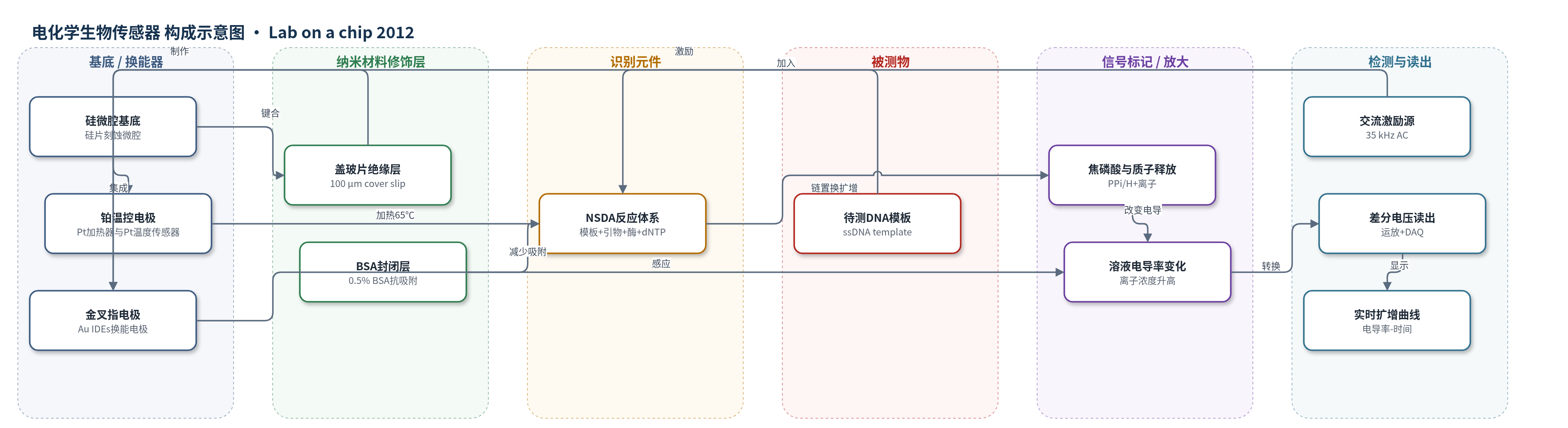
点击图片查看大图 · 依据论文自动绘制
传感器类型
电化学生物传感器
检测对象
DNA(DNA,含纯DNA ladder、ssDNA模板及NSDA扩增产物);样品基质:NSDA等温扩增反应液/水溶液/微腔反应体系
检测原理
该传感器采用电容耦合无接触电导率检测。金叉指电极(Au IDEs)与反应液之间由盖玻片绝缘,形成壁电容Cw;交流激励下,溶液电导率变化引起电极间阻抗/电容变化,经运放转换为差分电压。NSDA中,ssDNA模板与引物杂交,Nb.BsmI在识别位点切割,Bst DNA聚合酶延伸并置换原链,识别位点再生,实现指数扩增。每次dNTP掺入释放焦磷酸根(PPi)和H+,使离子浓度升高、电导率增大;产物积累增加黏度,后期部分抵消。模板/产物越多,离子产生越多,信号越大。海藻糖保护酶活性,BSA减少壁吸附,提高信噪比。
检测灵敏度
LOD: 0.1 pg ml-1;可区分范围: 0.1 pg ml-1–0.5 pg ml-1;>1 ng ml-1 时达到最大电导并恒定;响应与DNA浓度对数正相关。
效应效果
系统无接触电极避免溶液直接接触,抗干扰、抗污染能力强,电极不易腐蚀,寿命长、可重复使用且成本低。IDE结构比单指电极灵敏度更高。在初始模板浓度2.5 nM(原文抽取显示2.5 mM,按上下文应为nM)下,7 min内完成NSDA扩增与EC检测;无海藻糖时差分电压约90 mV,加入海藻糖后最大差分电压升至300 mV,BSA封闭60 min后达500 mV。凝胶电泳确认100–200 bp预期产物,并出现少量<100 bp引物二聚体。该方法无需探针/标记,但尚不能区分不同序列,需结合特异性引物/探针;作者认为适合现场、即时检测及分子诊断、环境、食品等领域。
传感器的构成
- 基底/微腔层:双面抛光氧化硅片(silicon wafer),经HF和KOH刻蚀形成微腔,容纳NSDA反应液
- 温控层:铂(Pt)加热器与铂(Pt)温度传感器,位于硅片背面,用于65 ℃等温扩增和温度反馈
- 绝缘层:100 μm盖玻片(cover slip),作为介电绝缘层,隔离电极与溶液并形成电容耦合
- 换能电极层:金叉指电极(Au IDEs),lift-off制作于盖玻片上,无接触感应溶液电导率/电容变化
- 封闭层:0.5%牛血清白蛋白(BSA)预处理微腔壁,减少酶和反应组分吸附
- 识别/扩增层:NSDA反应体系,含ssDNA模板、F1/F2与R1/R2引物、Nb.BsmI切割内切酶、Bst DNA聚合酶、dNTP、NEBuffer 3及海藻糖(trehalose)
- 信号标记层:无标记(label-free),dNTP掺入释放焦磷酸根(PPi)和H+作为电导信号源
- 读出电路:Agilent交流激励源、运算放大器(1 MΩ反馈电阻)、数据采集卡(DAQ)与LabVIEW温控/数据处理软件
中文摘要
本文报道了一种无接触电导率检测系统的设计与实现,该系统由温控单元、数据处理系统和电化学(EC)池组成,用于无标记等温核酸扩增及其实时监测。EC池由微腔和叉指电极(IDE)构成无接触电导率生物传感器,并以盖玻片作为绝缘层。文中研究了无接触EC测量、海藻糖对扩增的影响以及芯片表面处理。凭借该生物传感器的优异性能,器件可检测低于0.1 pg/mL的纯DNA。集成加热器和温度传感器的EC池成功实现了基于切割的链置换扩增(NSDA),初始浓度为2.5 nM(原文抽取显示2.5 mM,按上下文应为nM),扩增产物无需探针或标记即可在线直接监测。该无接触检测器具有高抗干扰能力、长寿命、高可重复使用性和低成本等优点。此外,检测池体积小、功耗低、便携,使系统具有高度集成潜力,可用于现场服务和即时检测应用。
英文摘要
This paper reports the design and implementation of a contactless conductivity detection system which combines a thermal control cell, a data processing system and an electrochemical (EC) cell for label-free isothermal nucleic acid amplification and real-time monitoring. The EC cell consists of a microchamber and interdigitated electrodes as the contactless conductivity biosensor with a cover slip as insulation. In our work, contactless EC measurements, the effects of trehalose on amplification, and chip surface treatment are investigated. With the superior performance of the biosensor, the device can detect the amount of pure DNA at concentrations less than 0.1 pg μl(-1). The EC cell, integrated with a heater and a temperature sensor, has successfully implemented nicking-based strand-displacement amplification at an initial concentration of 2.5 μM and the yields are monitored directly (dismissing the use of probes or labels) on-line. This contactless detector carries important advantages: high anti-interference capability, long detector life, high reusability and low cost. In addition, the small size, low power consumption and portability of the detection cell give the system the potential to be highly integrated for use in field service and point of care applications.