组成图示
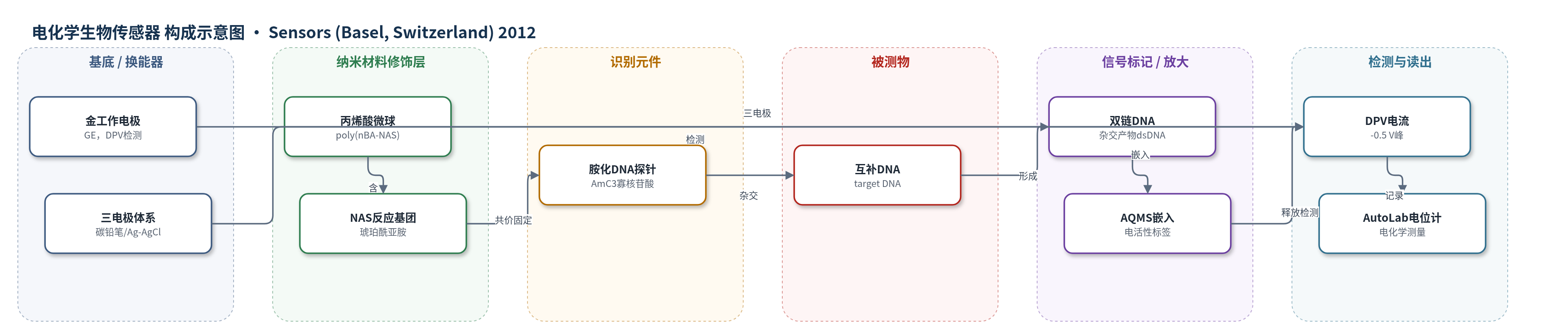
点击图片查看大图 · 依据论文自动绘制
传感器类型
电化学生物传感器
检测对象
互补 DNA(complementary DNA / target DNA),样品基质为磷酸盐缓冲液(0.05 M K-phosphate pH 7.0 或 0.25 M Na-phosphate pH 7.5 含 NaCl)
检测原理
NAS 修饰丙烯酸微球中的琥珀酰亚胺基团与胺化 DNA 探针的氨基共价结合,使探针固定于三维微球表面。加入互补目标 DNA 后,探针与目标 DNA 杂交形成双链 DNA(dsDNA)。AQMS 作为电活性嵌入剂插入 dsDNA 碱基对之间,其量随杂交程度增加。随后通过超声使杂交 DNA 从微球上脱落并释放 AQMS 到溶液中,金电极以差分脉冲伏安法(DPV)在约 −0.5 V 处检测 AQMS 的氧化还原峰。目标 DNA 浓度越高,形成的 dsDNA 和嵌入 AQMS 越多,释放后 DPV 峰电流越大。微球的大表面积提高探针负载,AQMS 嵌入与超声释放构成信号放大。
检测灵敏度
LOD: 9.46 × 10⁻¹⁷ M;线性范围: 1.0 × 10⁻¹⁶–1.0 × 10⁻⁸ M;R^2 = 0.97;图10(b) 拟合: y = 4.5341x + 74.636, R² = 0.9814;灵敏度斜率: 4.5341 nA/log µM(图10b)
效应效果
该传感器对互补 DNA 具有选择性,非互补 DNA、无 DNA 和空白微球体系中 AQMS 电流很小,表明 AQMS 非特异性吸附可忽略。优化条件为 pH 7.5、Na+ 离子、0.25 M Na-phosphate 缓冲液、2.0 M 离子强度、25 °C 杂交 30 min。重现性良好,RSD 为 2.84%(摘要)或 2.86%(结果,n=3)。与巯基修饰金电极自组装 DNA 探针传感器(线性 5.0×10⁻¹⁰–1.0×10⁻⁶ M,LOD 10−12 M)相比,本文线性范围更宽、检出限更低;作者认为其 LOD 至少比基于纳米材料膜或其他微球基质的 DNA 生物传感器低 1000 倍,适用于 fM 级 DNA 杂交检测。
传感器的构成
- 换能器电极:金电极(GE)作工作电极,碳铅笔作对电极,Ag/AgCl 作参比电极,用于差分脉冲伏安法(DPV)检测
- 微球基质:聚(正丁基丙烯酸酯-N-丙烯酰琥珀酰亚胺)微球(poly(nBA-NAS)),由 nBA、NAS、HDDA、DMPP 和 SDS 乳液光聚合制备,作为三维 DNA 固定载体
- 反应基团层:N-丙烯酰琥珀酰亚胺(NAS)官能团,与胺化 DNA 探针的氨基形成共价键
- 识别元件:胺化 DNA 探针(5’ GGGGCAGAGCCTCACAACCT,AmC3),共价固定于微球并保留互补杂交端
- 信号标记物:蒽醌-2-磺酸一水合物钠盐(AQMS),嵌入互补 DNA 杂交形成的双链 DNA(dsDNA),作为电活性杂交标签
- 检测介质:0.05 M K-phosphate buffer(pH 7.0)用于 DPV 扫描;杂交优化条件为 0.25 M Na-phosphate(pH 7.5)和 2.0 M NaCl
中文摘要
本文基于新型含反应性 N-丙烯酰琥珀酰亚胺(NAS)官能团的丙烯酸微球构建了一种用于 DNA 的电化学微生物传感器。采用简单的一步乳液光聚合技术合成了疏水性聚(正丁基丙烯酸酯-N-丙烯酰琥珀酰亚胺)微球。胺化 DNA 探针通过共价键连接到丙烯酸微球的琥珀酰亚胺官能团上。采用蒽醌-2-磺酸一水合物钠盐(AQMS)作为电活性杂交标签,通过差分脉冲伏安法研究固定化 DNA 探针与互补 DNA 的杂交。评估了 DNA 探针固定化与杂交时间、pH、离子种类、缓冲液浓度、离子强度、操作温度以及非互补 DNA 对传感器性能的影响。在优化条件下,该 DNA 微生物传感器对目标 DNA 在 1.0×10⁻¹⁶ 至 1.0×10⁻⁸ M 的宽浓度范围内呈线性响应,检出限(LOD)为 9.46×10⁻¹⁷ M(R²=0.97)。该传感器重现性良好,相对标准偏差(RSD)为 2.84%(n=3)。与其他使用纳米材料膜或微球作为 DNA 固定基质的 DNA 生物传感器相比,NAS 修饰丙烯酸微球提高了所构建 DNA 微生物传感器的整体分析性能。
英文摘要
An electrochemical microbiosensor for DNA has been fabricated based on new acrylic microspheres modified with reactive N-acryloxysuccinimide (NAS) functional groups. Hydrophobic poly(n-butylacrylate-N-acryloxysuccinimide) microspheres were synthesized in an emulsion form with a simple one-step photopolymerization technique. Aminated DNA probe was attached to the succinimde functional group of the acrylic microspheres via covalent bonding. The hybridization of the immobilized DNA probe with the complementary DNA was studied by differential pulse voltametry using anthraquninone-2-sulfonic acid monohydrate sodium salt (AQMS) as the electroactive hybridization label. The influences of many factors such as duration of DNA probe immobilization and hybridization, pH, type of ions, buffer concentrations, ionic strength, operational temperature and non-complementary DNA on the biosensor performance were evaluated. Under optimized conditions, the DNA microbiosensor demonstrated a linear response range to target DNA over a wide concentration range of 1.0 × 10(-16) and 1.0 × 10(-8) M with a lower limit of detection (LOD) of 9.46 × 10(-17) M (R(2) = 0.97). This DNA microbiosensor showed good reproducibility with 2.84% RSD (relative standard deviation) (n = 3). Application of the NAS-modified acrylic microspheres in the construction of DNA microbiosensor had improved the overall analytical performance of the resultant DNA microbiosensor when compared with other reported DNA biosensors using other nano-materials for membranes and microspheres as DNA immobilization matrices.