组成图示
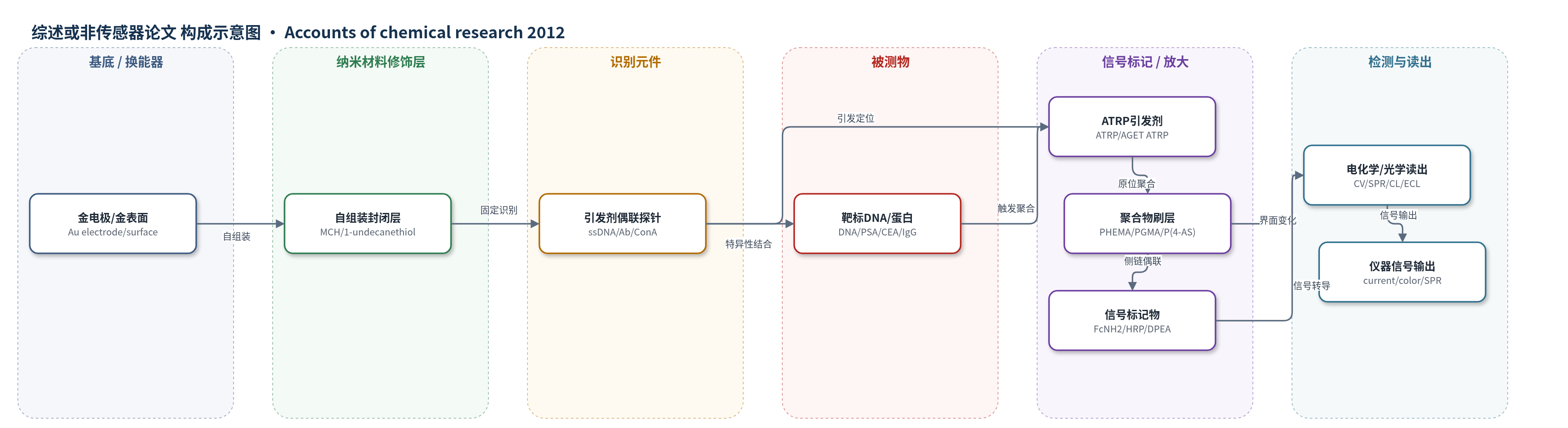
点击图片查看大图 · 依据论文自动绘制
传感器类型
综述或非传感器论文
检测对象
靶标DNA(target DNA,缓冲液/溶液)、卵白蛋白(ovalbumin,缓冲液/表面)、癌胚抗原(CEA,人血清)、前列腺特异性抗原(PSA,人血清)、免疫球蛋白G(IgG,溶液)、霍乱毒素(cholera toxin, CT,表面/缓冲液)
检测原理
小分子ATRP引发剂预先偶联到ssDNA探针、抗体或糖蛋白识别元件。靶标DNA杂交或免疫/糖蛋白识别后,引发剂定位到结合位点,ATRP/AGET ATRP原位聚合HEMA、GMA或4-乙酰氧基苯乙烯,形成PHEMA/PGMA或4-乙酰氧基苯乙烯聚合物刷,使数十至数百单体局部富集。聚合物改变反射率、颜色或SPR响应,并提供羟基/环氧/酚羟基位点,偶联FcNH2、HRP或DPEA。FcNH2氧化还原电流、HRP催化CL/电催化、DPEA/Ru(bpy)3^2+ ECL或酪氨酸酶氧化酚羟基产生的电化学信号随靶标浓度增加。AGET ATRP经Cu(II)/Cu(I)循环耗氧,提高空气耐受。
检测灵敏度
DNA(电化学/FcNH2): 线性范围 0.1–1000 nM;LOD 15 pM;峰电流与DNA浓度对数在5个数量级内成正比,约30 amol可检出。卵白蛋白(电化学/FcNH2): 线性范围 0.1–500 ng/mL;LOD 0.07 pg/mL。CEA(电化学/FcNH2): 线性范围 0.0005–40 ng/mL;LOD 0.1 pg/mL。PSA(电化学/FcNH2): 线性范围 0.001–40 ng/mL;LOD 0.14 pg/mL。PSA(HRP/CL-电化学): 线性范围 0.005–20 ng/mL;LOD 1.3 pg/mL。CEA(DPEA/ECL): 线性范围 0.001–1000 ng/mL;LOD 0.5 pg/mL。IgG(比色/GNP): 线性范围 0.5–25 ng/mL;LOD 0.03 ng/mL。CT(SPR): 表面覆盖范围 8.23×10^-15–3.61×10^-12 mol/cm2;LOD 6.27×10^-15 mol/cm2。DNA(可视化ATRP): 检出限 1 fmol;光引发聚合约10 zmol可见。
效应效果
选择性来自DNA杂交或免疫识别,小引发剂干扰小;聚合物空间稳定化减少假阴性。电化学DNA信号在5个数量级内与浓度对数成正比,约30 amol可检出;可视化DNA LOD 1 fmol,光引发约10 zmol可见。卵白蛋白信号提高7倍;PSA-HRP法CL和电催化电流分别提高13、14倍。100份血清PSA/CEA与临床ECL法一致,17份CEA ECL结果相似。SPR法CT LOD 6.27×10^-15 mol/cm2;比色IgG LOD 0.03 ng/mL。作者认为可用于便携式point-of-need传感。
传感器的构成
- 基底/换能器:金电极或金表面(Au),用于电化学、SPR、椭偏等信号读出。
- 自组装/封闭层:6-巯基-1-己醇(MCH)或十一硫醇(1-undecanethiol),控制引发剂表面密度并封闭非特异位点。
- 识别元件:引发剂偶联ssDNA探针、引发剂偶联多克隆PSA/CEA抗体、Con A、链霉亲和素(streptavidin)或生物素化抗体,用于DNA杂交或免疫/糖蛋白识别。
- 聚合引发元件:ATRP/AGET ATRP小分子引发剂(如2-溴异丁酰基溴),结合后定位并触发原位聚合。
- 聚合物放大层:HEMA或GMA单体原位聚合形成PHEMA/PGMA聚合物刷,或4-乙酰氧基苯乙烯形成聚合物,提供羟基/环氧/酚羟基位点并改变界面性质。
- 信号标记物:氨基二茂铁(FcNH2)、辣根过氧化物酶(HRP)、2-(二异丙氨基)乙胺(DPEA)或Ru(bpy)3^2+/TA体系,偶联到聚合物侧链产生电化学/CL/ECL信号。
- 酶/电子供体:酪氨酸酶(tyrosinase)与O2氧化酚羟基,HRP催化化学发光/电催化,DPEA作为ECL共反应物/信号标记。
- 纳米探针(可选):胶体金纳米颗粒(GNPs),表面接枝聚合物改变局域表面等离子共振颜色,用于比色免疫传感。
中文摘要
本文综述了目标触发聚合辅助信号放大在生物传感器中的应用。经典生物传感器将配体-靶标结合事件直接转换为可测物理信号,但早期灵敏度与选择性有限。目标触发聚合策略将小分子引发剂预先偶联到DNA或蛋白检测探针上,在不破坏生物活性的前提下,于DNA杂交或蛋白-靶标结合完成后原位触发聚合反应。数十至数百个小分子单体信号报告物在引发位点组装成长链聚合物,改变该位置的光学或电化学性质,使信号易于与背景区分;检测时间从数分钟到数小时,取决于所需放大程度。文章重点总结基于原子转移自由基聚合(ATRP)和电子转移生成引发剂型ATRP(AGET ATRP)的电化学与光学生物传感器,用于转导DNA杂交和蛋白-靶标结合。ATRP/AGET ATRP可容忍多种功能单体,并能制备分子量分布窄、分子量由单体与引发剂浓度比预定的可控聚合物。由于引发剂可通过成熟交联反应连接多种检测探针,该策略有望成为DNA和蛋白高灵敏检测的通用方法,并用于便携式即时检测传感器。
英文摘要
Because of the potential applications of biosensors in clinical diagnosis, biomedical research, environmental analysis, and food quality control, researchers are very interested in developing sensitive, selective, rapid, reliable, and low-cost versions of these devices. A classic biosensor directly transduces ligand-target binding events into a measurable physical readout. Because of the limited detection sensitivity and selectivity in earlier biosensors, researchers have developed a number of sensing/signal amplification strategies. Through the use of nanostructured or long chain polymeric materials to increase the upload of signal tags for amplification of the signal readout associated with the ligand-target binding events, researchers have achieved high sensitivity and exceptional selectivity. Very recently, target-triggered polymerization-assisted signal amplification strategies have been exploited as a new biosensing mechanism with many attractive features. This strategy couples a small initiator molecule to the DNA/protein detection probe prior to DNA hybridization or DNA/protein and protein/protein binding events. After ligand-target binding, the in-situ polymerization reaction is triggered. As a result, tens to hundreds of small monomer signal reporter molecules assemble into long chain polymers at the location where the initiator molecule was attached. The resulting polymer materials changed the optical and electrochemical properties at this location, which make the signal easily distinguishable from the background. The assay time ranged from minutes to hours and was determined by the degree of amplification needed. In this Account, we summarize a series of electrochemical and optical biosensors that employ target-triggered polymerization. We focus on the use of atom transfer radical polymerization (ATRP), as well as activator generated electron transfer for atom transfer radical polymerization (AGET ATRP) for in-situ formation of polymer materials for optically or electrochemically transducing DNA hybridization and protein-target binding. ATRP and AGET ATRP can tolerate a wide range of functional monomers. They also allow for the preparation of well-controlled polymers with narrow molecular weight distribution, which was predetermined by the concentration ratio of the consumed monomer to the introduced initiator. Because the reaction initiator can be attached to a variety of detection probes through well-established cross-linking reactions, this technique could be expanded as a universal strategy for the sensitive detection of DNA and proteins. We see enormous potential for this new sensing technology in the development of portable DNA/protein sensors for point-of-need applications.