组成图示
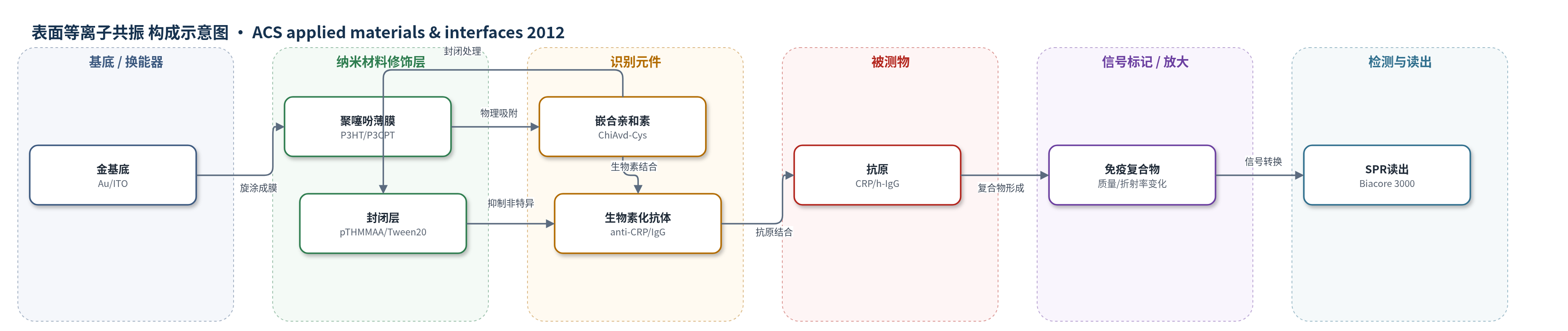
点击图片查看大图 · 依据论文自动绘制
传感器类型
表面等离子共振(SPR)生物传感器
检测对象
人免疫球蛋白G(human IgG, h-IgG)、C反应蛋白(C-reactive protein, CRP);样品基质为 PBS 缓冲液(含 0.5 mg/mL BSA 的抗原标准液)
检测原理
该传感方法以金基底上的旋涂聚噻吩薄膜为界面,嵌合亲和素(ChiAvd-Cys)通过疏水/静电作用物理吸附形成稳定支架。ChiAvd-Cys 的半胱氨酸可形成二硫键,使亲和素呈多聚或类双层结构,提高表面密度和抗洗脱能力。生物素化抗体经生物素-亲和素高亲和相互作用定向固定,pTHMMAA 和 Tween 20 封闭降低非特异结合。当 CRP 或 h-IgG 流过界面时,与抗体特异性结合,使界面质量和折射率增加,SPR 共振角/共振单位发生偏移。信号大小取决于抗体结合容量 Γ 与亲和常数 KA 的乘积;羧基化聚噻吩增强亲和素吸附,但容量与亲和之间存在权衡,P3HT 在 CRP 结合中表现较优。
检测灵敏度
S(×10^14 pg/(mm^2 M),anti-h-IgG 体系):P3HT/ChiAvd-Cys/biotinyl-F(ab')2 = 0.0027;P3HT-COOH15/ChiAvd-Cys = 0.0012;P3CPT/ChiAvd-Cys = 0.0006
效应效果
ChiAvd-Cys 在 P3HT 上的吸附量为 5150 ± 250 pg/mm^2,在 P3CPT 上达 8800 pg/mm^2,显著高于野生型亲和素和链霉亲和素,且对 pTHMMAA1 和 Tween 20 洗脱更稳定;TCEP(1–5 mM)可裂解二硫键并引起脱附,证实其多聚结构。与链霉亲和素相比,pTHMMAA1 封闭使 anti-CRP 结合减少 37%,而对 ChiAvd-Cys 影响不显著。喷印 ChiAvd-Cys 后,CRP 结合容量为 700 ± 100 pg/mm^2,KA = 1.1 ± 0.1 × 10^9 M^-1,结合效率 15–18%,约为被动吸附抗体的 4 倍。交叉反应为 CRP 对 anti-h-IgG 6%、h-IgG 对 anti-CRP 15.7%。作者认为该平台适合通用生物传感器和可打印诊断应用。
传感器的构成
- 基底/换能器:金基底(Au,含 ITO 中间层),SPR 换能基底,提供表面等离子共振信号
- 聚合物修饰层:旋涂聚噻吩薄膜(P3HT、P3HT-COOH15、P3CPT),形成疏水/羧基化界面并承载亲和素
- 识别支架:嵌合亲和素(ChiAvd、ChiAvd-Cys;比较 wt-Avd、SA、b-Avd),物理吸附于聚噻吩表面,结合生物素化抗体
- 封闭剂:pTHMMAA1、pTHMMAA4 和 Tween 20,降低非特异吸附;BSA 用于抗体固定后封闭
- 识别元件:生物素化抗体(biotinylated anti-human IgG F(ab')2、biotinylated anti-CRP),通过生物素-亲和素结合固定并特异性识别抗原
- 信号标记物:无外源标记物,依赖抗原-抗体结合引起的界面质量/折射率变化
- 信号读出:Biacore 3000 或 SPR-Navi 200,通过 SPR 共振角/共振单位(RU)监测结合
中文摘要
稳定的生物受体层是新型生物传感器设计的关键。此前研究表明,嵌合亲和素可将生物素化抗体更稳定地固定于金表面,优于野生型亲和素和链霉亲和素。本研究利用表面等离子共振(SPR)和原子力显微镜(AFM),考察嵌合亲和素作为通用结合支架在旋涂功能化聚噻吩薄膜上固定生物素化抗体的适用性。在聚[3-己基噻吩](P3HT)、羧基化 P3HT 和 P3CPT 表面,新型嵌合亲和素仅通过物理吸附即表现出显著优于野生型亲和素、链霉亲和素和细菌亲和素的结合特性,具有更高的抗体结合容量、亲和常数和固定稳定性。引入羧酸基团可进一步增强亲和素在聚噻吩层的吸附。该功能化聚噻吩-嵌合亲和素平台可用于固定抗人 IgG 和抗 C 反应蛋白(CRP)抗体,并通过 SPR 监测抗原结合,为有机场效应晶体管等生物传感器应用提供了通用、可打印的识别层方案。
英文摘要
Stabilized bioreceptor layers are of great importance in the design of novel biosensors. In earlier work, chimeric avidins enabled immobilization of biotinylated antibodies onto gold surfaces with greater stability compared to more conventional avidins (wild-type avidin and streptavidin). In the present study, the applicability of chimeric avidins as a general binding scaffold for biotinylated antibodies on spin-coated functionalized polythiophene thin films has been studied by surface plasmon resonance and atomic force microscopy. Novel chimeric avidins showed remarkably increased binding characteristics compared with other avidins, such as wild-type avidin, streptavidin, and bacterial avidin when merely physically adsorbed onto the polythiophene surface. They gave the highest binding capacities, the highest affinity constant, and the highest stability for biotinylated probe immobilization. Introduction of carboxylic acid groups to polythiophene layer further enhanced the binding level of the avidins. Polythiophene layers functionalized with chimeric avidins thus offered a promising generic platform for biosensor applications.