组成图示
点击图片查看大图 · 依据论文自动绘制
传感器类型
综述或非传感器论文
检测对象
激活态 Rac(Rac-GTP,兼可结合 Cdc42-GTP);样品基质:果蝇卵巢组织(GSC-CpC 界面)
检测原理
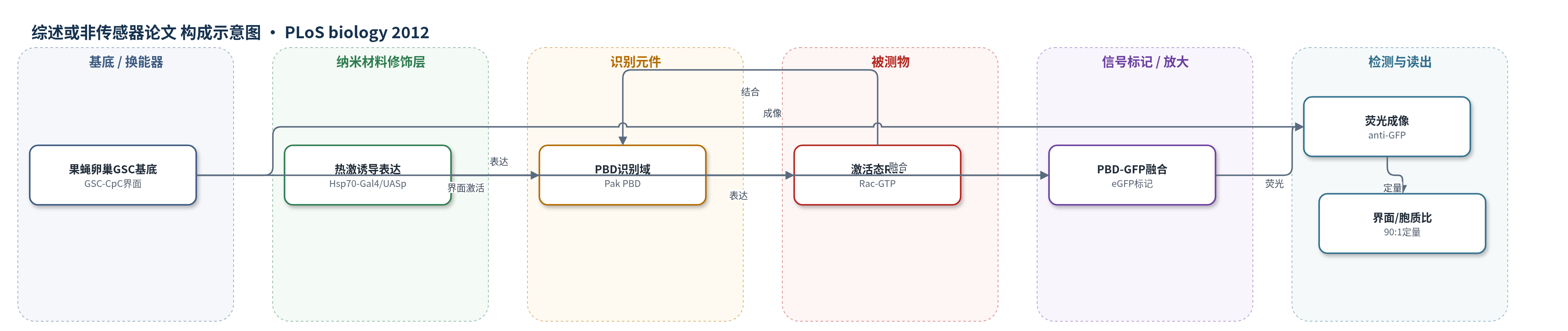
该检测基于 P21 激活激酶的 P21 结合域(PBD)对 GTP 结合态小 GTP 酶 Rac 的特异性结合。热激诱导表达 PBD-GFP 融合蛋白后,PBD 作为识别元件进入 GSC 胞质;当生态位-GSC 界面处 Rac 被激活并结合 GTP 时,PBD 与 Rac-GTP 结合,使 PBD-GFP 在界面局部富集。GFP 作为荧光信号标记物,其空间分布和强度反映局部 Rac 活性水平。通过 anti-GFP 免疫荧光成像,可比较界面区域与其余 GSC 胞质的荧光强度,从而判断 Rac 是否非对称激活。该过程无酶促或核酸放大,主要依赖荧光蛋白直接标记和共聚焦/荧光显微镜读出;若 Rac 活性升高或分布改变,PBD-GFP 的界面富集程度相应改变。
检测灵敏度
原文未报告 LOD、线性范围、灵敏度斜率或相关系数。
效应效果
该 PBD-GFP 生物传感器在野生型 GSC 中显示界面特异性富集,界面与胞质荧光强度比为 90:1(91625:1,n=10),说明对界面激活 Rac 具有较高空间分辨能力。特异性验证显示:单独表达 GFP 时信号均匀分布于 GSC;共表达 Rac1V12 与 PBD-GFP 时信号遍布整个 GSC;Rac 突变 GSC 中 PBD-GFP 不再富集于界面;Cdc42 部分功能缺失背景下 PBD-GFP 仍可正确定位,提示其对 Rac 激活的识别具有选择性。作者利用该传感器证明 Rac 在生态位-GSC 界面非对称激活,并进一步通过突变、RNAi 和过表达实验关联 Apc2 定位、中心体定向、JNK 通路与 BMP 信号,为成体干细胞非对称分裂机制提供工具。
传感器的构成
- 细胞基底:果蝇卵巢 GSC 与帽细胞(CpC)界面,提供 Rac 激活的局部微环境
- 表达调控层:Hsp70-Gal4 与 UASp-PakPBD::eGFP 转座子,热激诱导 PBD-GFP 表达
- 识别元件:P21 激活激酶 P21 结合域(PBD),特异性结合 GTP 结合态 Rac/Cdc42
- 信号标记物:绿色荧光蛋白(GFP/eGFP),与 PBD 融合,用于荧光成像
- 定位对照标记:anti-GFP、anti-Vasa、anti-DE-Cad 抗体,用于标记 GSC 和生态位-GSC 界面
中文摘要
果蝇雌性生殖干细胞(GSC)位于分泌骨形态发生蛋白(BMP)配体并通过黏附连接锚定 GSC 的细胞生态位旁。GSC 非对称分裂时,一个子细胞留在生态位中维持干细胞身份,另一个离开生态位并分化。由于 BMP 信号可扩散,局部胞外不对称如何产生稳健的非对称分裂仍不清楚。本文证明 GSC 相对于生态位具有极性,并使用改良生物传感器显示小 GTP 酶 Rac 在生态位-GSC 界面非对称激活。Rac 功能缺失和获得性功能突变实验表明,非对称 Rac 活性一方面将微管结合蛋白 Apc2 定位到界面,从而在间期将一个中心体定向于界面;另一方面激活 Jun 氨基末端激酶(JNK)通路,增强 GSC 对 BMP 配体的响应。若中心体定向错误,GSC 细胞周期停滞在前中期。因此,GSC 具有生态位相关极性,将分裂面控制与对胞外维持信号的增强响应相偶联;其他过程与 Rac 介导的极性并行作用,确保稳健的非对称分裂。作者推测成体干细胞可能采用多个独立机制维持组织稳态。
英文摘要
BACKGROUND: Drosophila female germline stem cells (GSCs) reside adjacent to a cellular niche that secretes Bone Morphogenetic Protein (BMP) ligands and anchors the GSCs through adherens junctions. The GSCs divide asymmetrically such that one daughter remains in the niche as a GSC, while the other is born away from the niche and differentiates. However, given that the BMP signal can be diffusible, it remains unclear how a local extracellular asymmetry is sufficient to result in a robust pattern of asymmetric division.
METHODS AND FINDINGS: Here we show that GSCs are polarized with respect to the cellular niche. We first use a modified biosensor to demonstrate that the small GTPase Rac is asymmetrically activated within the GSC at the niche-GSC interface. Experiments using loss-of-function and gain-of-function mutations in Rac indicate that asymmetric Rac activity both localizes the microtubule binding protein Apc2 to orient one GSC centrosome at the niche-GSC interface during interphase and activates the Jun N-terminal kinase pathway to increase the ability of the GSC to respond to BMP ligands. Other processes act in concert with each function of Rac. Specifically, we demonstrate that the GSC cell cycle arrests at prometaphase if centrosomes are misoriented.
CONCLUSIONS: Thus, the GSCs, an adult stem cell present in a cellular niche, have a niche-associated polarity that couples control of the division plane with increased response to an extracellular maintenance signal. Other processes work in parallel with the Rac-mediated polarity to ensure a robust pattern of asymmetric division. We suggest that all adult stem cells likely employ multiple, independently acting mechanisms to ensure asymmetric division to maintain tissue homeostasis.