组成图示
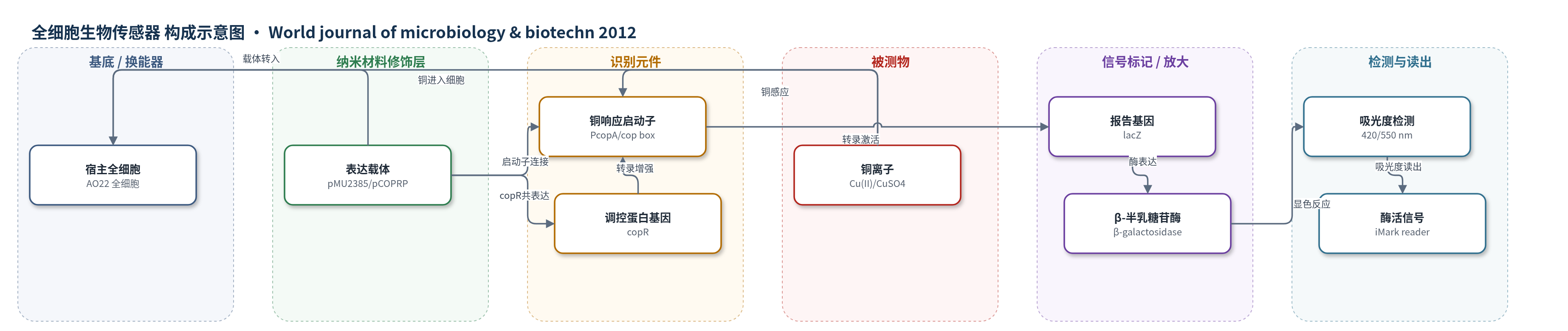
点击图片查看大图 · 依据论文自动绘制
传感器类型
全细胞生物传感器
检测对象
铜(copper, Cu/Cu(II));实验基质为 LB 培养基,目标应用为土壤/环境样品
检测原理
该传感器为全细胞细菌生物传感器。工程菌 AO22(pCOPRP) 或 E. coli(pCOPRP) 携带 pCOPRP,其中 Achromobacter sp. AO22 cop 操纵子来源的 PcopA 启动子(含 cop box、-35/-10 盒)与 copR 基因连接至 lacZ 报告基因上游。当环境中存在生物可利用 Cu(II) 时,铜被细胞感知并激活/增强 PcopA 转录;copR 编码的响应调控元件结合或增强 cop box 区域启动子活性,使 lacZ 转录翻译为 β-半乳糖苷酶。酶催化 Miller 法显色底物,产物在 420 nm 产生吸光度,Miller units 随 Cu 浓度升高而增加,在 0.1–3.0 mM 呈线性;过高 Cu 因细胞毒性使信号下降。信号放大主要依赖铜诱导的基因转录和酶催化显色,其他金属诱导极弱,体现铜选择性。
检测灵敏度
LOD: 约 0.1 mM(E. coli 与 AO22);线性范围: 0.1–3.0 mM(AO22(pCOPRP))
效应效果
AO22(pCOPRP) 对 Cu(II) 呈剂量依赖响应,最大酶活 1209.5 ± 118.4 Miller units(3.0 mM),约为 E. coli(pCOPRP) 最大 581.0 ± 72.8 Miller units(2.0 mM)的两倍;铜诱导较背景提高 250–400 倍。对 Ag(I)、Cd(II)、Pb(II)、Zn(II) 诱导极弱,显示铜特异性。线性范围 0.1–3.0 mM(约 6–191 ppm),覆盖安全限值。与 C. metallidurans CH34(0.1–10 μM)和 E. coli 传感器(0.3–300 μM)相比,范围更宽且对银响应更低。数据基于三次独立实验并报告 SD,未报告 RSD 与实际样品回收率;作者认为 AO22 更适合环境样品,可检测生物可利用铜。
传感器的构成
- 宿主细胞/换能器:Achromobacter sp. AO22(或 E. coli CB454)全细胞,感知铜并承载报告基因表达
- 遗传识别元件:PcopA 启动子(含 cop box、-35/-10 盒)与 copR 基因,响应铜并激活/增强转录
- 报告基因/信号标记:lacZ(β-半乳糖苷酶),表达量随铜诱导增加
- 表达载体:pMU2385(Tpr 标记、MCS),将 PcopA/copR 片段连接至 lacZ 上游
- 信号底物:Miller 法酶活检测底物,催化产物在 420 nm 产生吸光度
- 读出装置:iMark 微孔板吸光度仪,420/550 nm 测量 Miller units
中文摘要
人类活动使铜化合物进入环境,过量铜因高氧化还原电位和活性氧产生而对生态系统和人体健康有害。理化方法虽灵敏准确,但难以区分总铜与生物可利用铜,也无法反映不同生物对金属吸收的差异。细菌重金属抗性遗传系统为开发此类生物传感器提供了工具。本研究利用来自澳大利亚污染场地的耐重金属土壤菌 Achromobacter sp. AO22 的 cop 操纵子构建铜生物传感器。通过 lacZ 报告构建体 pCOPRP 在 E. coli 中鉴定出位于 copR 与 copA 之间、含回文 cop box 的区域为铜响应启动子;加入 copR 后表达增强。工程菌 AO22(pCOPRP) 诱导更强,两种宿主中 lacZ 表达均被铜显著增强 250–400 倍,而其他金属诱导极弱。AO22 构建体有望用于土壤细菌背景中检测铜生物可利用性及其潜在毒性,E. coli 构建体则适合实验室检测。
英文摘要
A number of human activities result in environmental contamination with copper compounds that can cause severe detrimental effects on the ecosystem as well as human health. The physico-chemical methods of metal detection have limitations such as inability to distinguish between total versus bio-available metals and differences in metal uptake in different organisms. The heavy metal resistance-encoding genetic systems of certain bacteria provide critical tools for development of biosensors for these purposes. This study reports a copper biosensor utilizing the cop operon of the heavy metal resistant bacterial isolate, Achromobacter sp. AO22, isolated from a contaminated site in Australia. A section located between the divergently transcribed putative response regulator gene copR and multicopper oxidase gene copA that included a palindromic cop box was identified as a copper-responsive promoter using a lacZ reporter construct, pCOPRP, in E. coli. The expression was found to be enhanced by inclusion of copR. Another engineered strain, AO22(pCOPRP), showed stronger induction, and the lacZ expression in both backgrounds was enhanced significantly (250-400 fold) by copper but minimally by other metals. The construct in Achromobacter sp. AO22 thus has a high potential as biosensor for detecting copper bioavailability (hence potential toxicity) in a soil bacterial background, while the construct in E. coli is ideal for laboratory-based testing.