组成图示
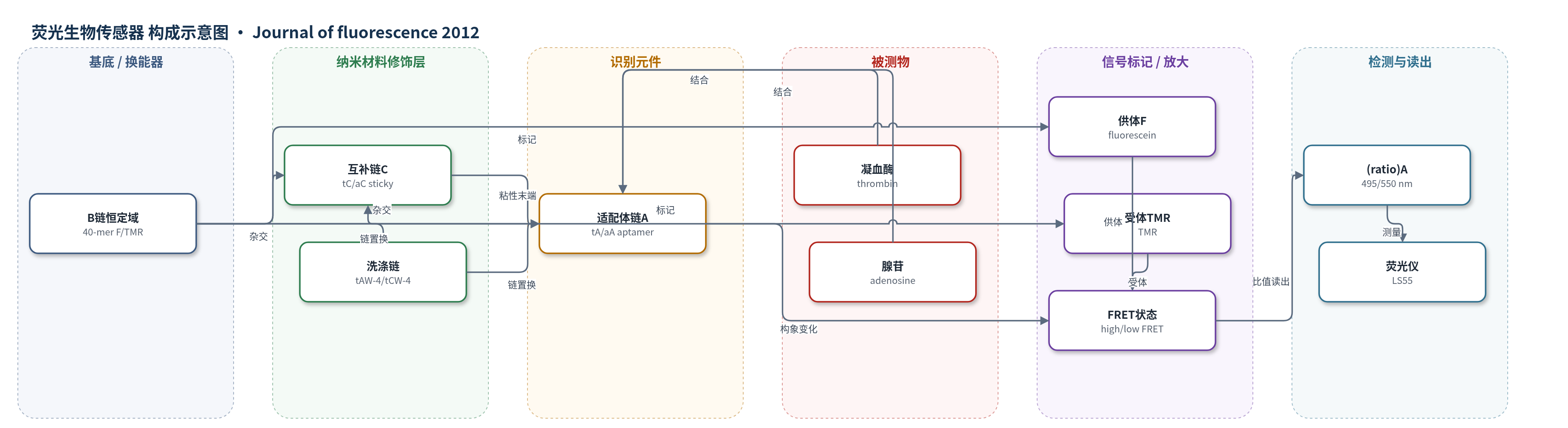
点击图片查看大图 · 依据论文自动绘制
传感器类型
荧光生物传感器
检测对象
凝血酶(thrombin)、腺苷(adenosine);样品基质为Tris缓冲液(含MgCl2、KCl、NaCl、BSA)
检测原理
传感器由恒定B链(5′-F、3′-TMR)与可变A/C链杂交形成。无靶标时,A链与C链粘性末端杂交使F与TMR靠近,形成折叠态,FRET效率高,(ratio)A高。加入凝血酶或腺苷后,适配体A链优先与靶标结合,破坏粘性末端双链,使结构展开,F与TMR距离增大,FRET效率降低,(ratio)A下降。Mg2+稳定磷酸骨架间的粘性末端杂交,K+促进抗凝血酶适配体G-四联体形成,从而优化折叠态稳定性与构象转换。通过495 nm激发下TMR敏化发射与550 nm直接激发发射的比值(ratio)A定量反映FRET效率,实现靶标浓度检测。
检测灵敏度
原文未报告LOD、线性范围、灵敏度斜率或相关系数。
效应效果
在优化条件(5 mM MgCl2、5 mM KCl、7碱基粘性末端、B:tA:tC=1:1:1)下,凝血酶传感器初始(ratio)A约0.43,随凝血酶增加下降;腺苷传感器初始(ratio)A约0.42,随腺苷增加下降,20 μM腺苷可产生响应。重构实验中,从凝血酶传感器经洗涤链移除tC/tA后,(ratio)A由0.43降至0.20、再升至0.33,随后组装aA/aC得到0.35,加入20 μM腺苷后降至0.30,验证可变域可替换。作者称该设计避免每次更换昂贵荧光标记,适用于DNA芯片高通量多靶标检测;但均相溶液存在不完全退火和废液累积等局限,建议表面固定化改进。
传感器的构成
- 恒定信号链:40-mer B strand,5′-F、3′-TMR双标记,提供FRET供体-受体对与恒定域
- 可变识别链:tA/aA aptamer strand,含抗凝血酶/抗腺苷适配体序列,识别靶标并驱动构象变化
- 可变互补链:tC/aC complementary strand,与A链粘性末端杂交形成折叠态,并与B链杂交固定
- 洗涤链:tAW-4/tCW-4 washer strands,通过toehold介导链置换移除tA/tC,实现传感器重构
- 工作介质:10 mM Tris pH 8.0、MgCl2、KCl、NaCl和0.1% BSA,调控折叠态稳定性与G-四联体形成
- 读出系统:Perkin Elmer LS55荧光光谱仪,采用(ratio)A法测量FRET效率
中文摘要
为改变典型分子适配体信标(MAB)以检测不同分析物,目前需要更换整个传感单元,包括昂贵的荧光标记物。本研究开发了一种基于DNA的可重构分子适配体信标。该传感器由可变部分和恒定部分组成:可变部分包含适配体链及其互补链,恒定部分为双标记Förster共振能量转移(FRET)对的寡核苷酸,两部分通过DNA杂交连接。传感器存在折叠(高FRET)和展开(低FRET)两种构象,分别对应无适配体-靶标结合和存在结合状态。通过加入适当的互补链(洗涤链)洗去适配体链和互补链,即可重构传感器。作为原理验证,首先构建了结合强结合分析物凝血酶的传感器,随后重构为结合弱结合分析物腺苷的传感器。作者认为该设计具有通用性,可适用于多种适配体。
英文摘要
In order to alter a typical molecular aptamer beacon (MAB) to detect a different analyte there is currently a need to change the whole sensor unit including the expensive labeling fluorophores. In this work a DNA-based reconfigurable molecular aptamer beacon was developed. It is composed of two parts: a variable part and a constant part. The variable part comprises an aptamer strand and its complementary strand while the constant part is an oligonucleotide doubly labeled with a Förster Resonance Energy Transfer (FRET) pair and the two parts become joined via DNA hybridization. The sensor exists in two conformations: a folded (high FRET) and an unfolded (low FRET) in the absence and presence of the aptamer-target binding respectively. This sensor can be reconfigured by washing away the aptamer and the complementary strand using proper complementary strands, called washers. As a proof of the principle, a sensor that bound the enzyme thrombin, an analyte with a strong binding, was first constructed and then reconfigured to bind adenosine, selected as an analyte with a weak binding. We believe that the design is of universal use applicable to many types of aptamers.