组成图示
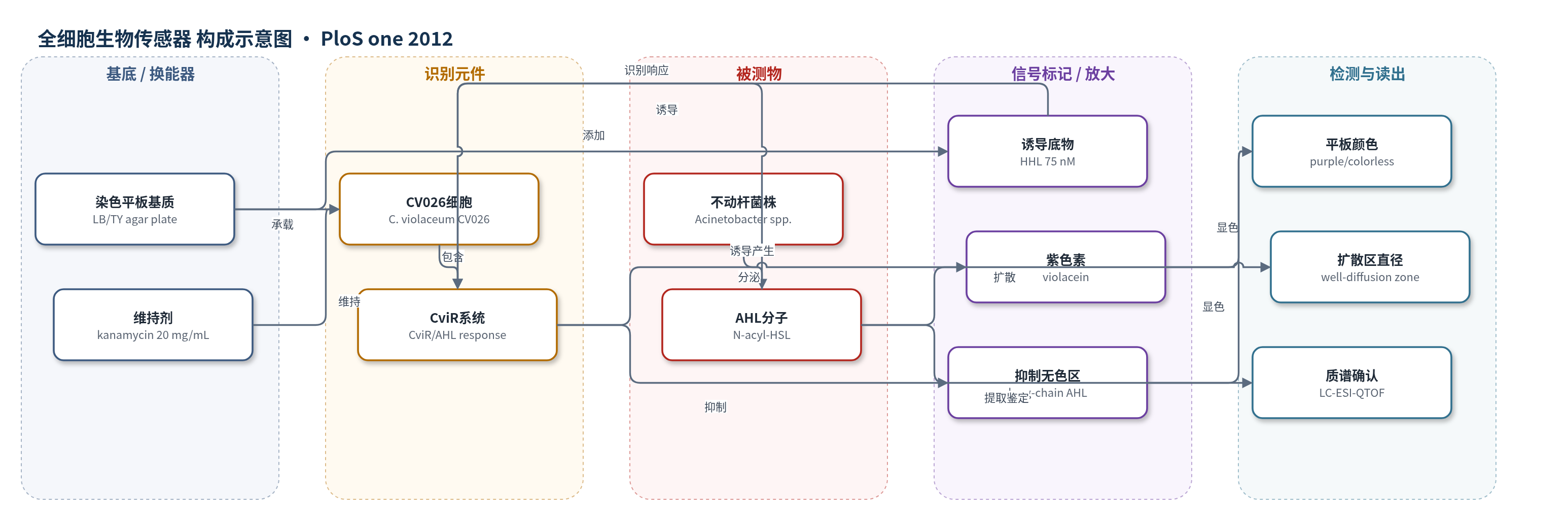
点击图片查看大图 · 依据论文自动绘制
传感器类型
全细胞生物传感器
检测对象
N-酰基高丝氨酸内酯(AHL,含N-癸酰高丝氨酸内酯DHL及C12酰基高丝氨酸内酯);样品基质为临床分离Acinetobacter spp.培养物及培养上清(源自血液、痰、气管分泌物、伤口拭子、尿液等)。
检测原理
CV026是紫色素阴性mini-Tn5突变株,其CviR(Chromobacterium violaceum Repressor)系统可响应N-酰基高丝氨酸内酯(AHL)。短链AHL(C4–C8)进入CV026后激活CviR,诱导violacein合成,菌落呈紫色;长链AHL(C10–C14)不能诱导色素,但可逆性抑制已被HHL诱导的CviR,使菌落呈无色。测试菌分泌的AHL在琼脂中扩散,浓度越高,诱导或抑制区直径越大,因此通过平板颜色或孔扩散区直径可半定量反映AHL水平。该过程依赖全细胞基因表达放大,而非化学标记放大;质谱用于进一步确认AHL酰基链长度。
检测灵敏度
原文未报告 LOD、线性范围、灵敏度斜率及相关系数。
效应效果
在50株临床分离不动杆菌属中,30株(60%)在延长培养后显著形成生物膜;CV026诱导法未检出短链AHL,抑制法检出7株长链AHL阳性株。质谱进一步确认5株产生C10 AHL(N-癸酰高丝氨酸内酯),2株产生C12酰基高丝氨酸内酯,与abaI基因PCR阳性结果一致。abaI::Tc突变体生物膜形成受抑制,加入野生型上清乙酸乙酯提取物后可恢复,而突变体提取物不能恢复,说明AHL信号与生物膜形成功能相关。该方法无需无菌上清或AHL提取,单张平板约可检测6株,操作快速;局限是CV026对部分AHL敏感性有限。作者认为其可用于筛选AHL产生株并辅助寻找群体感应拮抗剂。
传感器的构成
- 换能器细胞:Chromobacterium violaceum CV026,紫色素阴性 mini-Tn5 突变株,作为全细胞生物传感器,将 AHL 识别转化为色素表型。
- 识别元件:CviR(Chromobacterium violaceum Repressor)及其 AHL 响应调控系统,负责感知 N-酰基高丝氨酸内酯(AHL)。
- 报告信号:violacein(紫色素),短链 AHL 诱导其合成,长链 AHL 抑制诱导态色素产生。
- 支撑基质:LB agar 或 TY agar 染色平板(chromoplate),承载 CV026 菌落并允许 AHL 扩散。
- 维持剂:kanamycin(20 mg/mL),维持 CV026 在平板上生长。
- 诱导底物:N-hexanoyl homoserine lactone(HHL,75 nM),用于诱导 CV026 以检测长链 AHL 的抑制作用。
- 样品输入:Acinetobacter spp. 临床分离株培养物或培养上清,释放 AHL 信号分子。
中文摘要
群体感应是细菌监测自身种群密度并调控生物膜形成的环境感知系统,许多革兰阴性菌以N-酰基高丝氨酸内酯(AHL)作为信号分子。本研究旨在明确临床分离不动杆菌属(Acinetobacter spp.)的生物膜形成是否受自诱导群体感应分子调控。采用微孔板法评估50株临床分离株的生物膜形成能力,并用紫色杆菌CV026(Chromobacterium violaceum CV026)生物传感器系统检测AHL产生;进一步以质谱鉴定自诱导物结构,并鉴定自诱导物合成酶基因abaI及其突变对生物膜形成的影响。结果显示,50株中60%在延长培养后显著形成生物膜;CV026抑制法检出7株产生长链AHL;质谱确认其中5株产生N-癸酰高丝氨酸内酯,2株产生C12酰基高丝氨酸内酯。abaI基因在7株阳性株中检出,构建的abaI::Tc突变体生物膜形成受抑制,野生型上清提取物可恢复其生物膜形成能力。结果表明AHL信号参与不动杆菌属生物膜形成,提示群体感应信号阻断剂可能削弱多重耐药菌致病性。
英文摘要
BACKGROUND: Quorum sensing is a term that describes an environmental sensing system that allows bacteria to monitor their own population density which contributes significantly to the size and development of the biofilm. Many gram negative bacteria use N-acyl-homoserine lactones as quorum sensing signal molecules. In this study, we sought to find out if the biofilm formation among clinical isolates of Acinetobacter spp. is under the control of autoinducing quorum sensing molecules.
METHODOLOGY/PRINCIPAL FINDINGS: Biofilm formation among clinical isolates of Acinetobacter spp. was assessed and the production of signal molecules were detected with Chromobacterium violaceum CV026 biosensor system. Characterisation of autoinducers was carried out by mass spectrometric analysis. We have also reported the identification of an autoinducer synthase gene, abaΙ among the isolates that produce quorum sensing signal molecules and have reported that the mutation in the abaI gene influences their biofilm forming capabilities. Using a microtitre-plate assay it was shown that 60% of the 50 Acinetobacter spp. isolates significantly formed biofilms. Further detection with the biosensor strain showed that some of these isolates produced long chain signal molecules. Mass spectrometric analysis revealed that five of these isolates produced N-decanoyl homoserine lactone and two isolates produced acyl-homoserine lactone with a chain length equal to C(12). The abaΙ gene was identified and a tetracycline mutant of the abaΙ gene was created and the inhibition in biofilm formation in the mutant was shown.
CONCLUSIONS/SIGNIFICANCE: These data are of great significance as the signal molecules aid in biofilm formation which in turn confer various properties of pathogenicity to the clinical isolates including drug resistance. The use of quorum sensing signal blockers to attenuate bacterial pathogenicity is therefore highly attractive, particularly with respect to the emergence of multi antibiotic resistant bacteria.