组成图示
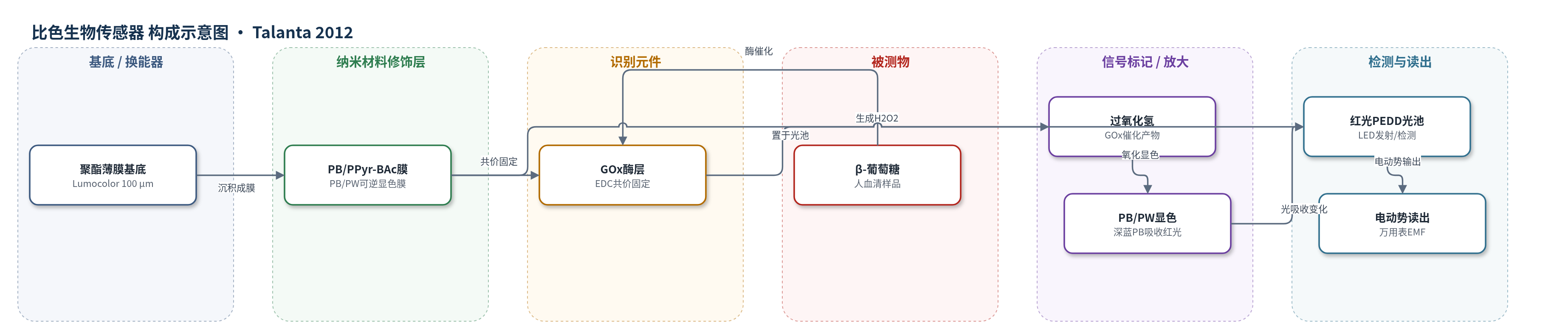
点击图片查看大图 · 依据论文自动绘制
传感器类型
比色生物传感器
检测对象
葡萄糖(glucose);样品基质:人血清(生理/病理参考血清,稀释后测定)
检测原理
该传感器基于酶促比色与LED光电检测,未采用HCR/RCA等额外放大。GOx识别并催化β-D-葡萄糖氧化,生成葡萄糖-δ-内酯和H2O2;H2O2扩散至PB/PPyr-BAc膜,将还原态普鲁士白(PW)氧化为普鲁士蓝(PB)。PB在约725 nm处具有强吸收,使红光PEDD光池中透过/反射光强改变。LED detector在光照下发生光电效应,产生与光强相关的电动势;依据Lambert–Beer定律和Shockley方程,电动势变化与PB吸光度及葡萄糖浓度相关。葡萄糖浓度越高,生成H2O2越多,PW转化为PB越多,信号变化越大。顺序注入流路用抗坏血酸将PB还原为PW实现再生,实现连续测量。
检测灵敏度
LOD: 23.8 μmol L−1;LOQ: 79.3 μmol L−1;动态工作范围: 0.1–2.5 mmol L−1(R^2=0.9979);动态线性范围: 延伸至2.0 mmol L−1;斜率: 0.156 V/(mmol L−1);ΔE(V)=0.156[glucose, mmol L−1]+0.048;R^2=0.9960
效应效果
方法重现性良好,1 mmol L−1葡萄糖连续5次测定RSD为2.3%。稳健性方面,GOx表面浓度或LED电流偏离最优值17%或18.5%时响应仅变化5%。抗干扰方面,抗坏血酸干扰可用二次多项式模型校正;血清4倍稀释后,生理范围内响应下降不超过3.4%。与Trinder分光光度法比较,5个人血清参考材料结果配对t检验无显著差异(p=0.077),且病理血清重复性更优。样品通量约20 h−1,提高流速至2 mL min−1可达90 h−1。干态储存135天酶活性损失18.8%,单膜可循环约800次。作者认为其成本低、坚固、适合糖尿病即时检测。
传感器的构成
- 光学换能器/流路:红色配对发射-检测二极管(PEDD,OSHR53E1A2M)与PVC壳体、PTFE/Tygon管路、硅胶密封构成无光纤LED内流池,发射红光并检测光信号产生的电动势
- 基底:透明聚酯薄膜(Lumocolor® universal transparency film,100 μm厚)作为非导电支撑和传感微区载体
- 化学识别/显色层:普鲁士蓝(PB,Fe4[Fe(CN)6]3)与N-取代聚吡咯(PPyr-BAc,由4-(吡咯-1-基)苯甲酸 Pyr-BAc 氧化聚合)形成有机-无机复合膜,作为H2O2化学受体和可逆PB/PW显色指示剂
- 生物识别层:葡萄糖氧化酶(GOx,Aspergillus niger)通过EDC(1-乙基-3-(二甲基氨基丙基)碳二亚胺)共价固定于PPyr-BAc羧基表面,催化β-葡萄糖氧化
- 再生/条件化试剂:抗坏血酸(ascorbic acid,AA,10 mmol L−1)将PB还原为普鲁士白(PW)用于基线再生;磷酸盐缓冲液(KH2PO4/K2HPO4,pH 7.2)作为载流液和酶稳定液
- 信号读出:手持数字万用表(Voltcraft VC820)经RS-232读取LED detector电动势,AutoAnalysis 5.0软件控制SI并采集数据
中文摘要
本文提出一种集成于自动顺序注入(SI)流路中的无光纤微型光学传感器,用于人血清中葡萄糖(模型分析物)的监测。该光流控生物传感器将普鲁士蓝(PB)和葡萄糖氧化酶(GOx)共固定于聚酯薄膜上,使其同时作为化学受体和生物受体。GOx在受体表面催化β-葡萄糖氧化生成过氧化氢,过氧化氢将PB的还原态(普鲁士白,PW)再氧化为深蓝色PB。薄膜光学性质变化由红色配对发射-检测二极管(PEDD)连续监测。采用全因子设计和Doehlert矩阵响应面进行多变量优化,发现LED发射电流和GOx表面浓度是影响响应最显著因素。该传感器稳健,GOx浓度变化17%或LED电流变化18.5%时响应仅变化5%。优化条件下,检出限和定量限分别为23.8 μmol L−1和79.3 μmol L−1,动态工作范围为0.1–2.5 mmol L−1。使用认证生理和病理人血清材料评估准确度,并与Trinder分光光度法比较。该酶生物传感器成本低(低于0.2欧元)、坚固且通用,受体和LED对可定制。
英文摘要
A miniaturized fiberless optical sensor integrated in an automated sequential injection (SI) manifold for mesofluidic handling of sample, conditioning and regeneration solutions is herein proposed for monitoring glucose (as a model analyte) in human serum. The optofluidic biosensor capitalizes on the co-immobilization of Prussian Blue (PB) and glucose oxidase (GOx) on a polyester film working concomitantly as a chemo- and bioreceptor. The oxidation of β-glucose at the receptor surface by GOx yields hydrogen peroxide whereby reoxidizing the reduced form of PB (the so-called Prussian White) so as to generate a deep blue color. The change in the optical properties of the film was continuously monitored by red paired emitter-detector diodes (PEDDs). A full factorial design followed by a Doehlert matrix-based response surface was exploited for multivariate optimization of the optofluidic PB-GOx-PEDD biosensor. The most significant variables influencing sensor's response were the current powering the light emitting diode (LED) emitter and the surface concentration of GOx. The optosensor was proven rugged as the response varies by merely 5% from the optimal value whenever the GOx concentration increases or decreases by 17% or the current powering the LED by 18.5%. Under the optimized physicochemical conditions, the limits of detection and quantification at the 3s(blank) and 10s(blank) levels, respectively, were estimated to be 23.8μmolL(-1) and 79.3μmolL(-1), respectively, with a dynamic working range spanning from 0.1 to 2.5mmolL(-1) of glucose. The trueness of the biosensor measurements was assessed with certified pathological and physiological human serum materials and compared against the spectrophotometric Trinder method. The devised enzymatic biosensor is affordable (less than 0.2€), sturdy, and versatile inasmuch as the chemical composition of the receptor and pair of LEDs might be customized at will.