组成图示
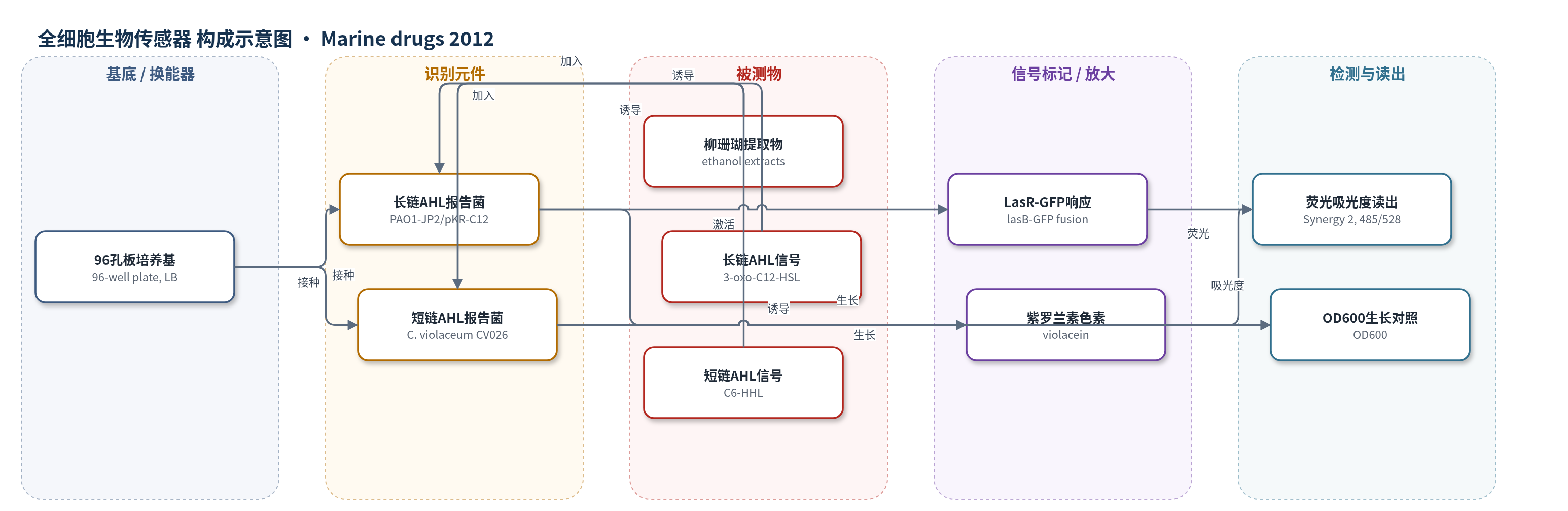
点击图片查看大图 · 依据论文自动绘制
传感器类型
全细胞生物传感器
检测对象
长链 N-酰基高丝氨酸内酯(long-chain AHL,3-oxo-C12-HSL)、短链 N-酰基高丝氨酸内酯/高丝氨酸内酯(short-chain AHL/HHL,C6-HHL)及柳珊瑚乙醇提取物中的 QS 抑制/刺激活性;样品基质:加勒比柳珊瑚乙醇提取物(100 mg/mL 母液,250 µg/mL 工作浓度)。
检测原理
长链 AHL(3-oxo-C12-HSL)进入 Pseudomonas aeruginosa PAO1-JP2 (pKR-C12) 后与 LasR 受体结合,激活 lasB-GFP 融合基因转录,不稳定 GFPmut3 表达产生荧光;柳珊瑚提取物若含抗 QS 化合物则荧光降低,若含 AHL 类似物则荧光升高。短链 AHL/HHL(C6-HHL)诱导 Chromobacterium violaceum CV026 合成紫罗兰素,提取物抑制时紫罗兰素减少,经 DMSO 溶解后以 A590 读出。信号强度随 AHL 浓度或提取物中 QS 活性变化,酶标仪同时检测 OD600 以排除生长抑制干扰。
检测灵敏度
原文未报告 LOD、线性范围、灵敏度斜率或相关系数。
效应效果
250 µg/mL 下,提取物不显著影响 PAO1-JP2 和 CV026 生长,排除生长抑制干扰。长链 AHL 抑制中,P. americana、P. acerosa、P. flexuosa 和 G. ventalina 最强(F=53.39, p<0.0001);短链 CV026 中 P. acerosa、P. americana、P. porosa 使紫罗兰素降低约 50%,G. ventalina 降低 30%(F=29.03, p<0.0001)。P. porosa 刺激长链 QS 最大 17 倍,G. ventalina 2 倍(F=7314.64, p<0.0001),约相当于 40% 的 50 nM 3-oxo-C12-HSL。抗菌方面,对非海洋菌高于海洋菌,对革兰氏阳性高于阴性;P. porosa 与 P. acerosa 最高,E. laciniata 最低,对三种 S. marcescens 几乎无抑制。作者认为提示柳珊瑚含新型 QS 调控和抗菌化合物,具生态与应用价值。
传感器的构成
- 反应基底:96孔平底塑料微孔板(Greiner bio-one)与 LB/海洋肉汤培养基,提供报告菌生长和反应环境。
- 识别元件:Pseudomonas aeruginosa PAO1-JP2 (pKR-C12) 报告菌,含 lasR 受体,识别长链 AHL(3-oxo-C12-HSL)。
- 识别元件:Chromobacterium violaceum CV026 报告菌,识别短链 AHL/HHL(C6-HHL)并产生紫罗兰素。
- 信号标记物:不稳定 GFPmut3(pKR-C12 中 lasB-GFP 融合),长链 AHL 激活后产生荧光。
- 信号标记物:紫罗兰素(violacein),短链 AHL 诱导合成,DMSO 溶解后 A590 检测。
- 信号分子:3-oxo-C12-HSL 与 C6-HHL,作为外源 AHL 诱导/抑制检测。
- 待测样品:柳珊瑚乙醇提取物(100 mg/mL 母液,250 µg/mL 工作浓度),含潜在抗菌/QS 调控化合物。
- 读出设备:Biotek Synergy 2 酶标仪,检测荧光(485/528 nm)、OD600 和 A590。
中文摘要
柳珊瑚含有多种新型天然产物,可能介导珊瑚与细菌之间的相互作用。由于许多细菌利用群体感应(QS)信号促进宿主定殖,调控原核细胞间通讯可能是重要的细菌控制机制。本研究检测了12种加勒比柳珊瑚乙醇提取物对微生物定殖的调控机制,包括抗菌活性和 QS 调控活性。来自波多黎各和佛罗里达礁岛群的柳珊瑚提取物,使用对长链 N-酰基高丝氨酸内酯(AHL)敏感的 Pseudomonas aeruginosa QS 报告菌和短链 AHL 生物传感器 Chromobacterium violaceum CV026,显示多种抗菌和 QS 活性。总体而言,柳珊瑚对非海洋菌株的抗菌活性高于海洋菌株。Pseudopterogorgia americana、Pseudopterogorgia acerosa 和 Pseudoplexaura flexuosa 的 QS 抑制作用最强;Pseudoplexaura porosa 提取物则刺激 QS,信号增加17倍。这种刺激可能促进特定微生物定殖或招募。结果表明柳珊瑚中存在新型 QS 刺激、QS 抑制和杀菌化合物,深入理解这些化合物有助于揭示珊瑚-微生物生态关系并评估其治疗潜力。
英文摘要
Gorgonian corals possess many novel natural products that could potentially mediate coral-bacterial interactions. Since many bacteria use quorum sensing (QS) signals to facilitate colonization of host organisms, regulation of prokaryotic cell-to-cell communication may represent an important bacterial control mechanism. In the present study, we examined extracts of twelve species of Caribbean gorgonian corals, for mechanisms that regulate microbial colonization, such as antibacterial activity and QS regulatory activity. Ethanol extracts of gorgonians collected from Puerto Rico and the Florida Keys showed a range of both antibacterial and QS activities using a specific Pseudomonas aeruginosa QS reporter, sensitive to long chain AHLs and a short chain N-acylhomoserine lactones (AHL) biosensor, Chromobacterium violaceium. Overall, the gorgonian corals had higher antimicrobial activity against non-marine strains when compared to marine strains. Pseudopterogorgia americana, Pseusopterogorgia acerosa, and Pseudoplexuara flexuosa had the highest QS inhibitory effect. Interestingly, Pseudoplexuara porosa extracts stimulated QS activity with a striking 17-fold increase in signal. The stimulation of QS by P. porosa or other elements of the holobiont may encourage colonization or recruitment of specific microbial species. Overall, these results suggest the presence of novel stimulatory QS, inhibitory QS and bactericidal compounds in gorgonian corals. A better understanding of these compounds may reveal insight into coral-microbial ecology and whether a therapeutic potential exists.