组成图示
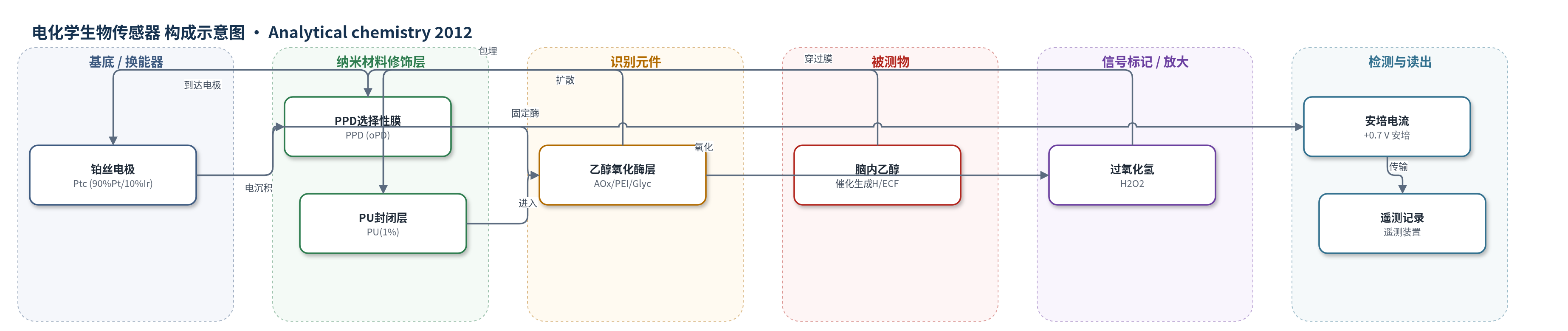
点击图片查看大图 · 依据论文自动绘制
传感器类型
电化学生物传感器
检测对象
乙醇(ethanol, EtOH);样品基质:大鼠脑细胞外液(brain extracellular fluid, ECF,伏隔核)
检测原理
该传感器以铂微电极作为换能器,表面电沉积 PPD 选择性膜,再固定 AOx/PEI/Glyc 并用 PU 包埋。脑 ECF 中的乙醇扩散穿过 PU 层进入 AOx 活性位点,AOx 以 FAD 为辅因子催化乙醇氧化为乙醛,同时消耗 O2 生成 H2O2。生成的 H2O2 扩散穿过 PPD 膜到达 Pt 表面,在 +0.7 V 固定电位下发生氧化反应,产生与 H2O2 浓度成正比的安培电流。由于 AOx 催化反应遵循 Michaelis–Menten 动力学,低浓度下电流与乙醇浓度近似线性,线性区斜率 LRS≈VMAX/KM;PPD 膜主要阻断 AA 等电活性干扰,PEI 增强酶活性、Glyc 稳定酶层,从而在 0–40 mM 范围内实现实时检测。
检测灵敏度
LOD: 0.09 ± 0.03 mmol L−1;LOQ: 0.27 ± 0.09 mmol L−1;线性范围: 0–40 mM;灵敏度斜率: 1.78 ± 0.44 nA mM−1(0–40 mM,R^2 = 0.992);LRS: 1.73 ± 0.08 nA mM−1(R^2 = 0.996)。
效应效果
体外 1 mM AA 响应为 1.72 ± 0.36 nA,AA ΔI 为 0.55 ± 0.12 nA;对 30 mM 乙醇电流的干扰第 2 天 <1%、第 7 天约 2%,第 14 天升至 25%,故仅适合约一周内植入。对多巴胺、DOPAC 和尿酸未见显著干扰,t90% = 1.6 ± 0.7 s。植入伏隔核后,大鼠经胃给予 1 g/kg 乙醇,电流峰值 23.4 ± 3.2 nA(60–80 min),后降至 11.8 ± 3.1 nA;雷尼替丁组峰值 27.9 ± 4.3 nA,140–160 min 为 23.2 ± 3.5 nA,显著高于对照组(p < 0.05)。与微透析报道的 23 mM、18 mM 峰值相比,本传感器估计约 14 mM,但可实时反映动态变化。
传感器的构成
- 绝缘基底:Teflon 包覆铂丝(90% Pt/10% Ir,直径 125 μm),切割暴露 1 mm 电极,提供绝缘与机械支撑
- 换能器电极:暴露 Pt 圆柱,作为工作电极,在 +0.7 V 下氧化 H2O2
- 选择性膜:电沉积 poly-ortho-phenylenediamine(PPD),由 oPD 在 +0.7 V 聚合,纳米厚膜,阻断抗坏血酸(AA)等电活性干扰
- 识别/催化层:alcohol oxidase(AOx,EC 1.1.3.13)与 polyethyleneimine(PEI,1%)、glycerol(Glyc,1%)共沉积(10 次浸渍-蒸发),催化乙醇氧化生成 H2O2
- 封闭/包埋层:polyurethane(PU,1%)浸渍形成 containment net,固定 AOx/PEI/Glyc 并维持结构
中文摘要
乙醇是西方社会中最常见的精神活性物质之一。其精神作用主要与 GABA 能和谷氨酸能系统有关,而正强化效应则与中脑边缘多巴胺通路激活及伏隔核多巴胺释放相关。因此,检测脑细胞外液(ECF)中的乙醇具有重要意义。本研究开发并表征了一种用于实时安培检测脑内乙醇的植入式生物传感器。作者对 10 种传感器设计进行了体外表征,评价 Michaelis–Menten 动力学参数(VMAX 和 KM)、灵敏度(线性区斜率、检出限 LOD 和定量限 LOQ)以及电活性干扰阻断能力,并对部分设计持续监测至制备后 28 天以评估稳定性。最终选择性能最佳的设计植入大鼠伏隔核,并连接低成本遥测装置,对自由移动、无束缚大鼠进行实时乙醇监测。实验中系统给予乙醇,单独或与酒精脱氢酶抑制剂雷尼替丁联用,连续记录传感器信号。结果表明,该植入式生物传感器可短时可靠地监测脑 ECF 中外源乙醇,为研究乙醇毒代动力学及药物对脑内乙醇水平的影响提供了新一代分析工具。
英文摘要
Ethanol is one of the most widespread psychotropic agents in western society. While its psychoactive effects are mainly associated with GABAergic and glutamatergic systems, the positive reinforcing properties of ethanol are related to activation of mesolimbic dopaminergic pathways resulting in a release of dopamine in the nucleus accumbens. Given these neurobiological implications, the detection of ethanol in brain extracellular fluid (ECF) is of great importance. In this study, we describe the development and characterization of an implantable biosensor for the amperometric detection of brain ethanol in real time. Ten different designs were characterized in vitro in terms of Michaelis-Menten kinetics (V(MAX) and K(M)), sensitivity (linear region slope, limit of detection (LOD), and limit of quantification (LOQ)), and electroactive interference blocking. The same parameters were monitored in selected designs up to 28 days after fabrication in order to quantify their stability. Finally, the best performing biosensor design was selected for implantation in the nucleus accumbens and coupled with a previously developed telemetric device for the real-time monitoring of ethanol in freely moving, untethered rats. Ethanol was then administered systemically to animals, either alone or in combination with ranitidine (an alcohol dehydrogenase inhibitor) while the biosensor signal was continuously recorded. The implanted biosensor, integrated in the low-cost telemetry system, was demonstrated to be a reliable device for the short-time monitoring of exogenous ethanol in brain ECF and represents a new generation of analytical tools for studying ethanol toxicokinetics and the effect of drugs on brain ethanol levels.