组成图示
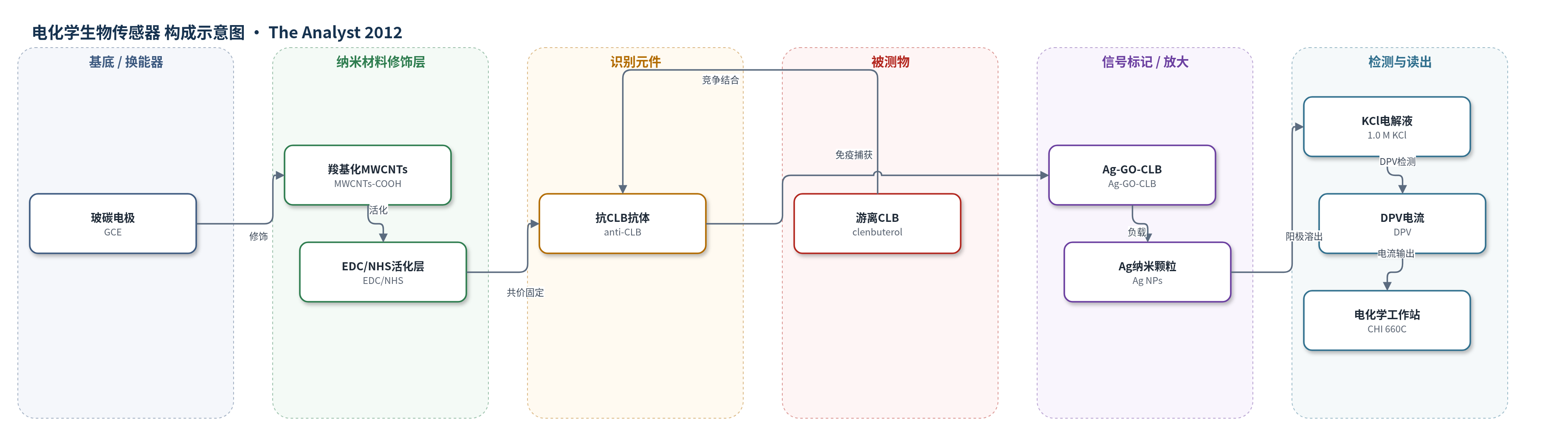
点击图片查看大图 · 依据论文自动绘制
传感器类型
电化学生物传感器
检测对象
克伦特罗(clenbuterol, CLB);样品基质:尿液(加标尿液)
检测原理
该传感器采用竞争免疫反应检测小分子克伦特罗。抗CLB单克隆抗体经EDC/NHS共价固定于MWCNTs-COOH修饰的GCE表面,BSA封闭后形成免疫电极。检测时,样品中游离CLB与Ag-GO-CLB偶联物竞争结合电极表面有限抗体位点:游离CLB浓度越高,被捕获的Ag-GO-CLB越少。Ag-GO-CLB中GO负载的Ag纳米颗粒作为电化学信号标签,在1.0 M KCl中通过正扫DPV发生Ag/AgCl固态伏安阳极溶出,产生与捕获量成正比的电流。以零浓度电流I0与样品电流Ix之差ΔI=I0−Ix定量,信号随CLB浓度升高而降低。MWCNTs提高抗体负载并促进电子转移,GO作为纳米载体同时承载Ag NPs和CLB,实现信号放大。
检测灵敏度
LOD: 6.8 pg mL−1 (signal-to-noise ratio of 3);线性范围: 0.01–10.0 ng mL−1;R^2 = 0.9940
效应效果
该免疫传感器对克伦特罗具有良好选择性,与0.1 mg mL−1的莱克多巴胺(RAC)、多巴酚丁胺(DOB)和沙丁胺醇(SAL)混合时无明显干扰。批内CV为3.2%和3.9%(0.1、1.0 ng mL−1,n=6),批间CV为4.1%和4.7%(0.1、1.0 ng mL−1,六个传感器),4 ℃保存1个月响应无明显下降。尿液加标5、10、20 mg kg−1时,本方法回收率为91.2%、93.1%、91.4%,RSD为4.16%、5.28%、4.31%,与ELISA和LC-MS结果无统计差异。其LOD优于无标记电化学免疫传感器(0.32 ng mL−1)和碳纳米管电化学免疫传感器(0.1 ng mL−1),作者认为可用于实际样品中CLB的快速、简便、超灵敏检测。
传感器的构成
- 基底/换能器电极:玻碳电极(GCE),经氧化铝抛光,作为电化学工作电极
- 纳米材料修饰层:羧基化多壁碳纳米管(MWCNTs-COOH),提供羧基并促进电子转移
- 共价交联层:EDC/NHS活化MWCNTs-COOH羧基,形成NHS酯以固定抗体
- 识别元件:抗克伦特罗单克隆抗体(anti-CLB),共价固定于电极表面并特异性结合CLB
- 封闭剂:牛血清白蛋白(BSA),封闭非特异性结合位点
- 信号标记物:Ag-GO-CLB纳米偶联物,GO负载Ag纳米颗粒并共价连接CLB,作为竞争抗原和电化学标签
- 电解液/读出介质:1.0 M KCl,支持Ag/AgCl固态伏安过程,用于DPV检测银
中文摘要
本文报道了一种基于银纳米颗粒修饰氧化石墨烯(GO)纳米片(Ag–GO)的超灵敏安培生物传感器,用于快速检测克伦特罗(CLB)。作者通过透射电子显微镜(TEM)、原子力显微镜(AFM)和紫外-可见光谱(UV-vis)表征了Ag–GO标记CLB(Ag–GO–CLB)的形貌与结构。免疫传感器通过将捕获抗体共价固定于多壁碳纳米管(MWCNTs)修饰的玻碳电极(GCE)表面制备。在竞争免疫反应中,Ag–GO–CLB纳米复合物被免疫传感器捕获,随后在KCl溶液中通过正差分脉冲伏安法(DPV)测定银,从而检测抗原。实验结果表明,该传感器在0.01–10.0 ng mL−1范围内呈线性响应,检出限为6.8 pg mL−1(信噪比为3)。基于Ag–GO的免疫传感器为金属免疫分析标签提供了简便路线,可避免复杂耗时的金属组分溶解步骤,实现超灵敏检测。此外,该电化学免疫分析具有可接受的特异性和稳定性,适用于实际样品中CLB的测定。
英文摘要
We report the development of an ultrasensitive amperometric biosensor based on Ag nanoparticles-decorated graphene oxide nanosheets (GO) (Ag-GO) for the rapid detection of clenbuterol (CLB). The morphology and structure of the Ag-GO labeled CLB (Ag-GO-CLB) were characterized by transmission electron microscope (TEM), atomic force microscope (AFM), and ultraviolet-visible spectroscope (UV-vis). The immunosensor was prepared by covalently immobilizing capture antibodies on a multi-walled carbon nanotubes-modified glassy carbon electrode. Through competitive immunoreactions, the Ag-GO-CLB nanocomposites were captured on the immunosensor and the silver was measured by positive differential pulse voltammetry (DPV) in KCl solution for the detection of antigen. The experimental results show a linear response over the range from 0.01 to 10.0 ng mL(-1) with a lower detection limit of 6.8 pg mL(-1) (signal-to-noise ratio of 3). The Ag-GO based immunosensor offers a simple and convenient route for metal-immunoassay labels, which can avoid the complicated and time-consuming dissolving of metal component for ultrasensitive determination. Moreover, the electrochemical immunoassay shows acceptable specificity and stability and is suitable for the determination of CLB in real samples.