组成图示
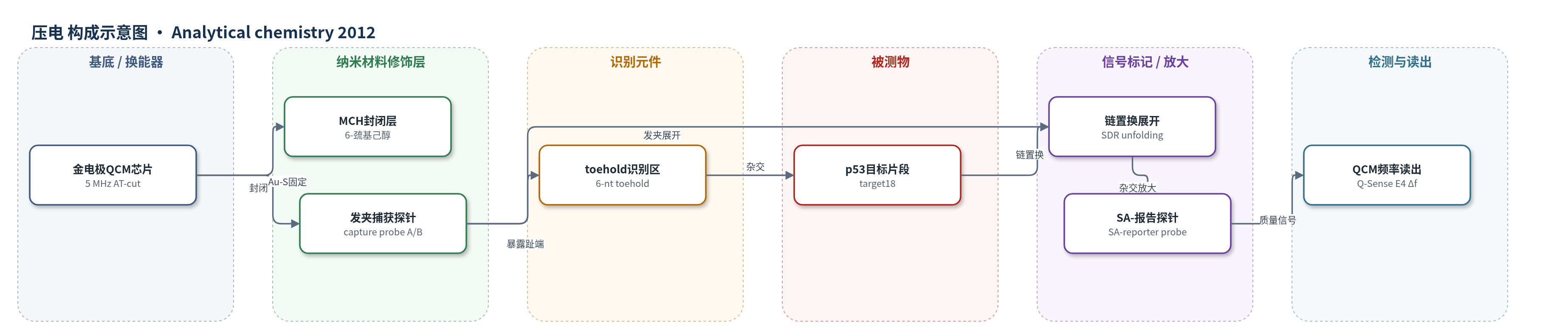
点击图片查看大图 · 依据论文自动绘制
传感器类型
压电(QCM)生物传感器
检测对象
p53 基因单核苷酸多态性目标序列(p53 SNP target18, 18-nt);样品基质:Tris-HCl 缓冲液、HeLa 细胞裂解液
检测原理
发夹捕获探针通过 Au-S 键固定于金电极表面,5′端 external toehold 暴露于溶液。目标 p53 片段 target18 先与 toehold 杂交,随后通过 branch migration 置换 3′端 stem 链,使发夹结构展开;单碱基突变序列因 toehold 3′端错配而难以启动链置换,因而不能有效展开。展开后的捕获探针暴露 3′端互补序列,与 SA-reporter probe 杂交。链霉亲和素(SA)作为大分子质量放大器沉积在晶体表面,使 QCM 频率下降。target18 浓度越高,展开捕获探针越多,SA-reporter 结合量越大,频率偏移越大,从而实现无酶、无标记、常温下的 SNP 检测。
检测灵敏度
LOD: 0.3 nM;线性范围: 0.5–20 nM
效应效果
该传感器对 target18 相对 mutant T、mutant A、mutant C 和 mutant D 的判别因子(DF)分别为 23、29、63 和 28,其中对 C-C 错配的最大 DF 为 63,选择性优于分子信标和三茎探针等无酶方法。温度实验显示 15、20、25 和 30 °C 下 SA-reporter 响应随温度升高而降低,20 °C 兼顾灵敏度与反应效率。报告探针与 SA 化学计量比为 1 时频率响应最大。未加标 HeLa 细胞裂解液无明显频率偏移;10% HeLa 细胞裂解液加标 20 nM target18 的回收率为 84.1%,RSD 为 6.7%(n=4)。无 SA-reporter 放大时仅能检测 10 nM 以上 target18,放大后 LOD 降至 0.3 nM,作者认为该策略可用于生物样品 SNP 检测。
传感器的构成
- 基底/换能器:金电极石英晶体微天平芯片(gold-coated QCM chip, 5 MHz AT-cut),提供质量敏感换能界面
- 封闭层:6-巯基己醇(MCH),封闭金表面并去除弱结合捕获探针
- 捕获探针层:发夹捕获探针 A/B(hairpin capture probe A/B,含 6-nt loop、12-bp stem、5′端 6-nt external toehold),经 Au-S 键固定
- 识别元件:捕获探针 5′端 external toehold 与 3′端 stem 序列,特异性识别 p53 基因片段 target18 并启动链置换
- 信号放大层:链霉亲和素-报告探针复合物(SA-reporter probe),与展开捕获探针杂交,增加表面质量
- 读出系统:Q-Sense E4 QCM-D 仪器,读取第九泛音频率偏移(Δf)
中文摘要
本文首次将趾端介导链置换反应(toehold-mediated strand displacement reaction, SDR)引入石英晶体微天平(QCM)生物传感器,在常温、无酶、无标记条件下实现 p53 抑癌基因单核苷酸多态性(SNP)的高选择性和高灵敏检测。作者设计并固定了一种带外部趾端(toehold)的发夹捕获探针于 QCM 金电极表面。目标 p53 基因片段 target18 先与外部趾端杂交,随后通过链置换使捕获探针展开;展开后的捕获探针再与链霉亲和素偶联报告探针(SA-reporter probe)杂交,利用大分子质量放大增强 QCM 频率响应。该传感器对 p53 目标序列相对单碱基突变序列具有显著判别能力,最大判别因子为 63(对 C-C 错配),20 °C 下检出限为 0.3 nM。荧光传感和原子力显微镜成像进一步验证了捕获探针的设计原理。在加标 HeLa 细胞裂解液中,target18 回收率为 84.1%,表明该传感器可用于生物样品中 SNP 检测。
英文摘要
Toehold-mediated strand displacement reaction (SDR) is first introduced to develop a simple quartz crystal microbalance (QCM) biosensor without an enzyme or label at normal temperature for highly selective and sensitive detection of single-nucleotide polymorphism (SNP) in the p53 tumor suppressor gene. A hairpin capture probe with an external toehold is designed and immobilized on the gold electrode surface of QCM. A successive SDR is initiated by the target sequence hybridization with the toehold domain and ends with the unfolding of the capture probe. Finally, the open-loop capture probe hybridizes with the streptavidin-coupled reporter probe as an efficient mass amplifier to enhance the QCM signal. The proposed biosensor displays remarkable specificity to target the p53 gene fragment against single-base mutant sequences (e.g., the largest discrimination factor is 63 to C-C mismatch) and high sensitivity with the detection limit of 0.3 nM at 20 °C. As the crucial component of the fabricated biosensor for providing the high discrimination capability, the design rationale of the capture probe is further verified by fluorescence sensing and atomic force microscopy imaging. Additionally, a recovery of 84.1% is obtained when detecting the target sequence in spiked HeLa cells lysate, demonstrating the feasibility of employing this biosensor in detecting SNPs in biological samples.