组成图示
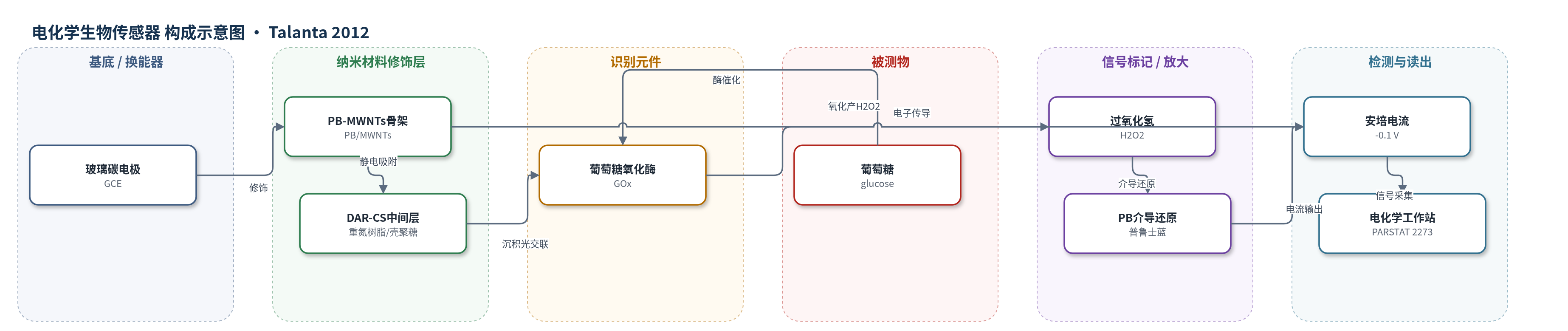
点击图片查看大图 · 依据论文自动绘制
传感器类型
电化学生物传感器
检测对象
葡萄糖(glucose);样品基质:PBS缓冲液、胎牛血清
检测原理
该传感器采用间接电化学检测。GOx作为识别元件,在PBS中催化葡萄糖氧化,生成等摩尔H2O2。H2O2扩散至PB-MWNTs复合膜内,PB作为低电位电子转移介导物,在-0.1 V处催化H2O2还原,PB/普鲁士白氧化还原循环将电子传递至GCE,形成安培还原电流。MWNTs提供高导电三维多孔通道,促进葡萄糖和H2O2扩散及电子转移。葡萄糖浓度升高时,酶促生成H2O2增多,PB介导的还原电流线性增大。DAR-CS通过静电自组装负载GOx,UV光交联将DAR重氮基与GOx羧基共价连接,提高固定稳定性,但不直接参与信号放大。
检测灵敏度
LOD: 3.1 × 10^-6 M;线性范围: 1.0 × 10^-5–1.1 × 10^-3 M;灵敏度: 77.9 mA mM^-1 cm^-2;R^2 = 0.9943
效应效果
该传感器10 s内达到稳态电流95%。0.1 mM尿酸和抗坏血酸对0.1 mM葡萄糖无明显干扰。同一传感器6次检测RSD 4.34%,5个独立制备传感器RSD 5.71%。4 ℃搅拌PBS储存5 h,未光交联响应降至约50%,光交联后保持80%以上。胎牛血清葡萄糖测定值4.37±0.09 mM,与传统酶法4.56±0.05 mM一致;加标0.1 mM回收率98.7±8.4%。灵敏度77.9 mA mM^-1 cm^-2高于文献15.2和21.0 mA mM^-1 cm^-2。作者认为该平台可构建多种稳定酶生物传感器。
传感器的构成
- 基底电极:玻璃碳电极(GCE),经抛光清洗,作为导电基底与换能器
- 导电纳米骨架:羧基功能化多壁碳纳米管(MWNTs),提供高导电通道和三维多孔结构
- 信号介导层:普鲁士蓝(PB),沉积于MWNTs表面,介导H2O2在-0.1 V的低电位还原
- 光敏聚电解质层:重氮树脂–壳聚糖(DAR–CS),DAR与CS混合后静电吸附于PB-MWNTs,形成正电荷光敏界面
- 识别元件层:葡萄糖氧化酶(GOx),在pH 6.5 PBS中呈负电荷,静电沉积于DAR–CS层,催化葡萄糖氧化生成H2O2
- 共价交联组分:重氮树脂(DAR),UV照射下生成苯基阳离子,与GOx羧基共价结合,提高固定稳定性
中文摘要
本文报道了一种基于静电自组装与原位光交联的葡萄糖生物传感器。以普鲁士蓝沉积多壁碳纳米管(PB-MWNTs)为导电骨架,先将其修饰在玻璃碳电极表面;再利用光敏重氮树脂–壳聚糖(DAR–CS)聚电解质作为中间层,通过静电作用吸附葡萄糖氧化酶(GOx);随后在365 nm紫外光照射下,DAR中的重氮基与GOx的羧基发生光化学反应,将弱离子键转化为强共价键,实现GOx的稳定固定。PB-MWNTs兼具多壁碳纳米管的高导电性和普鲁士蓝对过氧化氢的低电位电子转移介导作用,使修饰电极具有良好的电化学性能。该传感器对葡萄糖的灵敏度为77.9 mA mM^-1 cm^-2,线性范围为1.0×10^-5至1.1×10^-3 M,响应时间约10 s,检出限为3.1×10^-6 M,并表现出良好的抗干扰能力。与未光交联传感器相比,其稳定性显著提高。实际血清样品中葡萄糖测定结果与传统临床酶法一致,表明该策略具有实际应用潜力。
英文摘要
A glucose biosensor was fabricated based on electrostatic self-assembly in combination with in situ photo-cross-linking of glucose oxidase (GOx) and diazoresin-chitosan (DAR-CS) on Prussian blue deposited multi-walled carbon nanotubes (PB-MWNTs) backbone. It was demonstrated that GOx was initially ionically deposited and subsequently covalently photo-cross-linked onto the PB-MWNTs backbone using photosensitive DAR-CS as the assembly interlayer. The modified electrode exhibited good electrical conductivity and effective electron transfer mediation toward H(2)O(2) reduction due to the employment of PB-MWNTs as the fabrication backbone. The biosensor showed high sensitivity of 77.9 μA mM(-1) cm(-2) to glucose in the linear concentration range from 1.0×10(-5) to 1.1×10(-3) M with fast response time of 10s, detection limit of 3.1×10(-6) M, and good anti-interference ability. More importantly, the biosensor exhibited greatly improved biosensing stability in comparison with the non-photo-cross-linked biosensor attributed to the conversion of weak ionic bonds to strong covalent ones for enzyme immobilization by the proposed strategy. The results for glucose determination in real serum samples with the biosensor were found to be in good agreement with those obtained by the conventional clinical procedure.