组成图示
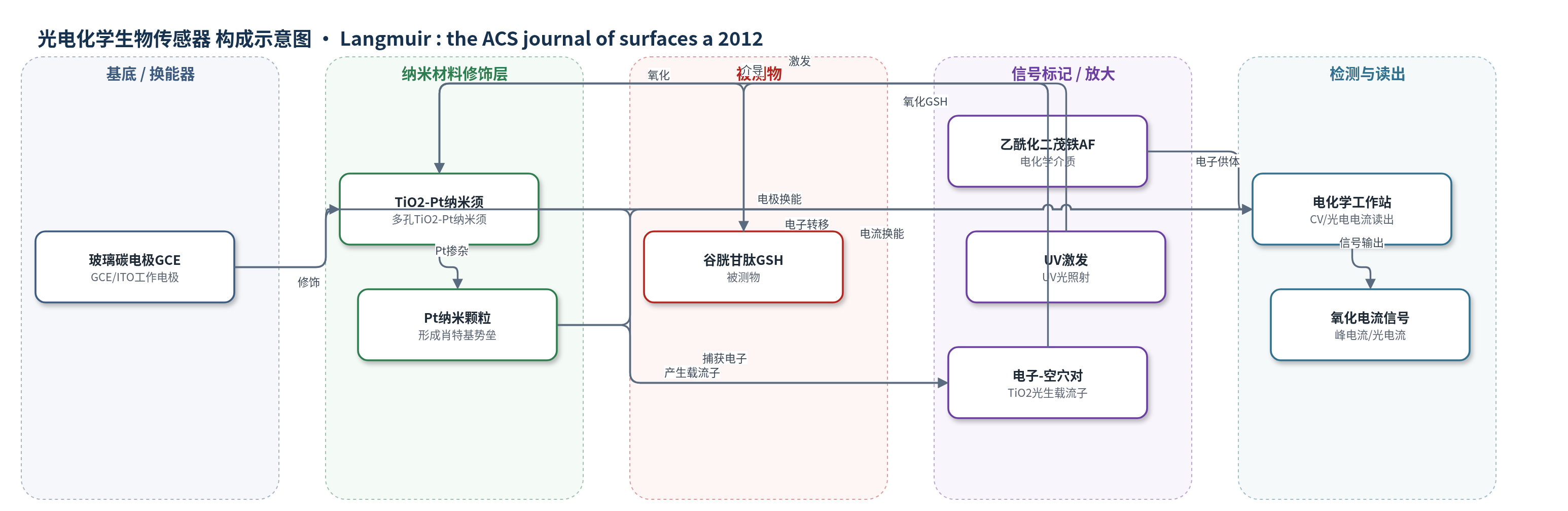
点击图片查看大图 · 依据论文自动绘制
传感器类型
光电化学生物传感器
检测对象
谷胱甘肽(glutathione, GSH);样品基质:人血液/红细胞裂解液
检测原理
UV照射多孔TiO2-Pt纳米须修饰电极时,TiO2吸收光能产生电子-空穴对;Pt纳米颗粒在TiO2表面形成肖特基势垒,捕获光生电子并抑制电子-空穴复合,使空穴在界面富集。空穴作为强氧化剂氧化GSH,乙酰化二茂铁(AF)作为电化学介质促进电子转移,降低氧化过电位并放大阳极电流。GSH浓度越高,界面氧化反应越强,产生的氧化电流/光电流越大。多孔结构提供高比表面积,增强反应位点与传质,从而实现光电催化信号放大。
检测灵敏度
LOD: 0.1 μmol L−1;线性范围: 0.5–40 μmol L−1;R^2 = 0.994
效应效果
对GSH氧化电流在0.5–40 μmol L−1线性良好,LOD 0.1 μmol L−1,线性范围宽于量子点ECL(0.024–0.214 mmol L−1)和光电化学法(0.05–2.4 mmol L−1),LOD低于8.3 μmol L−1与0.03 mmol L−1。开关实验显示光电流仅在含GSH时增强。5份正常人红细胞样品GSH为1.83、1.05、1.19、1.13、1.24 μmol L−1;加标5 μmol L−1后为6.9、6、6.24、6.2、6.2 μmol L−1,回收率101.03%、99.17%、100.87%、101.14%、99.2%。适合即时检测与早期诊断。
传感器的构成
- 基底电极:玻璃碳电极(GCE)或ITO电极,作为工作电极提供导电支撑与光电信号换能
- 纳米修饰层:多孔TiO2-Pt纳米须薄膜,提供光催化/电催化活性并增大比表面积
- 掺杂组分:Pt纳米颗粒,形成肖特基势垒,捕获光生电子并抑制电子-空穴复合
- 识别元件:无特异性生物识别元件,GSH直接在修饰电极表面发生光电催化氧化
- 电子供体/介质:乙酰化二茂铁(acetyl ferrocene, AF),介导电子转移并增强GSH氧化电流
- 电解液:0.1 mol L−1磷酸盐缓冲液(PBS,pH 7.1),维持反应环境
- 激发与读出:UV光照射及电化学工作站(CHI660B/Autolab PGSTAT302N),记录伏安/光电电流信号
中文摘要
本文报道了一种基于多孔TiO2-Pt纳米须的光电化学生物传感器,用于灵敏检测谷胱甘肽(GSH)。作者将TiO2-Pt纳米须悬浮液滴涂于玻璃碳电极(GCE)表面,构建新型纳米界面。TiO2-Pt纳米须兼具TiO2光催化与Pt电催化性能,Pt掺杂可在TiO2表面形成肖特基势垒,促进光生电子转移并抑制电子-空穴复合,从而提高光电催化效率。在UV照射下,电极表面产生强氧化性电子-空穴对,可氧化GSH;乙酰化二茂铁作为电化学介质进一步促进电子转移并放大氧化电流。扫描电镜、拉曼光谱和电化学阻抗谱表明,Pt与多孔TiO2纳米须良好复合,增强催化性能。该传感器对GSH检测灵敏度高、成本低、重现性好,可用于实际样品中GSH的快速检测。
英文摘要
The performance of TiO(2) nanoparticles is extremely attractive in various areas of chemical and biochemical engineering as they can effectively work by combining the photocatalytic property with various superior properties of the related nanostructure. The relevant photoelectrochemical detection has attracted considerable interest and shown potential applications in a wide range of areas. In this study, we have prepared new nanowhiskers of platinum-doped titanium dioxide (TiO(2)-Pt), which could be further used to fabricate a novel nanointerface for the sensitive detection of biomolecules including glutathione (GSH). Our observations demonstrate that the sensitive TiO(2)-Pt nanowhiskers biointerface could be readily fabricated by casting the TiO(2)-Pt nanowhiskers suspension on a glassy carbon electrode (GCE), which could readily combine the photocatalytic and eletrocatalytic properties of TiO(2) nanocomposites to introduce a novel photoelectrocatalytic biosensor for GSH detection in real samples. Compared to other analysis strategies, the TiO(2)-Pt nanowhiskers-modified GCE showed a considerably high sensitivity for the detection of GSH due to the excellent photoelectrocatalytic ability of the porous TiO(2)-Pt nanowhiskers. Scanning electron microscopy (SEM), Raman spectroscopy, and electrochemical impedance spectroscopy have shown that Pt can readily blend with porous TiO(2) nanowhiskers and facilitate the relevant catalysis property of TiO(2), resulting in the enhanced photoelectrocatalytic effect. Thus, through the new strategy of the utilization of the excellent photoelectrocatalytic property of TiO(2)-Pt nanocomposites, it is possible to realize the rapid electrochemical detection of glutathione with high sensitivity, low cost, and good reproducibility.