组成图示
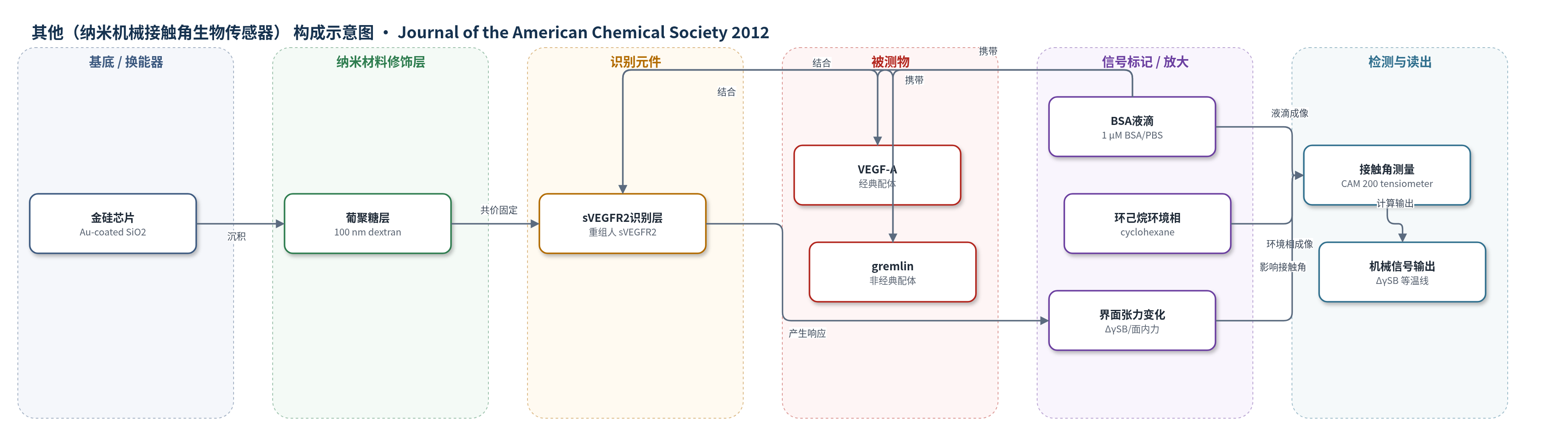
点击图片查看大图 · 依据论文自动绘制
传感器类型
其他(纳米机械接触角生物传感器)
检测对象
血管内皮生长因子A(VEGF-A)、gremlin(Gremlin);样品基质为 1 μM BSA/PBS 溶液(CONAMORE)或 HBS-EP 缓冲液(SPR)
检测原理
sVEGFR2 通过 EDC/NHS 共价固定于 100 nm dextran 修饰的金硅芯片上。当 VEGF-A 或 gremlin 与 sVEGFR2 结合时,受体发生构象重排并产生面内分子间吸引力,使固-液界面张力发生特异性变化 ΔγSB。CONAMORE 将含配体的 1 μM BSA/PBS 液滴置于芯片上,以 cyclohexane 为环境相,通过三相接触线处的接触角 θ 和液滴-环境相界面张力 γBC 计算 ΔγSB;ΔγSB 随配体浓度升高呈 Langmuir 型饱和,拟合得到表面纳米机械解离常数 Kd^σ mech。SPR 则通过结合质量引起界面折射率变化,以响应单位 RU 表征结合量与动力学。
检测灵敏度
—
效应效果
特异性:变性 sVEGFR2、仅 dextran 芯片和 TGF-β 均无结合,抗 VEGF-A 抗体可抑制。重现性:每液滴 3 次重复,2 片芯片重复。SPR:Kd^σ mass 为 34±8 与 65±20 nM,koff 差约 10 倍;CONAMORE:100 nM 时 ΔγSB 为 8.3±2.1 与 3.7±0.4 mN/m,Kd^σ mech 为 2±0.7 与 32±9 nM,机械亲和力差 16 倍。细胞:VEGF-A 更快聚集(FRET 12.27±2.93 对 21.18±5.14 min),更低浓度(0.16 对 1.0 nM)达最大 DNA 合成。作者认为可用于血管生成药物筛选。
传感器的构成
- 基底/换能器:Au-coated SiO2 芯片,提供 SPR 光学基底与表面机械响应平台
- 修饰层:100 nm dextran 层(CMD50L),提供 EDC/NHS 活化位点并承载 sVEGFR2
- 识别元件:重组人 sVEGFR2(VEGFR2 胞外域),特异性结合 VEGF-A 或 gremlin
- 偶联/封闭:EDC/NHS 活化 dextran 羧基,1.0 M ethanolamine 封闭未活化位点
- 样品相:1 μM BSA/PBS(pH 7.4)液滴,作为参考/样品溶液并携带配体
- 环境相:cyclohexane,形成三相接触线以测量接触角
- 读出装置:CAM 200 tensiometer 与 Navitar camera,测量 θ 和 γBC 并计算 ΔγSB
中文摘要
血管内皮生长因子受体2(VEGFR2)是内皮细胞上调控生理与病理血管生成的关键受体,也是癌症等血管生成依赖性疾病的治疗靶点。本研究利用专用纳米机械生物传感器,考察了经典配体VEGF-A和非经典配体gremlin与固定化VEGFR2胞外域(sVEGFR2)表面识别过程中的纳米机械现象。结果表明,两种配体与sVEGFR2的结合亲和力相近,但结合动力学不同,并产生不同的面内皮牛级分子间力,提示二者诱导sVEGFR2发生不同构象变化。上述差异可用“纳米机械亲和力”描述,VEGF-A对sVEGFR2的纳米机械亲和力约为gremlin的16倍。这些纳米机械差异进一步影响内皮细胞中的生物学效应:VEGF-A比gremlin更快诱导VEGFR2聚集,并引发更强的促有丝分裂反应。数据表明,细胞膜上激活受体之间的表面分子间相互作用是调控胞内信号级联的关键因素。
英文摘要
Vascular endothelial growth factor receptor-2 (VEGFR2) is an endothelial cell receptor that plays a pivotal role in physiologic and pathologic angiogenesis and is a therapeutic target for angiogenesis-dependent diseases, including cancer. By leveraging on a dedicated nanomechanical biosensor, we investigated the nanoscale mechanical phenomena intertwined with VEGFR2 surface recognition by its prototypic ligand VEGF-A and its noncanonical ligand gremlin. We found that the two ligands bind the immobilized extracellular domain of VEGFR2 (sVEGFR2) with comparable binding affinity. Nevertheless, they interact with sVEGFR2 with different binding kinetics and drive different in-plane piconewton intermolecular forces, suggesting that the binding of VEGF-A or gremlin induces different conformational changes in sVEGFR2. These behaviors can be effectively described in terms of a different "nanomechanical affinity" of the two ligands for sVEGFR2, about 16-fold higher for VEGF-A with respect to gremlin. Such nanomechanical differences affect the biological activity driven by the two angiogenic factors in endothelial cells, as evidenced by a more rapid VEGFR2 clustering and a more potent mitogenic response triggered by VEGF-A in respect to gremlin. Together, these data point to surface intermolecular interactions on cell membrane between activated receptors as a key modulator of the intracellular signaling cascade.