组成图示
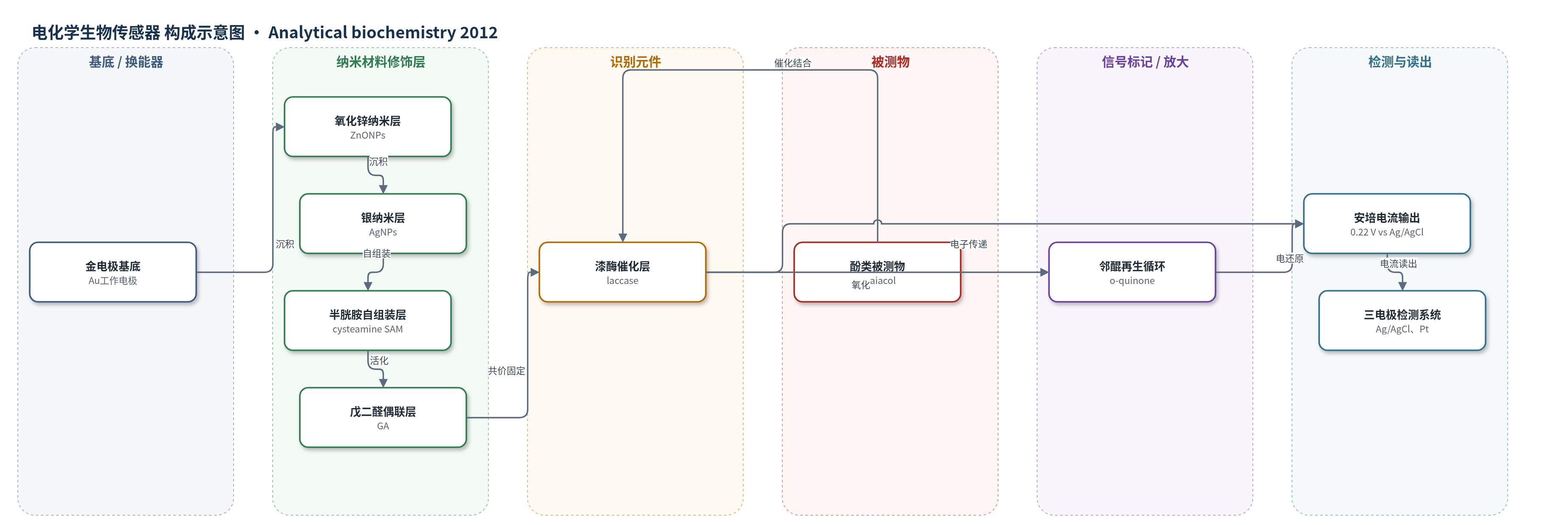
点击图片查看大图 · 依据论文自动绘制
传感器类型
电化学生物传感器
检测对象
总酚类化合物(total phenolic compounds,以愈创木酚 guaiacol 为标准底物);样品基质:葡萄酒(red wine,10倍醋酸缓冲液稀释)
检测原理
传感器以金电极为换能器,ZnONPs 和 AgNPs 纳米复合膜提供高比表面积并促进电子传递,半胱胺 SAM 与戊二醛将漆酶共价固定。检测时,葡萄酒中的酚类化合物(以愈创木酚为标准底物)进入漆酶活性中心,被漆酶催化氧化为邻醌;邻醌在电极表面发生电化学还原并再生为酚类,形成生物电催化循环。该循环使电子持续从溶液传递至工作电极,在 0.22 V(vs Ag/AgCl)下产生安培氧化电流。电流大小与酚类浓度成正比,从而实现定量检测。AgNPs/ZnONPs 降低界面阻抗、提高电活性面积,增强信号放大。
检测灵敏度
LOD: 0.05 μM (S/N = 3);线性范围: 0.1–500 μM;灵敏度: 0.71 μA μM−1 cm−2;分段斜率: 0.7047 (0.1–10 μM)、0.2935 (10–500 μM);r = 0.99;R^2 = 0.9972
效应效果
传感器在 0.1 mM 干扰物测试中,抗干扰有限:果糖、葡萄糖、乙酸、半胱氨酸、抗坏血酸分别使响应降至 74%、76%、80%、85%、85%,柠檬酸为 90%;作者指出漆酶底物特异性较宽,因此选择性有限。实际葡萄酒加标愈创木酚平均回收率为 98.0%。批内和批间变异系数分别为 1.7% 和 2.9%,重现性良好。与标准分光光度法比较,15 个葡萄酒样品相关系数 r=0.99,回归方程 y=1.0053x−3.5541,R^2=0.9972。所测红酒样品总酚含量为 202–237 μM 愈创木酚。传感器工作电位低(0.22 V)、响应快(8 s)、灵敏度 0.71 μA μM−1 cm−2,4 °C 保存 5 个月、200 次使用后仅损失 25% 活性,适合葡萄酒总酚快速检测。
传感器的构成
- 基底电极:金电极(Au),直径1 mm,经piranha溶液和氧化铝抛光,作为工作电极与电子换能器。
- 纳米修饰层1:氧化锌纳米粒子(ZnONPs),电化学沉积于Au表面,提供高比表面积、生物相容性和电子传导通道。
- 纳米修饰层2:银纳米粒子(AgNPs),电化学沉积于ZnONPs/Au表面,提高电活性面积和导电性。
- 自组装单分子层:半胱胺(cysteamine)胺端SAM,硫原子结合金属纳米粒子,氨基用于后续偶联。
- 交联偶联剂:戊二醛(GA),活化SAM氨基并与漆酶表面氨基形成共价键。
- 识别催化元件:漆酶(laccase,lac),来自Ganoderma sp. Rckk02,共价固定,催化酚类氧化。
中文摘要
本文报道了一种用于测定葡萄酒中总酚类化合物的高灵敏安培生物传感器。将漆酶共价固定于电化学沉积在金电极表面的银纳米粒子/氧化锌纳米粒子纳米复合膜上,构建 lac/AgNPs/ZnONPs/Au 电极。采用扫描电镜、X射线衍射和电化学阻抗谱表征电极表面形貌与结构,循环伏安法考察其对愈创木酚氧化的电化学行为。结果表明,AgNPs/ZnONPs 修饰使电极氧化电流增大、还原电流降低,电荷转移电阻由 ZnONPs/Au 的 220 Ω 降至 AgNPs/ZnONPs/Au 的 175 Ω,固定漆酶后升至 380 Ω,证实酶成功固定。传感器在 pH 6.0、35 °C、0.22 V(vs Ag/AgCl)下 8 s 内达到最佳响应,愈创木酚线性范围为 0.1–500 μM,检出限 0.05 μM(S/N=3),灵敏度 0.71 μA μM−1 cm−2。葡萄酒加标回收率为 98%,与标准分光光度法相关系数 r=0.99。4 °C 保存 5 个月、200 次使用后活性损失 25%。
英文摘要
A method is described for construction of a highly sensitive amperometric biosensor for measurement of total phenolic compounds in wine by immobilizing laccase covalently onto nanocomposite of silver nanoparticles (AgNPs)/zinc oxide nanoparticles (ZnONPs) electrochemically deposited onto gold (Au) electrode. Scanning electron microscopy, X-ray diffraction, and electrochemical impedance spectroscopy were applied for characterization of the surface morphology of the modified electrode, and cyclic voltammetry was used to investigate the electrochemical properties of the proposed electrode toward the oxidation of guaiacol. The linearity between the oxidation current and the guaiacol concentration was obtained in a range of 0.1 to 500μM with a detection limit of 0.05μM (signal-to-noise ratio (S/N)=3) and sensitivity of 0.71μAμM(-1)cm(-2). The electrode showed increased oxidation and reduced reduction current with the deposition of AgNPs/ZnONPs on it. R(CT) values of ZnONPs/Au, AgNPs/ZnONPs/Au, and laccase/AgNPs/ZnONPs/Au electrode were 220, 175, and 380Ω, respectively. The biosensor showed an optimal response within 8s at pH 6.0 (0.1M acetate buffer) and 35°C when operated at 0.22V against Ag/AgCl. Analytical recovery of added guaiacol was 98%. The method showed a good correlation (r=0.99) with the standard spectrophotometric method, with the regression equation being y=1.0053x-3.5541. The biosensor lost 25% of its initial activity after 200 uses over 5months.