组成图示
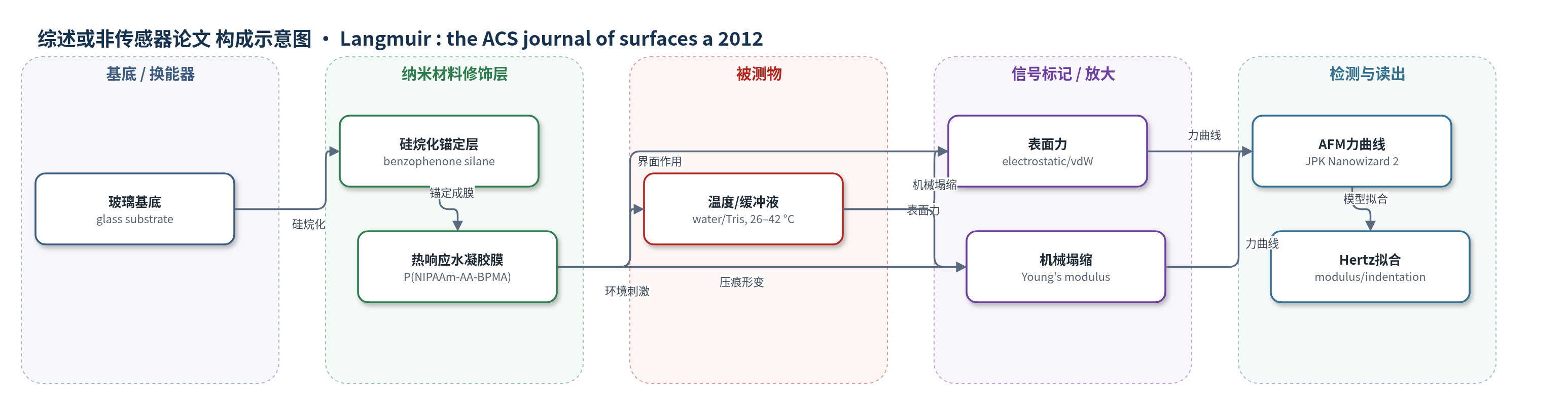
点击图片查看大图 · 依据论文自动绘制
传感器类型
综述或非传感器论文
检测对象
温度(temperature,26–42 °C)、表面力(surface forces)、杨氏模量(Young's modulus);样品基质:水(water)、Tris 缓冲液(Tris buffer, pH 7)
检测原理
本文并非基于生物识别事件的传感检测,而是用 AFM 探针接近水凝胶表面进行力-距离测量。非接触区记录探针与凝胶界面之间的静电排斥、范德华吸引及可能的聚合物桥接作用,形成表面力信号;接触区探针压入凝胶,依据修正 Hertz 模型拟合得到杨氏模量和最大压痕。当温度升高超过 LCST 时,PNIPAAm 主体脱水塌缩,凝胶变硬、压痕减小,机械响应发生明显变化;而丙烯酸富集链段被认为偏析于水相界面,使表面电荷密度和表面力作用距离在 26–42 °C 范围内基本保持恒定。加入 Tris 缓冲液后,AA 电离度增加并缩短 Debye 长度,导致塌缩温度升高、最大压痕减小,表面力特征减弱。最终信号以力-距离曲线及其拟合参数读出。
检测灵敏度
原文未报告 LOD、线性范围、灵敏度斜率或相关系数。
效应效果
实验显示,交联 30–120 min 的 P(NIPAAm-co-AA-co-BPMA) 薄膜在水中塌缩温度接近本体 PNIPAAm 的 32 °C;交联 5、10、15 min 的薄膜因表面支撑应力使转变温度升高约 10 K 或更多。pH 7 Tris 缓冲液使丙烯酸电离度增加,塌缩温度升高且最大压痕减小。水相力-距离曲线在接近平点处出现凸起,归因于静电排斥与短程吸引;120 min 样品衰减长度约 53 nm,短交联样品为 70 和 90 nm。冷却后塌缩可逆。短交联膜在水中数小时后可脱落,长交联膜更稳定。作者认为水界面性质对传感器和组织工程应用重要,表面 AA 富集层可维持界面性质稳定。
传感器的构成
- 基底:玻璃片(glass substrate),经 Hellmanex 溶液预处理,提供平整支撑面
- 硅烷化层:4-(三乙氧基硅基丙氧基)苯甲酮(4-(triethoxysilyl propyloxy)benzophenone),在玻璃表面形成光反应性锚定基团
- 水凝胶膜:P(NIPAAm-co-AA-co-BPMA) 三聚物,10 wt% 乙醇溶液旋涂后 UV 交联,形成热响应锚定水凝胶
- 交联/锚定单体:4-苯甲酮甲基丙烯酸酯(BPMA),通过 UV 引发交联并实现薄膜表面锚定
- 识别元件:无,本文未引入抗体、适配体、酶或 DNA 探针等生物识别元件
- 信号标记物:无,本文未使用荧光、电化学或酶促信号标记
- 封闭剂/电子供体:无,原文未涉及封闭剂或电子供体
中文摘要
水凝胶薄膜被广泛用于生物传感器和生物医学器件的制备,其水相界面特性对器件功能至关重要;热响应聚合物的力学性质变化也是影响其行为的重要特征。本文采用原子力显微镜(AFM)表征了由 N-异丙基丙烯酰胺(NIPAAm)和丙烯酸(AA)组成的热响应三聚物、并以苯甲酮甲基丙烯酸酯(BPMA)作为光反应性交联共聚单体所制备的聚合物水凝胶薄膜的表面与力学性质。通过分析力-距离曲线,评估了与水凝胶相关的表面力和力学响应,并在水和 Tris 缓冲液中、不同交联程度下随温度变化进行研究。在水中的样品,当温度从 26 升至 42 °C 时,表面力有效作用距离保持恒定,尽管力学响应表明样品已被加热至下临界溶液温度(LCST)以上。LCST 以上聚合物主体溶解度降低,但似乎不影响表面性质。这可能是由于丙烯酸富集聚合物链段向凝胶表面偏析所致,与相关体系报道一致。
英文摘要
Hydrogel films have been used extensively in the preparation of biosensors and biomedical devices. The characteristics of the aqueous interface of the polymer layer are significant for the biosensor or device function; likewise, the changing mechanical properties of thermoresponsive polymers are an important feature that affects the polymer behavior. Atomic force microscopy was used here to characterize both the surface and the mechanical properties of polymeric hydrogel films prepared from a thermoresponsive terpolymer of N-isopropylacrylamide and acrylic acid with benzophenonemethacrylate as a photoreactive cross-linker comonomer. The force-distance curves thus obtained were analyzed to assess both the surface forces and the mechanical response that were associated with the hydrogel. These properties were investigated as a function of temperature, in water and in Tris buffer, for different degrees of polymer cross-linking. For samples in water, the distance over which the surface forces were effective was found to remain constant as the temperature was increased from 26 to 42 °C, even though the mechanical response indicated that the samples had been heated past the lower critical solution temperature, or LCST. The bulk of the polymer becomes less soluble above the LCST, although this does not seem to affect the surface properties. This may be due to the segregation of the acrylic acid-rich polymer segments near the gel surface, which is in agreement with reports for related systems.