组成图示
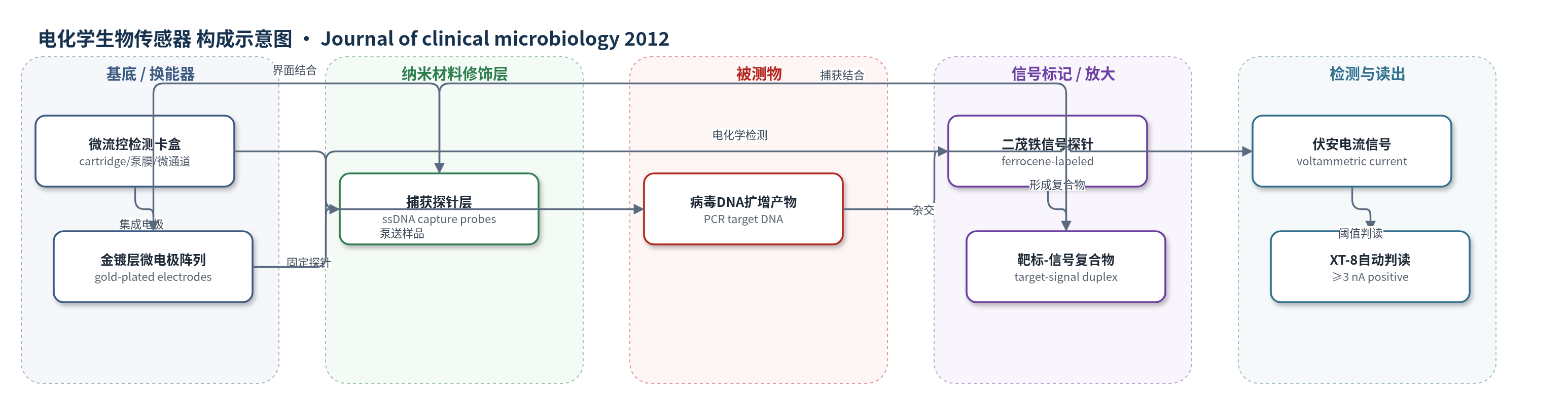
点击图片查看大图 · 依据论文自动绘制
传感器类型
电化学生物传感器
检测对象
呼吸道病毒(腺病毒 AdV、冠状病毒 CoV、甲型流感病毒 IV A、乙型流感病毒 IV B、人偏肺病毒 MPV、副流感病毒 PIV、呼吸道合胞病毒 RSV、鼻病毒 RhV),样品基质为儿童呼吸道标本(鼻咽吸出液、鼻咽拭子、气管吸出液、支气管肺泡灌洗液)
检测原理
样品核酸经提取后,用多重终点 PCR 扩增呼吸道病毒 RNA/DNA,形成靶标 DNA 扩增产物;外切酶将双链扩增产物消化为单链。二茂铁标记的信号探针与靶标 DNA 杂交,形成靶标-信号复合物。混合液被泵入微流控卡盒,流经金镀层微电极阵列,电极表面固定的单链捕获探针捕获该复合物,使二茂铁标记物靠近金电极。仪器对各电极施加电压,通过电化学伏安法检测二茂铁氧化还原产生的电流;捕获的病毒靶标越多,电流越大,≥3 nA 判为阳性。PCR 扩增提供核酸放大,微阵列捕获实现多重识别,但 CT 与 nA 关系呈非线性。
检测灵敏度
LOD: 0.005 50% 组织培养感染剂量(TCID50)/ml(鼻病毒,制造商报告);R^2: 0.87(IV A H1)、0.81(IV A H3)、0.92(IV A (H1N1)pdm09)、0.83(IV B)、0.79(RSV A)、0.91(RSV B)、0.95(PIV 1)、0.93(PIV 2)、0.85(PIV 3)、0.80(MPV)、0.83(AdV)、0.35(RhV);阳性阈值: ≥3 nA
效应效果
与自建实时PCR相比,eSensor RVP总体一致性99.2%(kappa 0.96,95%CI 0.94-0.98),阳性一致率95.4%,阴性一致率99.7%;不一致样本平均CT 39.73。甲流亚型正确识别68/70(97.1%)。鼻病毒较PCR更敏感,19株高载量肠道病毒均无交叉。腺病毒B/C/E有交叉,A-E组血清型均至少一项阳性,仅F组40/41阴性,6/18(33.3%)多重阳性。47例共感染中39例(83.0%)全部识别。399次运行6次无效(1.5%)。作者认为其稳健、易操作、可多联检测,但耗时较长且需操作扩增产物。
传感器的构成
- 检测卡盒:一次性 eSensor RVP cartridge,含预编程记忆芯片、气动泵膜和蛇形微通道,用于输送扩增-杂交混合液并执行检测
- 换能器电极:预组装单列金镀层微电极阵列(gold-plated electrodes),位于蛇形通道中,作为电化学伏安检测界面
- 识别元件:电极表面固定的单链寡核苷酸捕获探针(ssDNA capture probes),特异性结合各呼吸道病毒靶标 DNA
- 信号标记物:杂交缓冲液中的二茂铁标记信号探针(ferrocene-labeled signal probes),与靶标 DNA 杂交后将电化学标记物带到电极附近
- 内标质控:噬菌体 MS2 内标(bacteriophage MS2 internal control),在核酸提取前加入,用于监控提取与检测过程
- 靶标核酸:经终点 PCR 扩增并经外切酶消化为单链的病毒 DNA 扩增产物(target DNA amplicons),与信号探针杂交后进入卡盒
- 读出系统:eSensor XT-8 仪器对每个电极施加电流,通过电化学伏安法读取电流,≥3 nA 判为阳性
中文摘要
本研究将 GenMark Diagnostics 的 eSensor 呼吸道病毒多重核酸检测面板(eSensor RVP)与实验室自建实时 PCR 方法比较,用于检测儿童呼吸道标本中的多种呼吸道病毒。共检测 250 份既往已用实时 PCR 判定的冷冻儿童呼吸道标本。两种方法对共同检测靶标的总体一致性为 99.2%(kappa 0.96,95% CI 0.94-0.98);合并阳性一致率为 95.4%(95% CI 92.5-97.3),阴性一致率为 99.7%(95% CI 99.4-99.8)。不一致结果的实时 PCR 平均 CT 值为 39.73(95% CI 38.03-41.43)。共感染检测和甲型流感病毒亚型识别能力与实时 PCR 相当。eSensor RVP 鼻病毒检测比相应实时 PCR 更敏感且更特异;但腺病毒 B、C、E 检测对 A-F 组腺病毒血清型存在一定交叉反应。作者认为 eSensor RVP 稳健、操作相对简便,采用独特生物传感器技术,多重设计可同时对单份标本检测多种病毒;不足是周转时间较慢,且需操作扩增产物,增加污染风险。
英文摘要
A novel eSensor respiratory viral panel (eSensor RVP) multiplexed nucleic acid amplification test (GenMark Diagnostics, Inc., Carlsbad, CA) was compared to laboratory-developed real-time PCR assays for the detection of various respiratory viruses. A total of 250 frozen archived pediatric respiratory specimens previously characterized as either negative or positive for one or more viruses by real-time PCR were examined using the eSensor RVP. Overall agreement between the eSensor RVP and corresponding real-time PCR assays for shared analytes was 99.2% (kappa = 0.96 [95% confidence interval {CI}, 0.94 to 0.98]). The combined positive percent agreement was 95.4% (95% CI, 92.5 to 97.3); the negative percent agreement was 99.7% (95% CI, 99.4 to 99.8). The mean real-time PCR threshold cycle (C(T)) value for specimens with discordant results was 39.73 (95% CI, 38.03 to 41.43). Detection of coinfections and correct identification of influenza A virus subtypes were comparable between methods. Of note, the eSensor RVP rhinovirus assay was found to be more sensitive and specific than the corresponding rhinovirus real-time PCR. In contrast, the eSensor RVP adenovirus B, C, and E assays demonstrated some cross-reactivity when tested against known adenovirus serotypes representing groups A through F. The eSensor RVP is robust and relatively easy to perform, it involves a unique biosensor technology for target detection, and its multiplexed design allows for efficient and simultaneous interrogation of a single specimen for multiple viruses. Potential drawbacks include a slower turnaround time and the need to manipulate amplified product during the protocol, increasing the possibility of contamination.