组成图示
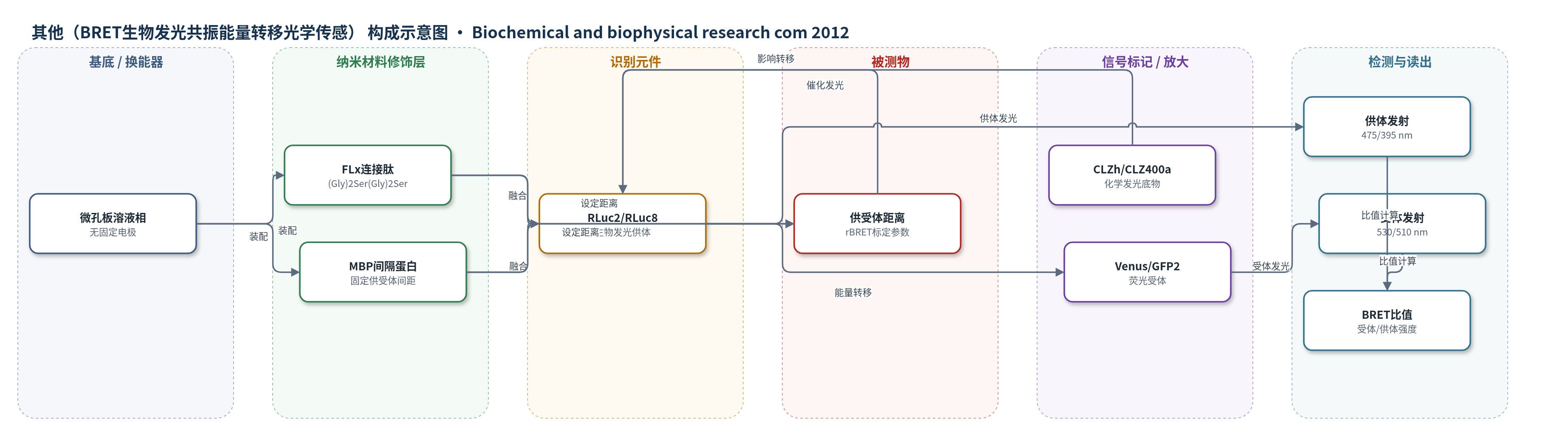
点击图片查看大图 · 依据论文自动绘制
传感器类型
其他(BRET生物发光共振能量转移光学传感)
检测对象
无特定外源分析物;被测参数为供体-受体距离(donor–acceptor separation, rBRET),样品基质为纯化BRET融合蛋白溶液(含CLZh或CLZ400a底物)。
检测原理
BRET融合蛋白中,RLuc2或RLuc8在加入coelenterazine h(CLZh)或coelenterazine 400a(CLZ400a)后发生氧化发光,形成生物发光供体。当Venus或GFP2受体位于供体附近时,供体激发态能量通过非辐射Förster机制转移至受体,受体随后发射荧光。供体与受体距离r增大时,能量转移效率按E=R0^6/(R0^6+r^6)下降,因此BRET比值(受体积分强度/供体积分强度)随距离增加而降低。本文用FLx或MBP连接肽构建已知间距的融合蛋白,测量不同距离下的BRET比值并拟合Förster曲线,从而获得R0。信号增强主要来自RLuc2/RLuc8更高量子产率、稳定性和Venus/GFP2更高亮度,而非酶催化沉积或核酸放大。
检测灵敏度
R^2 ≥ 0.99(Förster曲线拟合)
效应效果
Venus–FL1–RLuc2/RLuc8的BRET比值分别为4.8±0.5和5.0±0.4,高于原始EYFP–FL1–RLuc的3.2±0.1。RLuc2/Venus与RLuc8/Venus的R0为5.68±0.02 nm和5.55±0.03 nm,较原始4.44±0.03 nm提高约25%,工作距离扩展至2.78–8.52 nm。BRET2中RLuc2/GFP2与RLuc8/GFP2的R0为7.67±0.04 nm和8.15±0.02 nm,较原始7.50±0.03 nm仅提高2%–9%,最大可测距离增至12.23 nm,信号提高约25–30倍。未报告选择性、稳定性、回收率或方法对比;作者认为可指导BRET传感器选择。
传感器的构成
- 供体生物发光蛋白:RLuc2或RLuc8,作为BRET供体,催化底物氧化发光并提供能量转移源
- 受体荧光蛋白:Venus用于BRET1、GFP2用于BRET2,作为能量受体,接收能量后发射荧光
- 连接/间隔元件:FLx柔性连接肽((Gly)2Ser(Gly)2Ser重复1、3、5、7或9次)或MBP,控制供体与受体间距离
- 化学发光底物:coelenterazine h(CLZh)用于BRET1,coelenterazine 400a(CLZ400a)用于BRET2,作为供体发光底物
- 检测载体:微孔板溶液相体系,无固定电极或纳米修饰层,用于纯化融合蛋白的BRET测量
- 信号读出装置:SpectraMax M2或POLARstar OPTIMA微孔板读板机,双发射通道读取供体与受体强度并计算BRET比值
中文摘要
生物发光共振能量转移(BRET)是监测大分子相互作用的重要工具,也可作为生物传感器开发的换能技术。Förster距离(R0)表示最大能量转移的50%所对应的分子间距离,是连接BRET比值变化与物理距离尺度的关键参数,可估算任意供体-受体对可测距离范围。近期通过引入具有更高量子产率、稳定性和亮度的RLuc2、RLuc8及Venus等新型BRET组分,BRET检测灵敏度得到提高。本文测定了含RLuc2或RLuc8与Venus的BRET1系统的R0,分别为5.68 nm和5.55 nm,较原始BRET1系统约高25%。含GFP2与RLuc2或RLuc8的BRET2系统R0分别为7.67 nm和8.15 nm,仅比原始BRET2系统高2%–9%,但信号亮度提高约30倍。结果表明,增强型组分显著扩展BRET1可测距离,并改善BRET2信号强度,为BRET生物传感器系统选择提供依据。
英文摘要
Bioluminescence resonance energy transfer (BRET) is an important tool for monitoring macromolecular interactions and is useful as a transduction technique for biosensor development. Förster distance (R(0)), the intermolecular separation characterized by 50% of the maximum possible energy transfer, is a critical BRET parameter. R(0) provides a means of linking measured changes in BRET ratio to a physical dimension scale and allows estimation of the range of distances that can be measured by any donor-acceptor pair. The sensitivity of BRET assays has recently been improved by introduction of new BRET components, RLuc2, RLuc8 and Venus with improved quantum yields, stability and brightness. We determined R(0) for BRET(1) systems incorporating novel RLuc variants RLuc2 or RLuc8, in combination with Venus, as 5.68 or 5.55 nm respectively. These values were approximately 25% higher than the R(0) of the original BRET(1) system. R(0) for BRET(2) systems combining green fluorescent proteins (GFP(2)) with RLuc2 or RLuc8 variants was 7.67 or 8.15 nm, i.e. only 2-9% greater than the original BRET(2) system despite being ~30-fold brighter.