组成图示
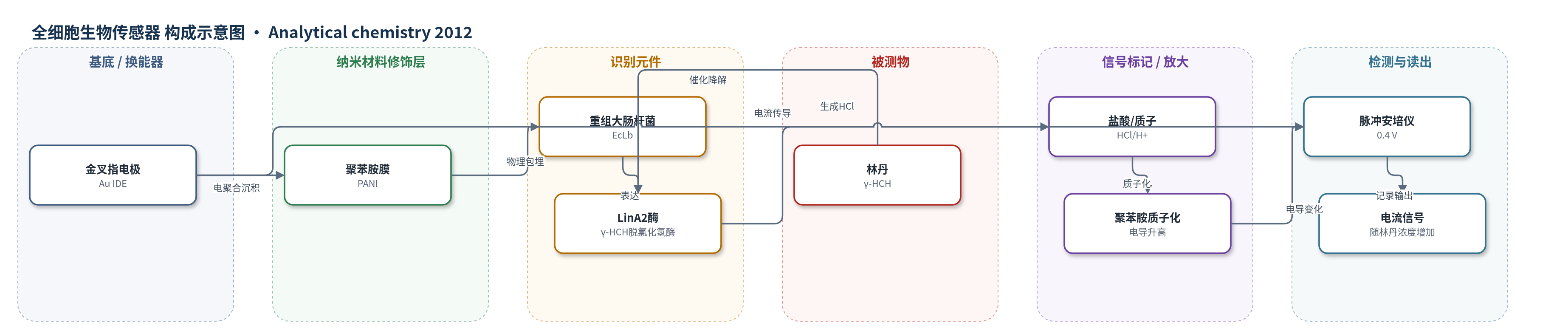
点击图片查看大图 · 依据论文自动绘制
传感器类型
全细胞生物传感器
检测对象
林丹(lindane,γ-六氯环己烷 γ-HCH);亦响应α/β-HCH及PCCH;样品基质:水相/环境水样(论文以缓冲液/水相电化学体系验证,未报告实际样品加标)
检测原理
重组大肠杆菌EcLb过表达LinA2并包埋于PANI膜中。林丹扩散至细胞后,LinA2催化γ-HCH逐步脱氯化氢,生成三氯苯并释放HCl。H+在PANI微环境中局部积累,使PANI由emeraldine base向emeraldine salt质子化,电导显著升高。在0.4 V脉冲安培下,电流随H+浓度增加而增大;由于PANI对微环境pH高度敏感,ppt级林丹产生的少量H+可被局部放大,相当于体相HCl浓度变化2–3个数量级,从而获得低检出限。响应在60–100 s内达到稳态。
检测灵敏度
LOD: ∼2 ppt;线性范围: 2–45 ppt(摘要);5–45 ppt(0.5 OD与1 OD,表1);5–25 ppt(1.5 OD);灵敏度: 0.0368 ± 0.0014 ppt−1(0.5 OD)、0.0696 ± 0.0024 ppt−1(1 OD)、0.1077 ± 0.0075 ppt−1(1.5 OD);R^2 = 0.995(0.5 OD与1 OD)、0.993(1.5 OD)。
效应效果
传感器对α、β、γ-HCH及PCCH均响应,PCCH响应约为同浓度林丹的3倍;对三氯苯、氯苯、1,2,3-三氯苯、氯丁烷、三氯乙烷、环己烷无响应,DDT和DDE在10 ppm下干扰很小。25 ppt林丹检测RSD约1–2%(n=5),响应时间60–100 s。4 ℃干燥储存15 d活性损失约5%,30 d损失约35%,有效保存期15 d。相比GC-ECD等需溶剂萃取的方法,该法直接检测、可微型化,适合现场监测。
传感器的构成
- 工作电极/换能器基底:金叉指电极(Au IDE),承载聚苯胺膜并传导电流
- 导电聚合物修饰层:聚苯胺(PANI)膜,电聚合沉积,作为H+敏感电导换能层
- 识别元件层:重组大肠杆菌EcLb(E. coli BL21(DE3), pET16b-linA2, pLysS),物理吸附/包埋于PANI中,提供LinA2酶活性
- 识别酶:LinA2(γ-HCH脱氯化氢酶),催化林丹脱氯化氢
- 信号分子:HCl/H+,林丹降解副产物,质子化PANI并提高电导
- 电化学测量组件:Ag/AgCl(3 M KCl)参比电极与Pt辅助电极,构成三电极体系
- 信号读出:脉冲安培法,0.4 V脉冲电位下记录电流
中文摘要
本文报道了一种高灵敏、高选择性且快速的全细胞电化学生物传感器,用于检测持久性有机氯农药林丹(γ-六氯环己烷,γ-HCH)。作者将编码γ-HCH脱氯化氢酶LinA2的linA2基因克隆并过表达于大肠杆菌BL21(DE3)中,构建林丹降解菌株EcLb,并将其物理吸附固定于电聚合聚苯胺(PANI)膜中。在PANI微环境中,重组大肠杆菌快速降解林丹并伴随生成盐酸,使PANI质子化、电导升高,该变化通过脉冲安培法监测。传感器可在ppt级浓度范围检测林丹,线性响应为2–45 ppt,对HCH各异构体及五氯环己烷具有选择性,不响应三氯苯、其他脂肪族/芳香族氯化物以及DDT、DDE。作者据此提出PANI对微环境释放H+高度敏感的机理。
英文摘要
A highly sensitive, selective, and rapid, whole-cell-based electrochemical biosensor was developed for detection of the persistent organochlorine pesticide γ-hexachlorocyclohexane (γ-HCH), commonly known as lindane. The gene linA2 encoding the enzyme γ-hexachlorocyclohexane (HCH) dehydrochlorinase (LinA2), involved in the initial steps of lindane (γ-HCH) biotransformation, was cloned and overexpressed in Escherichia coli . The lindane-biodegrading E. coli cells were immobilized on polyaniline film. The rapid and selective degradation of lindane and concomitant generation of hydrochloric acid by the recombinant E. coli cells in the microenvironment of polyaniline led to a change in its conductivity, which was monitored by pulsed amperometry. The biosensor could detect lindane in the part-per-trillion concentration range with a linear response from 2 to 45 ppt. The sensor was found to be selective to all the isomers of hexachlorocyclohexane (HCH) and to pentachlorocyclohexane (PCCH) but did not respond to other aliphatic and aromatic chlorides or to the end product of lindane degradation, i.e., trichlorobenzene (TCB). The sensor also did not respond to other commonly used organochlorine pesticides like DDT and DDE. On the basis of experimental results, a rationale has been proposed for the excellent sensitivity of polyaniline as a pH sensor for detection of H(+) ions released in its microenvironment.