组成图示
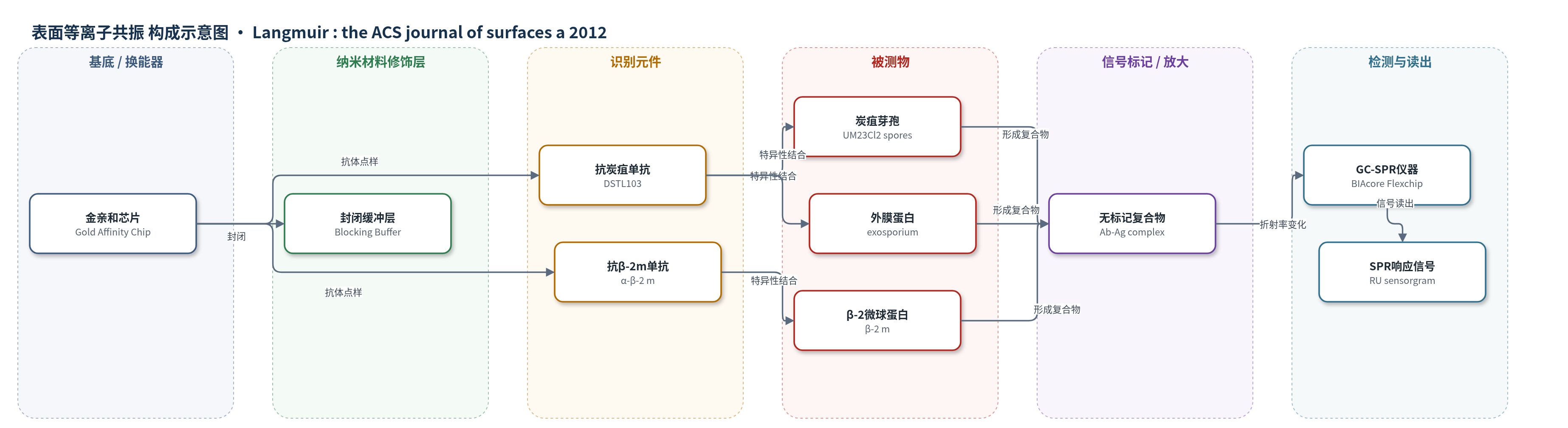
点击图片查看大图 · 依据论文自动绘制
传感器类型
表面等离子共振(SPR)生物传感器
检测对象
炭疽芽孢杆菌芽孢(Bacillus anthracis UM23Cl2 spores)、炭疽芽孢杆菌外膜蛋白(UM23Cl2-exosporium)、短小芽孢杆菌芽孢(Bacillus atrophaeus BG spores)、人β-2微球蛋白(human β-2 microglobulin, β-2 m);样品基质为 PBS(T) 缓冲液
检测原理
该传感器采用无标记光栅耦合表面等离子共振(GC-SPR)检测。金亲和芯片表面点样抗体,经封闭后,目标抗原或芽孢与特异性抗体结合,在传感表面形成抗原-抗体复合物。结合事件改变界面局部折射率/质量,使表面等离子体共振条件改变,仪器记录响应单位(RU)随时间变化。可溶蛋白主要靠扩散和流动输运到达表面,响应较均匀;约1 μm 的芽孢颗粒还受沉降、剪切和流体力学影响,入口高剪切降低捕获,出口/边缘沉降时间更长且剪切较低,响应更高。信号大小正比于结合在倏逝场有效范围内的抗原量,但颗粒响应具有空间依赖性,需校正。
检测灵敏度
原文未报告 LOD、线性范围、灵敏度斜率或相关系数。
效应效果
实验显示特异性良好:对照抗体 α-OA 或无抗体区域对 BG 芽孢无结合,参考校正可去除非特异贡献。DSTL103 对 UM23Cl2 芽孢平均响应 (1100 ± 200) RU,非特异响应 (280 ± 20) RU,占 29%;对外膜蛋白平均响应 (2100 ± 50) RU。α-β-2 m 对 β-2 m 平均响应 (160 ± 20) RU,DSTL103 非特异 (33 ± 8) RU,占 20%。单芯片内变异系数约 9%,芯片间约 16%;β-2 m 多芯片 CV 约 11%。应用位置校正因子后,单芯片变异从约 9% 降至 3%。作者认为该结果对颗粒抗原筛选、多病原环境检测和识别元件布局优化有重要价值。
传感器的构成
- 基底/换能器:Gold Affinity Chip(金亲和芯片),提供 SPR 传感表面并承载抗体点阵
- 识别元件:DSTL103(抗 Bacillus anthracis 单克隆抗体),物理吸附于金表面,特异性结合 UM23Cl2 芽孢及外膜蛋白
- 对照识别元件:α-β-2 m、α-BG、α-OA 抗体,用于特异性验证与参考校正
- 封闭层:Flexchip Blocking Buffer(1×),封闭非抗体区域,降低非特异结合
- 运行介质:PBS(T)(含 0.05% Tween 20 的 PBS),维持缓冲环境并减少非特异吸附
中文摘要
生物传感器被期望用于环境生物威胁、毒素、病毒和细菌等多种分析物的检测,理想情况下单一传感器应能同时检测多种分析物。此类分析物性质多样且尺寸差异显著,给高置信度仪器开发带来挑战。许多现有生物传感器采用功能化流动池,在空间定义阵列中固定抗体等识别元件,以特异性捕获目标物。为最优工作,阵列应在有效面积内对等效事件提供等效响应。本文使用光栅耦合表面等离子共振(GC-SPR)仪器 BIAcore Flexchip 获得实验数据,发现蛋白类与颗粒分析物的响应行为存在差异。特别是炭疽芽孢杆菌芽孢的响应幅度受剪切和重力效应影响,而可溶蛋白响应更均匀。作者进一步探讨该依赖性,以理解其对多分析物环境生物检测系统成功实施的基本影响。
英文摘要
Biosensors are desired for the detection of a wide range of analytes in various scenarios, for example environmental monitoring for biological threats, from toxins to viruses and bacteria. Ideally a single sensor will be capable of simultaneous multianalyte detection. The varying nature, and in particular disparate size, of such a variety of analytes poses a significant challenge in the development of effective high-confidence instruments. Many existing biosensors employ functionalized flow cells in which spatially defined arrays of surface-immobilized recognition elements, such as antibodies, specifically capture their analyte of interest. To function optimally, arrays should provide equivalent responses for equivalent events across their active area. Experimental data obtained using a grating coupled surface plasmon resonance (GC-SPR) instrument, the BIAcore Flexchip, have revealed differences in response behaviors between proteinaceous and particulate analytes. In particular, the magnitude of responses seen with Bacillus anthracis spores appears to be influenced by shear and gravitational effects while those from soluble proteins are more uniform. We have explored this dependence to understand its fundamental impact on the successful implementation of multianalyte environmental biological detection systems.